What Is Legacy Migration and Why to Consider It
What Is Legacy Migration and Why to Consider It?

Software technologies and applications are on the road to an inevitable innovation- one that helps improve business processes, ensures better customer acquisition, leads to exponential financial growth, and adds seamlessness to enterprise infrastructure. SMBs and established organizations find it almost tedious to keep pace with changing trends, and doing so with legacy applications makes it even more far-fetched.
Amidst the cut-throat competition for industrial dominance- the changing customer demands, and the necessity to adapt the infrastructure to suit the modern needs, legacy applications and their outdated makeup aren’t able to comprehend the growing enterprise requirements and unable to suffice the modern platforms needs.
However, some businesses still hold on to these obsolete legacy systems or applications for two reasons: they store all the historical data, and a legacy shift might disturb the cyclic nature of the business process. Although these are valid concerns, they are not enough to hold on to old systems, lose customers, sales, revenue, and conversions in the process.
Legacy migration is no longer a luxury but a need of the hour. And enterprises must accept this change willingly.
This article discusses what legacy applications are, how they’ve lost their touch in the modern IT sector, and why legacy migration is a vital step for enterprises- big and small.
What are Legacy Applications?
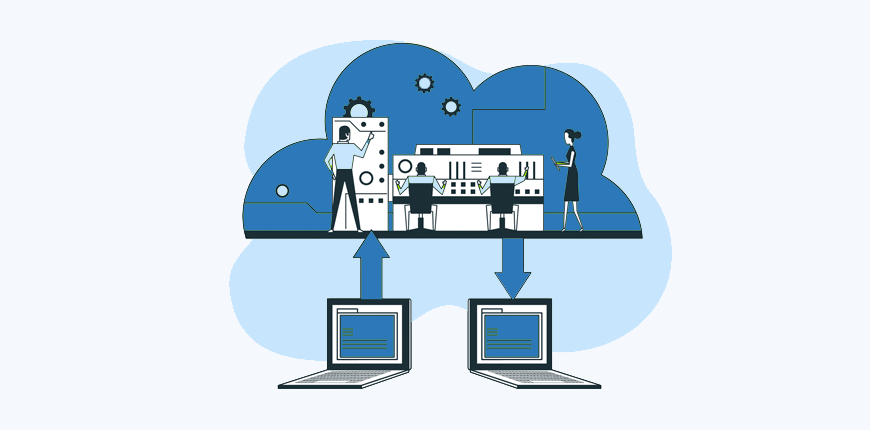
A legacy system or application is a software program developed using obsolete programming languages. However, businesses have relied on these languages for decades; their bulky and slow operating nature has made them inefficient and cumbersome in the modern IT setup. For organizations that still employ legacy systems to their core, legacy migration is the only solution that ensures adaptability and existing infrastructure maintenance.
Why Business still employ outdated legacy systems?
Businesses consider legacy migration to be a daunting process, which is probably one reason they are so reluctant to migrate their systems. However, other reasons why companies continue to employ old legacy architecture include:
A running application: Enterprises that already have a running application feel there is no urgent need to upgrade or fix their legacy architecture. Even if there are persistent issues, they think it is easy to maintain their status quo, especially if employees are comfortable with it.
An expensive decision: The cost of designing, replacing, or upgrading a legacy application is a monumental expense. Businesses consider legacy migrations complex, time-consuming, and the expenses can spiral out of hand if mismanaged.
Might disrupt the traditional workflows: Legacy migration can disturb traditional workflows and ask employees to understand the new structure- a big enough reason not to opt for it.
Why Enterprises Must Migrate Their Legacy Systems
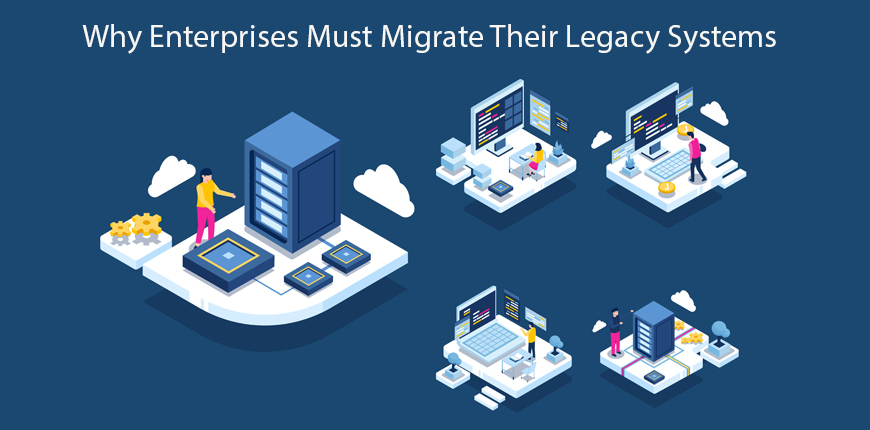
Legacy modernization has become a need for organizations to avoid pouring money and resources in their old systems and ultimately, down the drain. Legacy migration consists of either porting the entire setup or rewriting it to the desired software platform by employing all the necessary third-party libraries, codes, APIs, hardware, protocols, etc.
The following are some reasons why legacy migration is a must:
Allow multi-platform support and portability
IT systems were developed over a decade ago. Not only were there fewer choices at that time, but the concept of building applications for multiple platforms seemed foreign for companies. As a result, software vendors developed applications based on open-sourced languages or Linux OS. Moreover, thanks to technological advancements, even Java-based systems are on the verge of being considered as legacy in the coming years.
Portability is another factor that makes legacy systems an outdated idea. The needs in each department vary- one might require higher storage space in the design, while others might need more processing speed. An enterprise needs a portable IT system that delivers optimum results in all conditions. And legacy systems don’t possess such capabilities.
Better enterprise performance:
Legacy systems were built on bulkier languages leading to slower processing speeds- which was fine during those times. However, the enterprise demands have changed, and legacy systems aren’t competent enough to supply speedy performance. With better hardware capabilities, legacy migration boosts the interoperability of features and applications. Once developers decipher the correct application OS, software UI of hardware modules, and technologies that enable interface accessing- they can find the right modern platforms for your applications and systems, eventually improving enterprise performance and enforcing scalability.
Enabling data protection:
Legacy systems were not adequately protected because there weren’t many known computer viruses or hackers at that time. However, now the local hosting of your systems and applications leaves your business vulnerable to viruses, data loss, intellectual property, or identity theft. Moreover, legacy systems don’t have a reliable backup or a data recovery plan in action to restore essential data in the event of its loss or damage.
Outdated technology:
Most of the legacy systems were hosted on local servers, making tracking and upgrading a tedious and time-consuming process requiring days of business downtime. On the other hand, legacy migration to the cloud means automatic updates and monitoring, personalized data access based on organizational hierarchy, optimized work experience, and data-based decision-making based on data analytics and insights.
Application Mobility:
Legacy systems were based on Windows computers and desktops. However, modern times require solutions to be accessible on Mac and several mobile OSs. Legacy modernization on the cloud makes data available 24/7 to your employees- meaning you can access data from anywhere, anytime. Also, the migration of legacy systems to the cloud allows multiple users to simultaneously share and work on the same data.
The Types of Legacy Migration
There are two types of legacy migration: lift-and-shift and business transformation.
lift-and-shift migrations:
These migrations replace or update the underlying infrastructure or technology. In this scenario, there is no urgent need for legacy migration; hence, the IT team rebuilds the entire existing system slowly and steadily, one by one as per the new technology.
Business Transformation migrations:
As the name suggests, these migrations result in business transformation or innovation. The entire legacy systems are updated or replaced in this setup since it no longer supports the modern business processes or provides the right user experience. Hence, the team might hire a business transformation consultant that can assist them in adapting legacy systems to the modern infrastructure.
These are of two types:
Core legacy migrations:
Solutions like portals or custom ERP systems replace the core of the business processes to add scalability and better performance.
Non-core legacy migrations:
These require migrating smaller apps built using technologies like Microsoft Access or SharePoint. It is mainly practiced to enable business innovation, centralized governance, and allow easy data migration.
Conclusion
Legacy applications were developed to support a decade-old technology. These systems employed old hardware and coding platforms that formulated the core backbone of several enterprises. However, today, things have changed. Organizations are surrounded by several challenges, the prominent ones being the changing customer demands-their utter need to indulge in product experiences rather than product descriptions and newer technologies being adopted by competitors. Legacy systems are not able to sustain the modern needs or fit into the tech-savvy equations.
Enterprises require scalable, agile, innovative, unique, efficient, and effective solutions. They need up-to-date platforms like .NET, MEAN, MERN, the cloud, or new Java technologies. And legacy migration can help achieve such modernization requirements and more.
Latest Articles

The Hidden Revenue Leak in FMCG: Solving Secondary Sales Visibility with Technology
The Hidden Revenue Leak in FMCG: Solving Secondary Sales Visibility with Technology .. Read More
By Abhinav Kumar | Jun 11, 2026

Why Cloud-Native Mobile and Web App Development Companies Are the Future of Scalable Digit..
Why Cloud-Native Mobile and Web App Development Companies Are the Future of Scalable Digital Products .. Read More
By Abhinav Kumar | Mar 30, 2026

How AI-Powered Enterprise Software Development Services Are Transforming Modern Businesses
How AI-Powered Enterprise Software Development Services Are Transforming Modern Businesses .. Read More
By Abhinav Kumar | Mar 24, 2026

Outsourcing vs. In-House: Why Companies Prefer Outsource Development Teams
Outsourcing vs In-House: Why Companies Prefer Outsource Development Teams In toda .. Read More
By Abhinav Kumar | Feb 27, 2026

Future Trends in Custom ERP Software Development for 2026 and Beyond
Future Trends in Custom ERP Software Development for 2026 and Beyond The way busi .. Read More
By Abhinav Kumar | Feb 26, 2026

How an Ionic App Development Company Helps You Build Scalable and Cost-Effective Apps
How an Ionic App Development Company Helps You Build Scalable and Cost-Effective Apps When a business decides to build .. Read More
By Abhinav Kumar | Feb 24, 2026

Hybrid App Development Company vs. Native Development: Which Is the Best Choice in 2026?
Hybrid App Development Company vs. Native Development: Which Is the Best Choice in 2026? Choosing the right developmen .. Read More
By Abhinav Kumar | Feb 17, 2026

Why Businesses Prefer Flutter App Development Companies Over Native Development Teams
Why Businesses Prefer Flutter App Development Companies Over Native Development Teams When businesses plan to build a .. Read More
By Abhinav Kumar | Feb 11, 2026

Cost Savings and Quality: The Value Proposition of Web Application Offshore Development
When it comes to building robust, scalable web applications, businesses are increasingly looking beyond borders to find .. Read More
By Abhinav Kumar | Jan 13, 2026

Emerging Trends in Custom Web App Development for 2026 and Beyond
The world of apps is growing faster than ever. According to Statista, the global mobile app market is expected to reach .. Read More
By Abhinav Kumar | Jan 13, 2026

Driving Successful Digital Transformation: A People-Centric Approach
Communicate a Clear Vision A successful digital transformation starts with a compelling "why." End users n .. Read More
By Abhinav Kumar | Sep 11, 2025

Comparing Offshore vs. Onshore Software Development Companies: Pros and Cons
Today’s enterprises are casting a wider net when it comes to building their software solutions. In the last fiv .. Read More
By Abhinav Kumar | Sep 11, 2025

How App Development Companies Ensure Your App Stands Out in a Crowded Market
As of June 4, 2025, the mobile app ecosystem has never been more crowded. Google Play hosts a staggering 2,031,61 .. Read More
By Abhinav Kumar | Sep 11, 2025

Why partnering with an offshore web development company can boost your business growth
Picture this: you’re leading a growing enterprise with big digital goals, maybe a global eCommerce rollout or a .. Read More
By Abhinav Kumar | Sep 10, 2025
How to Build Effective and Scalable Web Applications – The Best Practices
A big part of any web application development is its capacity to scale in the later growth stages. Irrespective of the p .. Read More
By Abhinav Kumar | Aug 22, 2025
How Artificial Intelligence in Mobile Banking is a Game-Changer?
Let’s start this discussion with a simple question, how many of you still stand in queues outside banks just to get ge .. Read More
By Abhinav Kumar | Aug 14, 2025
Utility mobile application development role in the digital transformation
What is utility mobile application development and why it matters?At this point, mobile applications have become an inal .. Read More
By Abhinav Kumar | Jul 30, 2025

How to build a successful and agile offshore development team?
As a global trend, outsourced software development holds a market size of $92.5 billion, and a significant chunk of .. Read More
By Abhinav Kumar | Jul 15, 2025
What is VAPT and does your organization need it?
What is VAPT and does your organization need it? To no one's wonder, there is a flood of applications and softwar .. Read More
By Abhinav Kumar | Jul 08, 2025
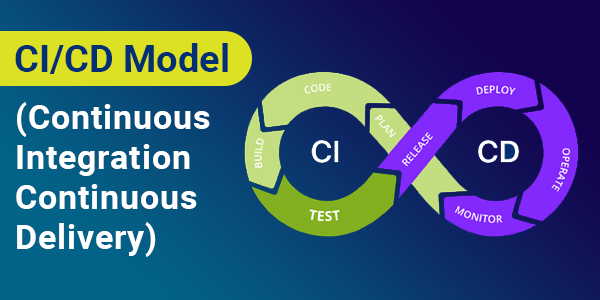
CI/CD Model: what and why it matters in software development
CI/CD Model: what and why it matters in software development There was a time when software development was si .. Read More
By Abhinav Kumar | Jun 01, 2025
What Is Legacy Migration and Why to Consider It
What Is Legacy Migration and Why to Consider It? Software technologies and applications are on the road to an ine .. Read More
By Monu Kumar | May 25, 2025
What Makes CMMI Appraisal Necessary for Software Development Companies ?
What Makes CMMI Appraisal Necessary for Software Development Companies? During software development, your product .. Read More
By Abhinav Kumar | May 10, 2025

2- Why to choose react native for mobile app development project?
React Native for mobile app development: Is it the right choice? For the 21st century, mobile phones are like sou .. Read More
By Abhinav Kumar | Apr 30, 2025
How Digital Transformation Impacts Software Development Services
Digital Transformation and its impact on Software Development Lifecycle Today's industrial landscape ta .. Read More
By Monu Kumar | Apr 15, 2025
What is the right price for developing a mobile app?
What is the price to develop an iPhone app? Or rather, how much does mobile app development cost? Well, Kudos to you bec .. Read More
By Monu Kumar | Apr 07, 2025
Should I use Flutter for my next Mobile App Development project?
So, what was the mobile app development story before Flutter? Let's consider mobile application develo .. Read More
By Monu Kumar | Mar 31, 2025
Understanding Python Development Services and their role in building next-gen enterprise a..
From being awarded the best programming language for development to replacing the stardom held previously by Java., Pyth .. Read More
By Abhinav Kumar | Mar 15, 2025
Is there any right pricing strategy for mobile app development?
No phrase can appropriately describe the accelerating mobile app development market! Definitely, it is on a consistent b .. Read More
By Abhinav Kumar | Mar 01, 2025
Mobile App Development: Freelancer or a Software Development Company
So, you’ve decided to build software, and now you’re faced with the debatable and inevitable question: software dev .. Read More
By Monu Kumar | Feb 21, 2025
Hybrid Mobile App Vs. Native Mobile App… Am I Making A Right Choice?
This seems to be a million-dollar question when it comes for making a choice between hybrid mobile app or native mobile .. Read More
By Abhinav Kumar | Feb 11, 2025
Let’s Create the Future Together
Accelerate your digital transformation journey with Triazine Software — delivering secure, scalable, and AI-driven enterprise solutions worldwide.
 Get free quote