Loader

CUSTOM WEB DEVELOPMENT SERVICES

Custom Web Development & Web Application Development Services

Triazine Software builds websites, customer portals and web applications for enterprises, designed around your brand, your workflows and the systems you already run, from ERP and CRM to SAP. You own every line of code, and delivery follows CMMI Level 3 discipline.

A template or website builder asks your business to fit inside someone else's layout, plugins and integration limits. Enterprise web platforms carry real weight: lead generation, customer self-service, partner portals, internal tools and online transactions, all on infrastructure that has to hold up under real traffic. As a custom web development company, we design and build each website or web application from your content, users and systems outward, so performance, security, accessibility and SEO are built in rather than patched on after launch. We deliver for clients across the US, UK, UAE, Australia, South Africa and India.

Trusted by IGL, Godfrey Phillips, Ministry of Defence, Toyota Boshoku, Schindler, University of Cambridge and other enterprises worldwide

Indraprastha Gas Limited Godfrey Phillips India Aavantika Gas Limited Ministry of Defence India Toyota Boshoku Schindler University of Cambridge Domino's Pizza Crompton NTPC Sound Royalties India Meteorological Department

What Is Custom Website & Web Application Development?

A website builder solves a general problem for a general business. Custom website development services solve your business's specific problem, using your data, your brand, and your operational rules. A templated platform caps functionality behind paid tiers and design presets; you can't build a workflow the template's authors never anticipated. Custom web application development services start with your requirements, and you own everything from day one. If you need a backend system or internal tool with no public-facing site, that falls under our custom software development service instead.

The practical difference shows up in three places: a themed template locks you into its plugin ecosystem and hosting environment, while a custom build lets you choose your own stack and hosting, including cloud infrastructure we set up and migrate for you. A template's information architecture is fixed; a custom build's architecture is drawn from your actual content and user paths. A template's integrations stop at what the marketplace offers; a custom build connects directly to the ERP, CRM, or EHS system you already run.

A website mainly presents information; a web application lets users log in, submit, approve and track work in the browser. Most enterprise projects combine both.

The result is a platform matched to the complexity your business genuinely carries, not a generic template stretched past the use cases it was built for.

Business Outcomes

A Site Built Around Your Brand and Users, Beyond a Template

A Site Built Around Your Brand and Users, Beyond a Template

Layouts and navigation are drawn from real user paths recorded during discovery, not a pre-set theme. As a result, visitors reach a form, a product page, or a support flow in fewer steps than a templated site typically allows.

Full Ownership of Your Code and Platform

Full Ownership of Your Code and Platform

Source code, database schema, and hosting configuration are handed over in full at go-live, so you can switch developers, add a team, or move hosts without a vendor lock-in clause standing in the way.

Performance and Scale That Hold Under Real Traffic

Performance and Scale That Hold Under Real Traffic

Architecture is load-tested against projected peak traffic before go-live, not after a slowdown, so a seasonal spike or a campaign surge doesn't take the platform down.

Faster Time to Value Through Integration-First Delivery

Faster Time to Value Through Integration-First Delivery

CRM, ERP, and marketing integrations are scoped during the requirements phase rather than bolted on post-launch, so form submissions and transactions reach your system of record from week one, not month three.

Custom Development vs Website Builder vs Themed CMS: Which Fits Your Business?

Custom web development means designing and building a website or web application specifically for your organization, instead of adapting a builder template or a pre-made theme. Here is how the three common routes compare.

Custom development Website builder (Wix, Squarespace) Themed CMS (WordPress / Shopify theme)
Fit to your brand and users Designed from your content and user paths Limited to the builder's templates Partly, within the theme's layouts
Logins, roles and workflows Built to your rules Not supported Through plugins, with limits
Integrations ERP, CRM, SAP and EHS designed in from day one Basic forms and payments only Only where a plugin exists
Code and data ownership You own both Locked to the vendor Code partly yours; plugins are third-party
Performance at scale Load-tested to your peak traffic Depends on the vendor Slows as plugins pile up
Cost profile Higher upfront, no per-seat or plugin lock-in Lowest upfront, monthly fees Low to moderate, plugin and upkeep costs grow
Time to launch 8–12 weeks for a website, months for a portal Days Weeks
Best for Portals, transactional platforms, integration-heavy sites Small brochure sites Content and marketing sites with standard needs

Build custom when

  • Users need to log in, submit, approve or track work on the site
  • The site must connect to ERP, CRM, SAP or other core systems
  • Plugins and workarounds are slowing the site or blocking features
  • Traffic peaks or security rules need architecture you control
  • Accessibility, data residency or audit trails are compliance requirements

Use a builder or themed CMS when

  • You need a simple brochure or content site
  • Standard templates and plugins cover about 90% of the need
  • You need it live in days, not months

We will tell you if a builder or themed CMS fits better than a custom build. For content-heavy marketing sites, we also build on WordPress or a headless CMS.

Our Custom Web Development Services

Custom Website Development

Purpose-built websites for brand, content, and conversion, coded against your requirements from the ground up so page structure, content types, and conversion paths match how your business actually presents itself. See an example in our corporate website case study.

Custom Web Application Development

Full-featured web applications, including customer portals, internal dashboards, and self-service platforms, built with the same architectural rigour as an enterprise product: role-based access, audit trails, and workflows engineered for the processes your teams already run on. Our government employment portal case study is one example at scale.

E-Commerce & Transactional Platform Development

Commerce and transaction platforms built around your catalogue structure, pricing logic, and checkout flow, including multi-currency, multi-warehouse, or approval-based checkout for retail and e-commerce businesses where a standard store template would force a workaround. Our vendor bill management case study shows this in a transactional, approval-heavy setting.

Content Management System (CMS) Development

Custom or headless CMS builds that give content and marketing teams direct control over pages, media, and publishing schedules, without a developer needed for every update, while keeping the front end decoupled for speed and flexibility.

Web Application Integration with ERP/CRM/EHS/OPS

Direct integration into the ERP, CRM, EHS, and operations platforms you already run, so form submissions, transactions, and user data land in your system of record automatically. Our EHS management platform case study shows this integration depth in practice.

Support, Maintenance & Lifecycle Management

Go-live is the starting point. We monitor uptime, response time, and security patches on every deployed platform through our IT support and maintenance service, and extend functionality as traffic, content volume, and business requirements grow past what launch-day scope covered.

Customer, Partner and Citizen Portal Development

Secure self-service portals for customers, vendors, distributors, employees or citizens: onboarding, applications, payments, document exchange, request tracking and dashboards, with role-based access. See our gas utility customer platform and government employment portal case studies.

Progressive Web App (PWA) Development

Web apps that install on the home screen, load fast on weak networks, work offline, and send push notifications, without separate iOS and Android builds. Where a native app is needed, our mobile app development team builds it on the same back end.

Website Redesign and Modernization

Rebuild an outdated, slow or hard-to-manage website without losing the search traffic it has earned: a full audit, a modern stack, a reusable design system, a better CMS and a complete 301 redirect map. Deeper re-engineering is covered by legacy application modernization and UI/UX design and redesign.

Engagement Models: Fixed Price, Time and Materials or Dedicated Team

Choose the commercial model that matches how certain your requirements. Most enterprise clients start with a short discovery phase, then pick up a model.

01

Fixed scope, fixed price

Best for corporate websites, redesigns and well-defined portals. Scope, milestones and budget are agreed after discovery.

02

Time and materials

Best when requirements will evolve, such as a new web application. You pay for effort, prioritise each sprint and stay in control of direction.

03

Dedicated web team

Best for long-running platforms with a continuous roadmap. A stable team of developers, designers and QA works as an extension of yours. See our dedicated development centre.

04

Staff augmentation and white-label

Best when you have the plan and need engineers, or you are an agency that needs a development partner under NDA. Explore dedicated web developers and hiring software engineers.

Our Web Application Development Process

Most corporate websites launch in 8 to 12 weeks, and portals or web applications reach a working pilot in 3 to 5 months.

  1. Requirements mapping

    We define the business goal, the user journeys involved, and the measurable outcome the site or application needs to deliver, documented before any design work starts so scope stays fixed through development.

    Typical duration: 1-2 weeks

  2. Architecture & UX design

    Information architecture, interface wireframes, and the technical foundation are drawn from your actual content inventory and user paths, reviewed with your team before development begins. This stage draws on our UI/UX design and strategy service.

    Typical duration: 2-4 weeks

  3. Sprint-based development

    Development runs in iterative sprints, typically one to two weeks each, with a working build reviewed at every checkpoint. This keeps direction aligned and catches changes early, rather than at the end.

    Typical duration: 2-week cycles

  4. Integration

    The site or application is connected to your existing CRM, ERP, EHS, or operational systems during development, not after launch, so data flow is tested against real records before go-live.

    Typical duration: Inside sprints

  5. QA & performance testing

    Functionality, load performance, and security are validated against real-world traffic scenarios, including peak-load simulation, before anything reaches production.

    Typical duration: Continuous + 1-3 weeks hardening

  6. Pilot deploy

    The build is released into a staging or limited-access environment for final review, using real content and live integrations within a contained scope, so issues surface before the full audience sees them.

    Typical duration: 1-2 weeks

  7. Go-live

    Deployment to production happens with uptime and error monitoring active from the first hour, not added afterwards. For redesigns, launch week includes SEO redirect checks.

    Typical duration: Launch week, with SEO redirect checks for redesigns

  8. Monitoring

    Performance, uptime, and usage are tracked on an ongoing basis through our IT support and maintenance service, and what's learned feeds back into requirements mapping for the next phase of work.

    Typical duration: Ongoing

AI-Assisted Web Development, Human-Owned Quality

We use AI to speed up web development, not to replace engineering judgment. Our designers and engineers stay responsible for the architecture, user experience, security, accessibility, performance and testing of every website and web application we build. AI shortens feedback loops in design, coding and testing, powers features inside your site where they earn their place, and helps us build pages that search engines and AI assistants can understand. Every output is reviewed and validated by experienced engineers before it ships, we agree up front which code and data AI tools may access, and the code we hand over stays fully owned by you.

01

Faster design and prototyping

AI-assisted content audits, wireframes and clickable prototypes help stakeholders react to something real in the first weeks.

02

Better code and test coverage

AI helps with boilerplate, test generation, accessibility checks and review suggestions, while senior engineers approve every merge.

03

AI inside your website or portal

Chat assistants that answer from your own content, intelligent site search, document reading inside portals and personalised recommendations. See conversational AI, AI-powered document processing and agentic AI.

04

Ready for AI search

Clean semantic HTML, structured data and clear answers on every page, so search engines and AI assistants can understand and cite your services.

Technology Stack and Platforms

We deliver custom web development services on modern, enterprise-proven frameworks and platforms, backed by infrastructure and delivery discipline built across 11+ years of mission-critical software delivery. We select the stack per project, based on your existing systems, team skillset, and scale requirements.

React

Next.js

Vue.js

Node.js

.NET

Java (Spring Boot)

Python

Django

FastAPI

WordPress

Headless CMS

PostgreSQL

MySQL

MongoDB

AWS

Azure

Google Cloud Platform

CDN Solutions

Azure DevOps

Jenkins

GitHub Actions

We choose the stack that fits your architecture and team. Combinations running in production for our clients: Angular + Django + MySQL on AWS with Flutter mobile apps (IGL Connect, 2M+ customers); React Native + Angular + Django (IGL Safety Work Permit); Django REST, Celery and Redis with SAML2 SSO and JWT (Godfrey Phillips platforms); real-time SAP integration on cloud infrastructure (AGL Connect); automated security scanning with GitHub Actions.

Secure, Accessible and Fast by Default

Security, accessibility and performance are designed into the architecture from the first sprint, not configured after launch. We build platforms that support your regulatory obligations; certification of your own organisation stays with you and your auditor.

01

Enterprise identity and access

SAML2 single sign-on with your identity provider, JWT-secured APIs, OTP authentication and role-based access. One client platform enforces 11 roles with regional and branch scoping.

02

Audit trails and compliance-ready design

Every action logged with user identity and timestamp, multi-level approvals and records that stand up to audits. Architectures support UK and EU GDPR, Saudi PDPL and UAE frameworks, and PNGRB and IOGP requirements in energy, depending on geography.

03

VAPT and secure pipeline

Independent vulnerability assessment and penetration testing with all findings remediated, OWASP Top 10 code reviews and automated security scanning via GitHub Actions. See DevSecOps and QA testing.

04

Accessibility (WCAG 2.2 AA)

Keyboard navigation, colour contrast, screen-reader labels and automated plus manual testing before launch, which is often a procurement requirement for government and healthcare portals.

05

Performance and Core Web Vitals

Targets of LCP under 2.5s, INP under 200ms and CLS under 0.1, tested on mid-range phones, with server rendering, image optimisation, CDN delivery and load testing to projected peak traffic.

06

Process standards and IP protection

CMMI Level 3 delivery governance and ISO 9001:2015 quality management standards. Your idea is protected by our Non-Disclosure Agreement, and code, design files and documentation belong to you, with repositories in your organisation.

Web Development Case Studies and Results

Real websites, portals and web applications in continuous production, some for five years and more, for enterprises in energy, FMCG and the public sector.

What Clients Say About Working With Triazine

"We weren't looking for a traditional vendor. We wanted a true technology partner who could integrate with our team, understand our creators, and share our vision. Feels like one unified team collaborating across continents."

Chip Correra

Fractional CTO, Sound Royalties (United States)

"Working with Triazine Software was an excellent experience. Their flexibility, responsiveness, and problem-solving expertise delivered every requirement, improved our app store ratings, enhanced customer experience... and significantly reduced the cost of resolving customer complaints."

Anadi Mishra

Chief General Manager, Indraprastha Gas Limited (India)

"Triazine delivered high-quality work on time, transforming our vision into a successful hybrid app. Their patience, responsiveness, flexibility across time zones, and commitment to implementing every feedback ensured outstanding results."

Roger Yarrow

CEO, TrueLook (United States)

"Triazine Software was recommended by IBM for our Pizza Online Ordering mobile app and the team stood up to our expectation... I highly recommend Triazine Software as dependable development partner for organization like us."

Sudhir Kumar Singh

Technical Program Manager, Domino's Pizza (India)

"Triazine Software transformed Ticketkore with a powerful smart ticketing and reservation platform."

Khomotjo R. Lebepe

CEO, Ticketkore (South Africa)

Why Choose Triazine as Your Web Development Company?

Triazine Software helps enterprises move from templated websites that limit growth to platforms built around their actual business. Our approach to custom web development services combines proven engineering discipline with the integration depth and domain expertise enterprise digital platforms require.

01

Websites and Applications Designed From Your Actual User Data

Every custom website development services engagement starts with a review of how your current visitors and users behave, not a theme adapted to fit, so navigation and content structure follow real usage patterns.

02

Full Ownership of Your Code and Platform

Every website, application, and integration we build transfers to you in full at delivery, giving you control over hosting and roadmap without dependency on our platform or infrastructure.

03

Integration-First Delivery Into Systems You Already Run

As a custom web development services company, we connect new sites and applications directly into your existing ERP, CRM, EHS, and operations platforms from day one, rather than treating integration as a later add-on. See this approach in our digital file tracking and governance case study.

04

Delivery Discipline That Scales With Complexity

CMMI Level 3-certified delivery process applies the same documentation, review, and QA rigour to every website design and development services engagement, regardless of project size. Read more about Triazine.

05

Performance and Security Engineered In From the Start

Custom web application development services are load-tested and security-reviewed during development, not after a launch-week incident forces the issue.

06

Support That Continues Well Beyond Go-Live

Uptime, performance, and security are monitored on every deployed platform on an ongoing basis, with functionality extended as content volume, traffic, and business requirements grow. Our IT support and maintenance service handles this.

07

SEO-Safe Launches and Redesigns

Every redesign ships with a full URL audit, a 301 redirect map, carried-over metadata and structured data, and post-launch monitoring in Google Search Console, so you keep the rankings you have earned.

Who You Will Work With and Where We Are

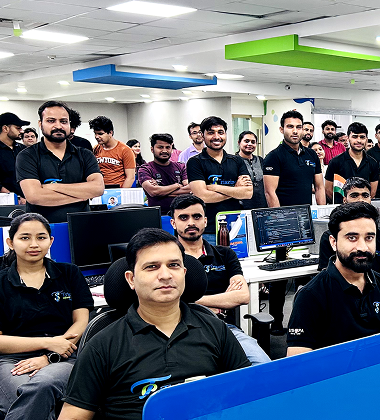
Triazine Software was founded in 2015 by Abhinav Kumar and Vikash Srivastava to help enterprises replace fragmented systems and manual workarounds with platforms that run with clarity, governance and accountability. Abhinav, Co-Founder and Director, brings over two decades of enterprise software engineering experience and leads technology direction and delivery. Vikash, Co-Founder and Director, leads operations, client success and strategic partnerships.

Your delivery team

Project managers and technical leads who own each engagement

UI/UX designers, front-end and back-end developers, QA and business analysts inside the same sprint team

Senior sales and solution leadership for scoping and commercials

Meet the leadership and core team

Contact and locations

USA: Triazine Software LLC, 8 The Green, Ste A, Dover, DE 19901. +1 (347) 941-1655

India: Triazine Software Pvt. Ltd., B-28 & 29, Sector 58, Noida 201301. +91-120 4275378

Email: sales@triazinesoft.com

Serving enterprises across North America, Europe, the Middle East, Africa and Asia Pacific.

Frequently Asked Questions

Custom web development is designing and building a website or web application around your brand, content, users and systems. A website builder limits design and functionality to its templates and paid tiers. Custom development gives you full control over features, integrations, performance and code.

A website mainly presents information: your brand, services, content and lead forms. A web application lets users do work in the browser, such as logging in, paying bills, submitting requests or approving transactions. Many enterprise projects, such as IGL Connect, combine both.

A custom corporate website typically costs about $10,000 to $40,000, a customer or vendor portal $30,000 to $100,000, and an integration-heavy enterprise web application $80,000 to $250,000 or more, driven by roles, workflows, integrations and compliance. We give a fixed estimate after a short discovery phase.

A corporate website usually takes 8 to 12 weeks, a portal or mid-size web application 3 to 5 months, and a complex enterprise platform 5 to 9 months. We work in two-week sprints and release in phases, so you see working software early.

Use a themed CMS when standard templates and plugins cover most of your needs. Build custom when users need logins and workflows, the site must connect to ERP, CRM or SAP, or plugins are slowing the site. We also build custom themes and headless setups on WordPress when that fits best.

Both, plus time and materials and staff augmentation. Fixed price suits websites and well-defined portals; a dedicated team suits evolving, long-running platforms.

Yes. Integration is planned in architecture design and built through APIs and integration layers. For Aavantika Gas we built AGL Connect with real-time SAP synchronisation across billing, payments and service operations. See also SAP implementation and support.

Yes. We crawl the current site, map every URL to its new equivalent with 301 redirects, carry over titles, meta descriptions and structured data, benchmark Core Web Vitals, and monitor indexing in Google Search Console after launch.

Yes. We build PWAs that install on the home screen and work offline, and native or cross-platform mobile apps on the same back end when needed, as we did with the IGL Connect web and Flutter apps. See mobile app development.

You do. Code, design files, data models and documentation transfer fully to you, repositories live in your organisation, and there is no vendor lock-in.

We design role-based access, SAML2 SSO or OTP authentication, encryption in transit and at rest, and audit trails into the architecture. Platforms handling sensitive data undergo independent VAPT with all findings remediated, and pipelines run automated security scanning. Architectures support GDPR, PDPL, PNGRB and IOGP requirements where they apply.

Yes. We build to WCAG 2.2 AA, and every build ships with semantic HTML, structured data, XML sitemaps, optimised images and Core Web Vitals targets, so the site is ready for search engines and AI search from launch.

Annual maintenance is commonly budgeted at roughly 15 to 20% of build cost and covers monitoring, security updates, framework updates, backups, fixes and small enhancements. See our IT support and maintenance service.

We agree an overlap window with your team, run sprint reviews every two weeks and keep one shared backlog. We work with clients in the United States, Australia, South Africa, the UK and the Middle East, and clients such as TrueLook have highlighted our flexibility across time zones.

Yes. Triazine Software LLC is registered in Dover, Delaware, and you can reach the US team on +1 (347) 941-1655 or sales@triazinesoft.com. Delivery is run from our Noida, India centre with US clients such as Sound Royalties and TrueLook.

Get a Free Web Development Estimate

Tell us what your website or web application needs to do and which systems it must connect to. We will respond within 24 hours with a ballpark budget, timeline and recommended first release. Your idea is protected by our Non-Disclosure Agreement.

Request an Estimate

Prefer to talk? US: +1 (347) 941-1655 | India: +91-120 4275378 | sales@triazinesoft.com

Proven Excellence

Trusted by Enterprise Operations.

  • 11+ Years of Enterprise Delivery
  • CMMI Level 3 Certified process
  • Full Code & Platform Ownership
500+ Solutions & Platforms
100% Code & IP ownership
Triazine team
2M+ Customers on one client portal
99.9% Platform uptime