Loader

ENTERPRISE AGENTIC AI DEVELOPMENT

Enterprise Agentic AI & Autonomous Workflow Orchestration

Autonomous AI agents that go beyond recommending the next step and execute it. Triazine Software designs and orchestrates multi-agent systems that plan, decide and act across enterprise workflows, turning fragmented, manual processes into governed operations that run end to end, auditable at every step.

Enterprise processes span multiple systems, and every outcome depends on decisions working in concert. A distribution approval moves across ERP, finance and field operations; a compliance review moves through operations, legal and multiple approval layers. Conventional automation stalls at the boundary of a single system; agentic AI carries the workflow through it. Triazine Software engineers the orchestration layer that reasons across the entire process: decomposing work into tasks, routing each to the agent or system best equipped to execute it, and coordinating every handoff until the outcome is complete, visible, governed and audit-ready from first step to last.

Trusted by the Tony Elumelu Foundation, IGL, Godfrey Phillips, Domino's Pizza, Ministry of Defence, Toyota Boshoku, Schindler, University of Cambridge and other enterprises worldwide

Tony Elumelu Foundation Indraprastha Gas Limited Godfrey Phillips India Aavantika Gas Limited Domino's Pizza Ministry of Defence India Toyota Boshoku Schindler University of Cambridge Crompton NTPC Sound Royalties

What Is Agentic AI Development?

Most AI tools answer a question. Agentic AI finishes a job. Give it a goal, the systems it needs, and the data behind them, and it plans the path, executes each step, checks its own work, adapts as conditions change and pauses only when a decision truly needs a person.

That's what separates it from the automation already running in your stack. RPA follows a fixed script and struggles the moment the process shifts. Generative AI drafts an answer but leaves the action to someone else. Agentic AI sits above both and multi-agent workflow orchestration is what makes that useful at scale: coordinating a chain of tasks, and the agents responsible for each, across an entire process calling APIs, updating systems of record, routing approvals, closing the loop end to end, inside a boundary you define for what it can decide alone and what still needs sign-off.

In regulated, high-stakes operations, that boundary is the entire value proposition. We build agentic AI solutions that keep people firmly in the loop, while removing the manual coordination between systems and teams and keeping the audit trail, the visibility and the governance fully intact around every decision that matters.

Business Outcomes

Operational Efficiency at Scale

Operational Efficiency at Scale

Agents carry repetitive, multi-system processes from trigger to outcome, taking action rather than handing a recommendation back to a person, so cycle times shrink from days of back-and-forth to minutes.

Faster Decisions

Faster, Better-Informed Decisions

Agents gather data, apply rules and route exceptions across systems in real time, ahead of the weekly review cycle so the decision is ready before the bottleneck forms.

Better Compliance

Governance Built Into Every Action

Every agent action, and every handoff between agents, is logged, auditable, and governed by the rules you define. Every action stays within the boundaries you set.

Reliability That Holds at Scale

Reliability That Holds at Scale

Every agent is tested against a set of real and edge-case scenarios before go-live and measured against the same set after it, so accuracy is tracked, not assumed, as volume grows.

Agentic AI vs RPA vs Chatbots vs AI Copilots: What Is the Difference?

Agentic AI development means building software agents that are given a goal, the tools they may use, and the limits of their authority, then plan and complete multi-step work on their own. Here is how it compares with the automation most enterprises already run.

Agentic AI RPA Chatbot / GenAI assistant AI copilot
What it does Plans and completes multi-step work toward a goal Repeats a fixed, scripted sequence Answers questions or drafts content Suggests the next step to a person
Handles exceptions Reasons about them, or escalates Breaks when the screen or rule changes Not applicable Leaves them to the person
Acts in your systems Yes, through APIs and tools, within set permissions Yes, through the user interface Usually, no Rarely, and only on request
Who decides The agent, within its authority; a person above it The script The person The person
Audit trail Every step, tool call and decision logged Bot run logs Conversation logs Limited
Best for Cross-system processes with judgment and exceptions Stable, high-volume, rule-only tasks Knowledge access and drafting Individual productivity

RPA, chatbots, and agents work together. We often keep a stable RPA bot in place and put an agent above it to handle exceptions and decisions.

Your process is ready for an AI agent when

  • It runs across two or more systems, such as ERP, CRM, email and documents
  • It follows rules most of the time but has frequent exceptions
  • People spend their time gathering data, checking it and routing it rather than deciding
  • Volume is high enough that delays and backlogs cost money
  • The data and systems the agent needs are reachable through APIs or exports
  • You can define clearly what the agent may do alone and what needs sign-off

An agent is the wrong tool when

  • A fixed rule or a simple workflow tool already solves the problem
  • Every case needs senior judgment and cannot be broken into steps
  • The data the agent would rely on is unavailable or unreliable

We will tell you when a simpler workflow, RPA, or our conversational AI service fits better than an agent.

Agentic AI Development Services and Custom AI Agent Development

Custom AI Agent Development Services

Purpose-built from the start. As a dedicated agentic AI development services provider, we start with how your business actually runs, and build every agent's logic, scope and integrations around it working directly against your data and your architecture, so it operates independently or slots into a larger orchestrated workflow from day one.

We deliberately avoid generic templates, because most operational processes carry enough nuance exceptions, regional variation, legacy system quirks that a templated agent breaks down quickly in production. Custom AI agent development means the agent we hand over reflects your process as it actually runs, not a simplified version of it.

Autonomous Process Agents

Agents built to act, going beyond advice to execution. Scoped to a specific operational process, they reason over live data, decide within a defined authority, and execute updating a record, triggering a workflow, routing an exception then confirm the result and move to the next step on their own. Because each agent operates within clearly defined boundaries, teams retain full visibility into what it can and cannot decide, even as it works independently.

Deployed well, autonomous process agents don't just remove manual effort they compress the time between a trigger and an outcome, so processes that once took days of back-and-forth resolve in minutes, without sacrificing the checks that matter.

Multi-Agent Orchestration

This is the core of what we build. Complex processes get broken into discrete tasks, each handed to a specialised agent, coordinated through multi-agent workflow orchestration that manages sequence, timing and handoffs. Agents work the way departments do scoped to a role, connected across systems, moving in concert toward one outcome as a unified system rather than disconnected point solutions.

As enterprises adopt more AI capability across functions, orchestration is what turns a collection of individual agents into a genuinely intelligent operating layer one that understands how work moves through your organisation, not just how a single task gets done.

Decision Support Agents

For the calls that still belong to a person. These agents pull data from across the enterprise, apply the right rules or models, and hand a decision-maker a clear recommendation with the reasoning attached full context, complete transparency, judgment and accountability exactly where they belong.

Unlike a black-box model, every recommendation traces back to the data and logic behind it, so decision-makers can trust and defend the call they make.

Workflow Integration Agents

Built to work inside the systems you already run, fully embedded within them. These agents trigger actions, update records and move information between platforms without manual re-entry, so every process stays within its system of record with orchestration running across the architecture you already have. This matters most in enterprises where ERP, CRM and operational systems have grown over years into a complex, interconnected stack; rather than asking you to standardise or replace that stack, our agentic AI solutions for enterprise environments are designed to work with it as it stands.

AI Agent Integration with ERP/CRM/EHS/OPS

Deep integration into the ERP, CRM, EHS and operations platforms you already run agents that read, write and act on live data while working in step with every established workflow. Orchestration coordinates every action across these systems, delivering true agentic AI solutions for enterprise operations, so every action stays within its system of record.

For sectors where EHS and operational compliance carry real regulatory weight, this integration depth is particularly critical: agents need to act inside the systems of record your auditors already trust.

AI Agent Lifecycle Management

Go-live is where the real work begins. We track accuracy, drift and exception rates on every deployed agent, retraining and refining as your business rules, systems and conditions evolve so performance a year in is just as reliable as performance on day one.

Lifecycle management is how we make sure the agentic AI services we deliver keep earning their place in your operations well beyond the initial rollout, rather than degrading quietly in the background.

Agent Readiness Assessment and Use-Case Discovery

A structured review of your processes, systems and data to find where agents will pay back first. You leave with a ranked list of agent use cases, the autonomy level each one needs, the integrations required, and a pilot plan for the top candidate.

MCP Servers and Agent Tool Integration

We expose your ERP, CRM, SAP, EHS, document stores and internal APIs to agents as secure, permission-scoped tools, using the Model Context Protocol (MCP) and standard APIs, so any approved model or agent framework can use them without one-off connectors for every project.

Agent Guardrails, Evaluation and Red-Teaming

Before an agent touches a live system, we test it against a library of real and edge-case scenarios, attempt prompt-injection and misuse attacks against it, and set measurable pass criteria. The same tests run after every change, so quality never slips quietly in production.

Ways to Start With Agentic AI

Most clients start small, prove value on one process, then scale. Choose the model that matches where you are.

01

Agent use-case workshop

Best as the first step. A short, fixed-scope engagement with your process owners that ends with ranked use cases, autonomy levels and a pilot plan.

02

Fixed-scope pilot agent

Best for proving value fast. One agent, one process, real data and a contained scope, with success criteria agreed before build starts.

03

Production multi-agent programme

Best when the pilot has proven value. We scale to more processes and agents on a shared orchestration, tool and governance layer, so each new agent costs less effort than the last.

04

Dedicated AI agent team

Best when you own the roadmap and need capacity. AI architects, LLM engineers and integration engineers work as an extension of your team. See hire data and AI specialists and our dedicated development centre.

Our Agentic AI Development Process

Most single-agent pilots go live with real users in 6 to 10 weeks; multi-agent programmes scale in phases after that.

  1. Goal mapping

    Define the process, the outcome the agent needs to reach, and how much autonomy it's allowed to have before a decision requires sign-off.

    Typical duration: 1-2 weeks

  2. Data access

    Connect the systems, APIs, and data sources the agent will need to read from and write to, so it isn't reasoning on partial information.

    Typical duration: 1-2 weeks

  3. Agent design

    Define each agent's role, scope, and reasoning approach what it owns, what it doesn't, and how it should behave inside that boundary.

    Typical duration: 1-2 weeks

  4. Orchestrate

    Design how multiple agents hand work to one another: sequence, timing, and what happens at each handoff.

    Typical duration: Inside build sprints

  5. Guardrails

    Set the rules for what the agent can decide and execute on its own, and what must route to a human before it happens.

    Typical duration: Inside build sprints

  6. Simulation

    Run the agent against real and edge-case scenarios in a safe environment, before it ever touches a live system.

    Typical duration: 1-2 weeks against a tested scenario set, including prompt-injection tests

  7. Pilot deploy

    Release into production on a limited, closely monitored scope real data, real stakes, contained blast radius.

    Typical duration: 4-6 weeks with real users

  8. Full deployment

    Expand from pilot to full production scope once performance is validated and sign-off is granted full data volume, full workflow coverage, blast radius removed.

    Typical duration: Phased, autonomy raised step by step

  9. Monitoring

    Track accuracy, drift, and exception rates on an ongoing basis, and feed what's learned back into goal mapping which is what keeps this a lifecycle, not a one-time build.

    Typical duration: Ongoing

How We Build AI Agents You Can Trust

Every agent we deliver is built from the same governed components, so you can see exactly what it can do, what it remembers and when it stops to ask.

01

Planner, worker and checker agents

Complex processes are split between agents with clear roles: one plans the steps, specialist agents carry them out, and a checker agent verifies the result against your rules before anything is committed.

02

Memory with limits

Agents keep short-term context for the task in hand and long-term memory in a governed vector store, scoped to the data each user and process is allowed to see.

03

Tools, not free access

Agents act only through approved tools: API calls, MCP tools and system actions, each with its own permissions. An agent that can read invoices cannot approve payments unless you grant that tool.

04

Human approval gates

Decisions above a value, risk or confidence threshold pause for a named person to approve, edit or reject, and the agent learns nothing it should not from that decision.

Autonomy levels: you decide how far each agent goes

Most agents start at level 1 or 2 and move up only when their measured accuracy earns it.

Level What the agent does Example
1. Assist Gathers data and recommends; a person acts Drafts a permit pre-check for the safety officer
2. Act with approval Prepares the action; a person approves before it runs Prepares a distributor credit note for finance sign-off
3. Act within limits Acts alone below set thresholds; escalates above them Closes routine meter-reading exceptions; escalates disputes
4. Autonomous with audit Acts alone across the process; every step logged and reviewed Routes and tracks incoming citizen applications end to end

Technology Stack and Platforms

We build agentic systems on enterprise-proven frameworks and models, backed by delivery discipline from 11+ years of mission-critical software delivery.

LangChain

LangGraph

CrewAI

AutoGen

Semantic Kernel

LlamaIndex

Pinecone

Weaviate

pgvector

Temporal

Apache Airflow

Anthropic Claude API

OpenAI API

Azure OpenAI

Ray

We pick the model per task on accuracy, cost, speed and data-residency needs, and design the agent so the model can be swapped later without a rebuild. In production for our clients: OCR document verification, duplicate detection and a four-language NLU assistant on Azure with Prometheus and Grafana monitoring (TEFConnect), integrated with an Azure Fabric data warehouse and Power BI.

Agentic AI Security, Guardrails and Governance

Autonomous systems need stronger controls than ordinary software, because they act. These controls are designed in from the first sprint. We build agents that support your regulatory obligations; certification of your own organisation stays with you and your auditor.

01

Least-privilege tool permissions

Each agent gets only the tools and data its task needs, with separate read and write permissions, spending limits and rate limits, all reviewed with your security team.

02

Prompt-injection and misuse defence

Inputs from emails, documents and web content are treated as untrusted. Agents are tested against injection and data-exfiltration attacks before go-live, and every tool call is checked against policy before it runs.

03

Human approval and kill switch

High-impact actions pause for a named approver, and any agent can be paused or switched off instantly without touching the systems it works in.

04

Full decision audit trail

Every goal, step, tool call, data source and decision is logged with a timestamp. On TEFConnect, every AI flag is logged with reviewer override, so no application is rejected without human review.

05

Data protection and private deployment

PII masking, encryption in transit and at rest, and role-based access, with the option to run models in your own cloud or on-premise. Your data is not used to train public models. Architectures support GDPR, NDPR (TEFConnect), Saudi PDPL and UAE frameworks, and the transparency expected by emerging AI regulation such as the EU AI Act.

06

Process standards and IP protection

CMMI Level 3 delivery governance and ISO 9001:2015 quality management standards. Your use cases and data are protected by our Non-Disclosure Agreement, and every agent, prompt, tool and workflow belongs to you.

Agentic AI and Enterprise AI Case Studies

AI agents, language models, computer vision and machine learning in production, each architected, developed, implemented and supported by Triazine.

01

AI-Based Safety Monitoring: Agents That Classify Incidents and Drive Corrective Action

AI capabilities: Computer vision, agentic AI | Industry: Industrial safety | Services: Architecture, development, implementation, support and maintenance

Continuous manual monitoring of many CCTV feeds could not keep up with PPE compliance, restricted-zone access and real-time incident detection. Computer vision now analyses live footage across multiple cameras, detects missing helmets, vests and other protective gear and unauthorised entry into restricted areas, and sends instant alerts. AI agents then classify each incident or observation and prepare the corrective and preventive action (CAPA), following it up to closure.

02

TEF Chatbot: A LangGraph Agent Pipeline With Confidence-Based Human Handoff

AI capabilities: Retrieval-augmented generation (RAG), large language models | Industry: Customer support and knowledge management | Services: Architecture, development, implementation, support and maintenance

Support teams were answering the same questions repeatedly, user messages were vague or misspelt, and answers were scattered across FAQs and long documents. A LangGraph pipeline rewrites each message into a clear query, labels its intent and key entities, searches curated FAQs first and the knowledge base only when no FAQ matches, and scores confidence by combining retrieval similarity with an LLM check of context sufficiency. Low-confidence queries automatically create a support ticket and route the user to a person, so nothing is answered on a guess. Built with React, FastAPI, LangGraph, Groq-hosted LLMs, Chroma and PostgreSQL.

03

Conversational Search Chatbot: Enterprise Data on Request

AI capabilities: Natural language processing, large language models, natural language search | Industry: Multiple industries | Services: Architecture, development, implementation, support and maintenance

Users struggled to find information across multiple dashboards and filters, and non-technical staff avoided traditional reporting tools. The assistant understands the intent behind a plain-language question, converts it into system searches and returns reports, records and summaries instantly, cutting the time spent searching and speeding up decisions.

04

Predictive Analytics Engine: Incident Probability and Risk Areas

AI capabilities: Machine learning, predictive analytics | Industry: Oil and gas, manufacturing | Services: Architecture, development, implementation, support and maintenance

Large volumes of historical incident and operational data hid patterns that were hard to see manually. Machine learning models analyse that history to forecast the probability of incidents, highlight the locations and operations carrying the highest risk, and track trends in incidents, compliance and performance, so management can act before incidents occur.

05

PrimeEHS PPE Detection

AI capabilities: Computer vision and deep learning (YOLOv5, Faster R-CNN) | Industry: Industrial safety and manufacturing | Services: Architecture, development, implementation, support and maintenance

Real-time PPE detection across large sites with multiple cameras had to work in poor or harsh lighting and avoid confusing look-alike objects with PPE. YOLOv5 and Faster R-CNN models, trained on images across varied lighting and a diverse, high-quality dataset, run on combined edge and cloud processing, alert supervisors instantly, generate audit-ready reports, and mask or encrypt video to protect worker privacy.

06

PrimeEHS Fire and Smoke Detection

AI capabilities: Computer vision and video analytics | Industry: Multiple industries | Services: Architecture, development, implementation, support and maintenance

Fire and smoke vary in appearance, look-alike visuals cause false alarms, and early-stage fires are small and easy to miss. Temporal models (LSTM, 3D CNN) capture smoke and flicker motion, consistency checks separate smoke and fire from fog or dust, Mask R-CNN combines detection with pixel-level segmentation, thermal cameras cover low-light zones, and lightweight YOLOv8 and MobileNet SSD models keep detection real-time, with physical sensors as backup in high-risk areas.

07

Fraud Detection in a Restaurant Chain

AI capabilities: Computer vision and object detection | Industry: Food and beverage | Services: Architecture, development, implementation, support and maintenance

A manual, error-prone operational check had to be automated from low-quality CCTV footage with varied item designs and overlapping objects. Instance segmentation and tracking separate overlapping items and link them to individuals, negative training examples stop trays, bags and hands being mistaken for products, and YOLOv5n and YOLOv8n models with TensorRT run in real time on edge devices.

08

Sentiment Analysis for Digital Marketing With Social Media Feeds

AI capabilities: Natural language processing, sentiment analysis, social media analytics | Industry: Government | Services: Architecture, development, implementation, support and maintenance

Natural language processing analyses social media feeds to measure public sentiment towards digital campaigns and programmes, giving communication teams a real-time view of how messages are received.

09

AI Story Generation Platform

AI capabilities: Generative AI, multimodal AI, AI content generation | Industry: Digital media | Services: Architecture, development, implementation, support and maintenance

Large volumes of unstructured personal media from different sources had to become a coherent, engaging story. Multimodal AI handles image understanding, OCR and speech-to-text; LLM-based planning generates the story and its scenes; and AI narration with configurable voices and narrator personas produces narrated story videos and magazine-style PDF publications on a scalable processing workflow.

What Clients Say About Working With Triazine

"We weren't looking for a traditional vendor. We wanted a true technology partner who could integrate with our team, understand our creators, and share our vision. Feels like one unified team collaborating across continents."

Chip Correra

Fractional CTO, Sound Royalties (United States)

"Working with Triazine Software was an excellent experience. Their flexibility, responsiveness, and problem-solving expertise delivered every requirement, improved our app store ratings, enhanced customer experience... and significantly reduced the cost of resolving customer complaints."

Anadi Mishra

Chief General Manager, Indraprastha Gas Limited (India)

"Triazine Software was recommended by IBM for our Pizza Online Ordering mobile app and the team stood up to our expectation... I highly recommend Triazine Software as dependable development partner for organization like us."

Sudhir Kumar Singh

Technical Program Manager, Domino's Pizza (India)

"Triazine delivered high-quality work on time, transforming our vision into a successful hybrid app. Their patience, responsiveness, flexibility across time zones, and commitment to implementing every feedback ensured outstanding results."

Roger Yarrow

CEO, TrueLook (United States)

"Triazine Software transformed Ticketkore with a powerful smart ticketing and reservation platform."

Khomotjo R. Lebepe

CEO, Ticketkore (South Africa)

Why Choose Triazine as Your Agentic AI Development Company?

Triazine Software helps enterprises move agentic AI from pilot to production. Our approach combines proven multi-agent architecture with the governance, integration depth, and domain expertise every enterprise operation requires so agents deliver measurable outcomes in live operations.

01

Scalable Agentic AI for Enterprise Operations

We design agent architectures so orchestration logic, integrations, and monitoring can support additional processes as they stand, minimising marginal effort as adoption expands across your organisation.

02

Post-Deployment Monitoring & Agent Support

We track accuracy, drift, and exception rates continuously after go-live, retraining and refining agents as your business rules and systems evolve. Our team stays with you through the full lifecycle, from launch onward and beyond.

03

Governance, Compliance & Audit-Ready by Design

Regulatory scrutiny around autonomous AI is increasing globally, with governance and explainability now essential. Every agent action is logged and bounded by rules you define built to meet the compliance standards of regulated, high-stakes enterprise environments.

04

Proven on One Process Before You Scale

Every engagement starts with a fixed-scope pilot on real data, with success criteria agreed before build, so you see measured results before committing to a wider programme.

05

Measured, Not Assumed

Each agent ships with its own scenario test suite and accuracy targets. We report the numbers before go-live and keep reporting them after, so you always know how your agents are performing.

06

100% Ownership of Your Agents and Architecture

Every agent, integration, and workflow we build belongs entirely to you full ownership, complete independence from vendor lock-in, and infrastructure that stays fully in your control.

07

Model-Agnostic, With No Lock-In

We are not tied to one model vendor. Agents are designed so you can switch between Claude, OpenAI, Azure OpenAI or a private model as prices, performance or regulations change, without rebuilding the workflow.

Who You Will Work With and Where We Are

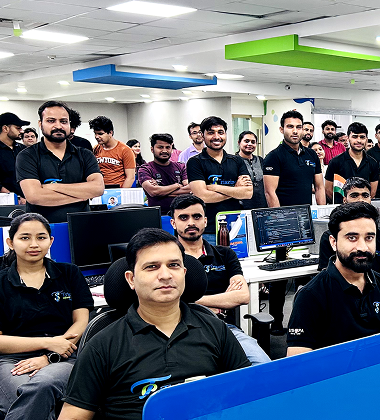
Triazine Software was founded in 2015 by Abhinav Kumar and Vikash Srivastava to help enterprises replace fragmented systems and manual workarounds with platforms that run with clarity, governance and accountability. Abhinav, Co-Founder and Director, brings over two decades of enterprise software engineering experience and leads technology direction and delivery. Vikash, Co-Founder and Director, leads operations, client success and strategic partnerships.

Your agent team

AI architects who own the agent design, autonomy levels and guardrails

LLM and integration engineers who build the agents and their tools inside your systems

QA and red-team engineers who test agents against real scenarios and attacks

Business analysts and project managers who work with your process owners

Meet the leadership and core team

Contact and locations

USA: Triazine Software LLC, 8 The Green, Ste A, Dover, DE 19901. +1 (347) 941-1655

India: Triazine Software Pvt. Ltd., B-28 & 29, Sector 58, Noida 201301. +91-120 4275378

Email: sales@triazinesoft.com

Serving enterprises across North America, Europe, the Middle East, Africa and Asia Pacific.

Frequently Asked Questions

An agentic AI development company designs, builds and runs AI agents that complete multi-step work on their own: it maps the process, connects the agent to your systems as tools, sets the limits of its authority, tests it against real scenarios, deploys it with human approval gates and monitors it in production.

Generative AI answers a question or drafts content when asked. Agentic AI is given a goal and the tools to reach it, then plans the steps, acts in your systems, checks the result and escalates to a person when a decision falls outside its authority.

RPA repeats a fixed script and breaks when a screen or rule changes. Agentic AI reasons about each case, handles exceptions and works through APIs rather than screens. Many enterprises keep stable RPA bots and add an agent above them to handle exceptions and decisions.

An AI agent is a single component that performs a task with tools. Agentic AI is the wider system: one or more agents with planning, memory, tools, guardrails and orchestration working toward a business outcome. Multi-agent systems split a process between specialist agents that hand work to each other.

Custom AI agent development builds an agent around your own process, data, systems and approval rules. Off-the-shelf agents built into SaaS products work well inside that one product. You need a custom agent when the work crosses several systems, follows your own business rules, or must meet your security and audit requirements.

Processes that cross two or more systems, follow rules most of the time but have frequent exceptions, run at high volume, and where people spend more time gathering and routing data than deciding. Typical examples are claim reconciliation, invoice matching, permit pre-checks, application verification and complaint triage.

A use-case workshop takes one to two weeks. A single pilot agent usually goes live with real users in 6 to 10 weeks. Multi-agent programmes then scale in phases, adding processes on a shared orchestration and governance layer.

You set an autonomy level for each agent, from recommend-only to act-within-limits. Actions above a value, risk or confidence threshold pause for a named approver, every step is logged, and any agent can be paused instantly with a kill switch.

Content from emails, documents and websites is treated as untrusted input, every tool call is checked against policy before it runs, agents hold only the permissions their task needs, and each agent is tested against injection and data-exfiltration attacks before go-live and after every change.

Yes. We connect agents to your systems through secure APIs and Model Context Protocol (MCP) tools with scoped permissions, so they read and write in your systems of record. Our AGL Connect platform already synchronises with SAP in real time.

We are model-agnostic: Anthropic Claude, OpenAI, Azure OpenAI or open-weight models for private deployment, chosen per task. For orchestration we use LangGraph, LangChain, CrewAI, AutoGen and Semantic Kernel, with Pinecone, Weaviate or pgvector for memory.

Yes, agents and models can run in your own Azure, AWS or Google Cloud account or on-premise. Your data is not used to train public models, PII can be masked before it reaches a model, and data stays in the regions you specify.

Each agent has a scenario test suite and agreed targets for task completion, accuracy, escalation rate and processing time. We measure against them before go-live and keep tracking them in production, with alerts when performance drifts.

No. Agents remove the gathering, checking and routing work that slows teams down, and keep people in charge of decisions that need judgment, context or accountability. The aim is more capacity from the same team.

Yes. Triazine Software LLC is registered in Dover, Delaware, and you can reach the US team on +1 (347) 941-1655 or sales@triazinesoft.com. Delivery is run from our Noida, India centre with US clients such as Sound Royalties and TrueLook.

Book a Free Agent Use-Case Workshop

Tell us which process is slowing your teams down. We will respond within 24 hours to set up a short session, and you will leave with the agent use cases worth building first, the autonomy level each needs and a pilot plan. Your processes and data are protected by our Non-Disclosure Agreement.

Book a Workshop

Prefer to talk? US: +1 (347) 941-1655 | India: +91-120 4275378 | sales@triazinesoft.com

Proven Excellence

Trusted by Enterprise Operations.

  • 11+ yrs Enterprise delivery
  • CMMI L3 Certified process
  • 100% Code, agent & IP ownership
  • 4 Languages handled by one AI assistant (TEFConnect)
500+ Solutions & platforms
150+ Engineers, designers and specialists
Triazine team
100% Duplicate applications caught by AI (TEFConnect)
90% Fewer complaints after go-live (TEFConnect)