Loader

ENTERPRISE INTELLIGENT DOCUMENT PROCESSING

Enterprise Intelligent Document Processing That Turns Documents into Decisions

Triazine Software engineers intelligent document processing (IDP) for enterprise operations: AI that reads invoices, claims, forms, contracts and scanned records, extracts the data that matters, validates it against business rules and posts it directly into ERP, SAP, CRM and EHS systems. Reviewers handle only the documents the AI flags as uncertain. Every solution is platform-neutral, trained on your own documents and fully owned by your organisation.

Most enterprise processes still begin with a person opening a document, interpreting it and re-keying it into another system. A distributor claim arrives as a PDF; a connection application arrives as a phone photo; a vendor bill is scanned with handwritten notes in the margin. Each step adds cost, delay and risk of error. Intelligent document processing replaces manual reading and re-keying with AI that classifies every document, extracts every field, validates it and escalates only genuine exceptions to a reviewer. We engineer IDP for document-intensive operations in energy, FMCG, industrial safety, healthcare and the public sector, across the US, UK, UAE, Australia, South Africa and India.

Trusted by the Tony Elumelu Foundation, IGL, Aavantika Gas, Godfrey Phillips, Ministry of Defence, Toyota Boshoku, Schindler, University of Cambridge and other enterprises worldwide

Tony Elumelu Foundation Indraprastha Gas Limited Aavantika Gas Limited Godfrey Phillips India Ministry of Defence India Toyota Boshoku Schindler University of Cambridge Domino's Pizza Crompton NTPC India Meteorological Department

What Is Intelligent Document Processing?

Intelligent document processing (IDP) uses OCR, machine learning, natural language processing and large language models to classify documents, extract the data inside them, validate it against business rules and send it to the systems that need it. It is how AI is used for document processing at enterprise scale: it reads the meaning of a document, not just its characters, so it keeps working when layouts change.

That's what separates this from a standard IT process automation tool. A conventional automation platform executes a task once it's told exactly what to do. AI for document processing adds the layer that's usually missing reading a document, understanding what it contains, and deciding what should happen next based on that content, rather than hardcoded field mapping. AI workflow automation ties that understanding to the rest of the process: routing an approval, updating a system of record, flagging an exception, and moving the work forward independent of manual interpretation.

It's built to remove the manual interpretation step, while keeping judgment exactly where it belongs. Every extracted field and every automated decision is validated and confidence-scored clean where the model is certain, flagged where it isn't so a person reviews genuine exceptions instead of processing every document by hand.


Business Outcomes

Faster Processes, Start to Finish

Faster Processes, Start to Finish

Documents are read, validated, and routed the moment they arrive email, upload, or scan carrying a process through to completion instead of stalling at the first manual checkpoint.

Consistent Decisions at Volume

Consistent Decisions at Volume

Business rules are applied the same way on document one and document ten thousand, so process outcomes stay consistent as transaction volume grows accuracy that holds under real operating load, well beyond a pilot.

Fewer Errors, Caught Earlier

Fewer Errors, Caught Earlier

Extracted data and process decisions are validated against defined rules before reaching a system of record catching mismatches and missing fields at the point of entry, well ahead of a downstream approval.

Capacity That Scales With Demand

Capacity That Scales With Demand

Enterprise workflow automation absorbs rising document and transaction volume without a proportional rise in headcount, freeing teams to focus on exceptions and judgment calls that genuinely need a person.

Manual Entry vs OCR vs Template Capture vs IDP vs GenAI Document AI

Each generation of document technology solved part of the problem. Here is how they compare, and why most enterprises now combine IDP with large language models.

Manual entry Basic OCR Template-based capture Intelligent document processing GenAI document AI
What it does People read and type Turns an image into text Pulls fields from fixed positions Classifies, extracts, validates and routes Reads, summarises and answers questions about documents
New or changed layouts Handled, slowly Text only, no fields Breaks; needs a new template Learns them from examples Handles most without examples
Handwriting, stamps, tables Yes Weak Weak Strong with trained models Strong
Understands meaning Yes No No Field and document level Clause and context level
Checks against business rules Sometimes No Limited Yes, built in Only if added
Accuracy control Spot checks None Per template Confidence scores and human review Needs guardrails and review
Best for Very low volume Searchable archives Identical forms High-volume invoices, claims and forms Contracts, letters and free text

We combine IDP for structured extraction with LLMs for unstructured documents, and keep confidence scoring and human review across both.

Your documents are ready for IDP when

  • You handle hundreds or more documents a month of the same family, such as invoices, claims or applications
  • The same fields are re-typed into an ERP, SAP, CRM or other system
  • Errors, late postings or disputes cost money or create compliance risk
  • You can share a sample of real documents, including the messy ones
  • Someone owns the rules that decide whether a document is correct

IDP is the wrong tool when

  • Volumes are a few documents a week, where manual entry is cheaper
  • The documents are already digital, structured data that can be read through an API
  • The real problem is the approval process, not reading the document; our agentic AI service fits that better

Intelligent Document Processing Services and AI Document Automation

IDP Consulting and Document Assessment

A review of your document types, volumes, layouts, quality and target systems, tested on a sample of your real documents. You get the fields that can be extracted reliably, the expected straight-through processing rate, the right platform or build approach, and a pilot plan.

Intelligent Document Processing

The core of what we build. Intelligent document processing combines OCR, AI-based classification, and field-level extraction to read incoming documents scanned, photographed, or digital and identify what each one is before a single field is extracted or a process step begins.

Post-Extraction Workflow & System Integration

Beyond reading a document, this is where extracted data is posted into the systems that need it: routing approvals, updating systems of record, and triggering the next step automatically, so a process moves from document intake to completion without manual handoffs in between.

AI Document Automation for Structured & Unstructured Data

Invoices, contracts, forms, and compliance records rarely follow one format. Our AI document automation is trained to extract meaning from both structured fields and unstructured text, applying business context so an amount, a clause, or a date is understood correctly regardless of layout.

Exception Handling & Business Rule Validation

Every extracted field and process decision is checked against your defined business rules in real time, so incomplete or inconsistent data is flagged before it reaches a system of record keeping exceptions genuinely rare, and genuinely worth a person's attention.

Enterprise Workflow Automation Across Systems

Automation carries across more than a single application. We design workflows that move a process across ERP, CRM, EHS, and operations platforms. As a result, a document or decision keeps moving through every system it touches, matching how work actually flows through your business.

Custom Process Automation Model Development

Templates rarely fit real operations. We train extraction and process-logic models against your actual documents, workflows, and edge cases the ones generic AI document tools misread so accuracy holds on the processes that matter most to your business.

Automation Platform Lifecycle Management

Go-live is the start, not the finish line. We monitor extraction accuracy and process performance on every deployed model, retraining as documents, workflows, and regulations change so intelligent process automation stays reliable well beyond initial rollout.

GenAI and LLM Document Understanding

Large language and vision models for documents that templates and classic extraction cannot handle: contracts, letters, reports and mixed-format files. Clause and obligation extraction, summarisation, question answering over document sets and comparison against standard terms, with confidence scores and human review.

IDP Platform Implementation and Integration

Vendor-neutral implementation on Azure AI Document Intelligence, AWS Textract, Google Document AI, UiPath or Automation Anywhere, or a custom build where licence costs or data rules make platforms a poor fit, integrated with your ERP, SAP, CRM and EHS systems.

Ways to Start With Intelligent Document Processing

Most clients start with one document family, prove the value, then add more.

01

Document assessment

Best as the first step. We test a sample of your real documents and report which fields can be extracted, the expected straight-through rate and a pilot plan.

02

Fixed-scope pilot

Best for proving value. One document family, such as vendor invoices or connection applications, processed end to end in parallel with your current manual process, against agreed accuracy targets.

03

Production IDP programme

Best when the pilot has proven value. More document families on a shared capture, review and integration layer, so each new document type costs less effort than the last.

04

Dedicated document AI team

Best when you own the roadmap and need capacity. ML engineers, integration engineers, and QA work as an extension of your team. See hire data and AI specialists.

Our Intelligent Document Processing Implementation Process

Most first document families go live in 6 to 10 weeks, depending on layout variety and integration scope.

  1. Process mapping

    Define the document types, decision points, and systems involved, and the outcome each workflow needs to reach.

    Typical duration: 1 week

  2. Source connection

    Connect the inboxes, portals, scanners, and systems the workflow will read from and write to, so processing starts from complete input.

    Typical duration: 1-2 weeks

  3. Classification design

    Define how documents and process steps are identified and categorised, so routing decisions start from an accurate read.

    Typical duration: 1 week

  4. Extraction & logic modelling

    Train models to pull the right fields and apply the right business rules for your specific document formats and workflows.

    Typical duration: 2-4 weeks

  5. Validation rules

    Set the business rules that extracted data and process decisions must meet before moving forward automatically.

    Typical duration: Inside modelling

  6. Exception guardrails

    Define what routes to a person for review, and what the system can carry forward on its own.

    Typical duration: Inside modelling

  7. Pilot deploy

    Release into production on a limited, closely monitored scope real documents, real workflows, contained blast radius.

    Typical duration: 4-6 weeks in parallel with the current manual process

  8. Monitoring

    Track extraction accuracy and process performance on an ongoing basis, feeding what's learned back into process mapping keeping this a lifecycle, not a one-time build.

    Typical duration: Ongoing

AI Extracts, People Decide: Human-in-the-Loop Document Processing

We use AI to read and process documents at speed, not to remove accountability for what happens next. Our engineers stay responsible for extraction accuracy, validation rules, security and integration, and your teams stay in control of every exception and every decision that matters. Every extracted field carries a confidence score; low-confidence and high-risk documents go to a person; every correction makes the model better, and the models, rules and data stay fully owned by you.

01

Confidence-scored fields

Each field gets its own confidence score, so a clean invoice posts automatically while a blurred total or a missing signature is sent for review.

02

Review screens built for speed

Reviewers see the document and the extracted fields side by side, with uncertain values highlighted, so a check takes seconds instead of re-typing the whole document.

03

Corrections that train the model

Every correction a reviewer makes is captured and used to retrain the model, so the share of documents that need review falls over time.

04

No silent rejections

The AI flags and explains; a person decides anything consequential. On TEFConnect, every AI flag is logged with reviewer override, so no application is rejected without human review.

How Intelligent Document Processing Works

Stage What happens How we measure it
1. CaptureDocuments arrive from email, portals, scanners, mobile photos and shared drivesEvery document received and logged
2. Pre-processingPages are de-skewed, cleaned, split and merged into the right documentsImage quality and page-split accuracy
3. ClassificationEach document is identified as an invoice, claim, ID, permit and so onClassification accuracy
4. ExtractionOCR, trained models and LLMs pull fields, tables, handwriting and clausesField-level accuracy
5. ValidationFields are checked against business rules and master data in your ERP or SAPRule pass rate and duplicates caught
6. Human reviewLow-confidence or high-risk documents go to a reviewerReview rate and handling time
7. IntegrationClean data is posted to ERP, SAP, CRM or EHS and the next step startsStraight-through processing rate
8. LearningReviewer corrections feed back into model trainingAccuracy and review rate over time

Technology Stack and Platforms

We build AI-powered document automation and enterprise workflow automation on the same OCR, NLP, and process-orchestration frameworks powering enterprise-grade automation today backed by infrastructure proven across 11+ years of mission-critical delivery.

Tesseract OCR

Azure AI Document Intelligence

AWS Textract

Google Document AI

Azure OpenAI

Anthropic Claude

OpenAI

spaCy

Hugging Face

UiPath

Power Automate

Camunda

Temporal

SharePoint

Azure Blob Storage

AWS S3

REST APIs

SAP

We choose the platform per document family on accuracy, volume, data-residency rules and licence cost, and design the solution so the extraction engine can be swapped later without rebuilding the workflow. In production for our clients: OCR document verification, cross-checks against expected formats and external data, and AI duplicate detection on Azure for TEFConnect, with every decision logged for audit.

Document Security, Privacy and Governance

Documents carry the most sensitive data a business holds: identities, bank details, health records, and contracts. These controls are designed from the first sprint. We build solutions that support your regulatory obligations; certification of your own organization stays with you and your auditor.

01

PII detection and redaction

Personal and financial data such as ID numbers, bank details, and health information are detected and masked or redacted before it is stored, shared, or sent to a model.

02

Data residency and private deployment

Documents and models stay in the cloud regions you specify or run in your own cloud account or on premises. Your documents are not used to train public models.

03

Retention and deletion

Retention periods are set per document type, and originals and extracted data are deleted on schedule, in line with your records policy.

04

Access control and audit trail

Role-based access to documents and review queues, and a complete log of who viewed, corrected or approved for each document. On TEFConnect, every AI decision is logged with reviewer override across twelve user roles.

05

Accuracy governance

Models are versioned, tested against a fixed set of real documents before every release, and monitored in production, so accuracy never drifts unnoticed.

06

Process standards and IP protection

CMMI Level 3 delivery governance and ISO 9001:2015 quality management standards. Architectures support GDPR, Nigeria's NDPR (TEFConnect), India's DPDP Act and Saudi PDPL, depending on geography. Your documents are protected by our Non-Disclosure Agreement, and every model, rule, and workflow belongs to you.

Intelligent Document Processing and Document AI Case Studies

Document verification, document knowledge retrieval and multimodal document understanding in production, each architected, developed, implemented and supported by Triazine.

01

TEFConnect: AI Document Verification at Continental Scale

AI capabilities: OCR, AI verification, duplicate detection | Industry: Government and public programmes | Services: Architecture, development, implementation, support and maintenance

The Tony Elumelu Foundation receives applications from entrepreneurs across 54 African countries, each with supporting documents. An AI verification layer reads applicant documents with OCR, cross-checks them against expected formats and external data, flags discrepancies and catches duplicate applications before a human reviewer sees them, with every AI flag logged and open to reviewer override. Result: 100% of duplicate applications caught by AI, 265,000+ applications processed, 90% fewer customer complaints after go-live and 99.9% uptime.

02

TEF Chatbot: Answers Drawn From FAQs and Long Documents, With Human Handoff

AI capabilities: Retrieval-augmented generation (RAG), large language models | Industry: Customer support and knowledge management | Services: Architecture, development, implementation, support and maintenance

Answers were scattered across FAQs and long documents, users asked vague or misspelt questions, and support teams answered the same queries repeatedly. A LangGraph pipeline rewrites each message into a clear query, labels its intent and key entities, searches curated FAQs first and the document knowledge base only when no FAQ matches, and scores confidence by combining retrieval similarity with an LLM check of context sufficiency. Low-confidence queries automatically create a support ticket and route the user to a person. Built with React, FastAPI, LangGraph, Groq-hosted LLMs, Chroma and PostgreSQL.

03

Conversational Search Chatbot: Records and Reports on Request

AI capabilities: Natural language processing, large language models, natural language search | Industry: Multiple industries | Services: Architecture, development, implementation, support and maintenance

Users struggled to find records and reports across multiple dashboards and filters. The assistant understands the intent behind a plain-language question, converts it into system searches and returns reports, records and structured summaries instantly, so information held in enterprise systems is available without manual navigation.

04

AI Story Generation Platform: Multimodal Document and Media Understanding

AI capabilities: Generative AI, multimodal AI, OCR, speech-to-text | Industry: Digital media | Services: Architecture, development, implementation, support and maintenance

Large volumes of unstructured photos, videos, audio, documents and text from different sources had to be understood and turned into coherent output. Multimodal AI handles image understanding, OCR and speech-to-text; LLM-based planning structures the content; and a scalable processing workflow produces narrated story videos and magazine-style PDF publications with configurable narrator voices and personas.

What Clients Say About Working With Triazine

"Working with Triazine Software was an excellent experience. Their flexibility, responsiveness, and problem-solving expertise delivered every requirement, improved our app store ratings, enhanced customer experience... and significantly reduced the cost of resolving customer complaints."

Anadi Mishra

Chief General Manager, Indraprastha Gas Limited (India)

"We weren't looking for a traditional vendor. We wanted a true technology partner who could integrate with our team, understand our creators, and share our vision. Feels like one unified team collaborating across continents."

Chip Correra

Fractional CTO, Sound Royalties (United States)

"Triazine Software was recommended by IBM for our Pizza Online Ordering mobile app and the team stood up to our expectation... I highly recommend Triazine Software as dependable development partner for organization like us."

Sudhir Kumar Singh

Technical Program Manager, Domino's Pizza (India)

"Triazine delivered high-quality work on time, transforming our vision into a successful hybrid app. Their patience, responsiveness, flexibility across time zones, and commitment to implementing every feedback ensured outstanding results."

Roger Yarrow

CEO, TrueLook (United States)

"Triazine Software transformed Ticketkore with a powerful smart ticketing and reservation platform."

Khomotjo R. Lebepe

CEO, Ticketkore (South Africa)

Why Choose Triazine for Intelligent Document Processing Services?

Triazine Software helps enterprises replace manual document handling with automation that reads, understands, and acts. Our approach to AI-powered document automation combines OCR, AI-based classification, and workflow logic with the integration depth and validation discipline document-heavy operations require. So extraction and automation hold up against your real documents, matching real-world volume and complexity.

01

Trained on Your Documents, Not Generic Templates

Off-the-shelf AI document tools misread the documents that matter most the crooked scan, the non-standard invoice layout, the form with handwritten notes in the margin. We train extraction and classification models for AI for document processing against your actual document formats and edge cases, so accuracy holds where generic tools fall short.

02

Validation Built Into Every Extraction

Every field we extract is checked against your business rules before it reaches a system of record an invoice total that doesn't reconcile, a missing signature, a mismatched date all get flagged automatically. This is intelligent document processing at work: errors caught at the point of entry, well ahead of a downstream approval.

03

Extraction That Lands Where Work Actually Happens

Extracted data moves beyond a review queue it flows directly into your ERP, CRM, EHS, or operations platform through enterprise workflow automation, the same systems your teams already run on. Every document lands inside your system of record, matched to where the work actually continues.

04

Built for Your Document Volume

Documents are classified, extracted, and routed the moment they arrive by email, upload, or scan so a rising volume of invoices, forms, or compliance filings gets processed at the same speed as day one. This is AI workflow automation designed for enterprise transaction volume, keeping pace as demand grows.

05

Confidence-Scored, So People Review What Actually Needs Them

Every extraction carries a confidence score clean data moves forward automatically, uncertain data gets flagged for a person to check. With intelligent process automation, teams spend their time on genuine exceptions, rather than re-keying every field on every document.

06

Accuracy That Holds as Documents Change

Go-live is the starting point, not the finish line. As part of our ongoing AI document automation practice, we monitor extraction accuracy and exception rates on every deployed model, retraining as document formats, vendors, and regulations shift. So accuracy holds a year in, matched to accuracy at launch.

07

Vendor-Neutral, With No Per-Page Lock-In

We are not a software vendor. We pick the extraction engine that fits each document family or build custom where licences or data rules make platforms a poor fit, and the solution stays yours, with no per-page or per-document licence tying you to us.

Who You Will Work With and Where We Are

Triazine Software was founded in 2015 by Abhinav Kumar and Vikash Srivastava to help enterprises replace fragmented systems and manual workarounds with platforms that run with clarity, governance and accountability. Abhinav, Co-Founder and Director, brings over two decades of enterprise software engineering experience and leads technology direction and delivery. Vikash, Co-Founder and Director, leads operations, client success and strategic partnerships.

Your IDP team

Business analysts who map your documents, rules and exceptions with your process owners

ML and document AI engineers who build classification, extraction and validation

Integration engineers who connect IDP to your ERP, SAP, CRM and EHS systems

QA engineers who test accuracy on your real documents before and after go-live

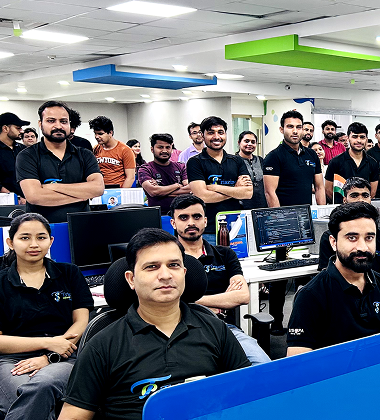
Meet the leadership and core team

Contact and locations

USA: Triazine Software LLC, 8 The Green, Ste A, Dover, DE 19901. +1 (347) 941-1655

India: Triazine Software Pvt. Ltd., B-28 & 29, Sector 58, Noida 201301. +91-120 4275378

Email: sales@triazinesoft.com

Serving enterprises across North America, Europe, the Middle East, Africa, and Asia Pacific.

Frequently Asked Questions

Intelligent document processing (IDP) uses OCR, machine learning, natural language processing and large language models to classify documents, extract the data inside them, validate it against business rules and send it to the systems that need it, with people reviewing only the documents the AI is unsure about.

Documents are captured from email, portals, scanners or phones, cleaned and split, classified by type, and their fields extracted. The data is checked against business rules and your master data; uncertain documents go to a reviewer, and clean data is posted to your ERP, SAP, CRM or EHS. Reviewer corrections are used to retrain the models.

OCR turns an image into text. IDP goes further: it understands what kind of document it is, finds the right fields wherever they appear, checks them against your rules, scores its own confidence, and sends the data where it needs to go. OCR is one component inside an IDP solution.

A document management system stores and retrieves files; it tells you where a document is, not what is inside it. IDP reads every document on the way in, extracts and validates its data, and moves that data into your business systems.

AI classifies documents, extracts fields and tables, reads handwriting, detects duplicates and fraud, checks data against rules, and, with large language models, summarizes contracts, extracts clauses and answers questions about document sets. The most reliable solutions combine trained extraction models with LLMs and keep a person in the loop for uncertain cases.

Scanned, photographed and digital documents, including invoices, purchase orders, claims, applications, identity documents, permits, inspection forms, bank statements, contracts, and letters. Trained models handle handwriting, stamps, tables, multi-page, and multilingual documents.

We measure field-level accuracy and straight-through processing rate (the share of documents that post with no human touch) on your own documents during the pilot, rather than quote a general figure. Accuracy improves after go-live as reviewer corrections are used to retrain the models.

Each field carries a confidence score. Anything below the threshold, or any document that breaks a business rule, goes to a reviewer, who sees the document and the extracted fields side by side and corrects only what is wrong.

Buy a platform when your documents are common types; volumes are high, and its licence model fits your budget over time. Build custom or combine a platform with custom models. When your documents are unusual, data must stay in your environment, or per-page licence costs grow faster than the value. We are vendor-neutral and recommend whichever fits each document family.

Azure AI Document Intelligence, AWS Textract, Google Document AI, UiPath, Automation Anywhere and Power Automate with AI Builder, as well as custom solutions built on open-source OCR, NLP and large language models.

Yes. Extracted data is validated against your master data and posted directly into ERP, SAP, CRM or EHS systems through APIs or connectors, so the next step in the process starts automatically.

A document assessment takes one to two weeks. A first document family usually goes live in 6 to 10 weeks, running in parallel with the current manual process during the pilot, and further document types are added in phases.

Usually, 50 to 200 real documents per document type, including the messy ones: poor scans, handwritten notes, and unusual layouts. Those edge cases matter more than clean examples.

Personal and financial data is detected and masked or redacted, documents are encrypted in transit and at rest, access is role-based and logged, retention periods are enforced, and documents stay in the regions you specify. Your documents are not used to train public models.

Yes. Triazine Software LLC is registered in Dover, Delaware, and you can reach the US team on +1 (347) 941-1655 or sales@triazinesoft.com. Delivery is run from our Noida, India centre with US clients such as Sound Royalties and TrueLook.

Get a Free Document Automation Assessment

Tell us which documents your team spends most of the time on. Share a sample set under NDA, and we will show you which fields can be extracted reliably, the expected straight-through processing rate and a pilot plan. We respond within 24 hours.

Request an Assessment

Prefer to talk? US: +1 (347) 941-1655 | India: +91-120 4275378 | sales@triazinesoft.com

Proven Excellence

Trusted by Enterprise Operations.

  • 11+ Years of Enterprise Delivery
  • CMMI Level 3 Certified
  • 100% Model, Code & Data Ownership
265,000+ Applications processed (TEFConnect)
150+ Engineers, designers and specialists
Triazine team
100% Duplicate applications caught by AI (TEFConnect)
500+ Solutions & Platforms