Loader

ENTERPRISE PREDICTIVE ANALYTICS SOLUTIONS & CONSULTING

Enterprise Predictive Analytics Solutions That Show What Happens Next

Triazine Software engineers enterprise predictive analytics solutions that forecast demand, score risk and surface emerging issues before they materialise, using the operational data your organisation already captures. Every engagement starts with the decisions that matter and the data behind them, and every model explains its predictions, runs inside your existing systems and remains fully owned by your organisation.

Most reporting explains what happened last month. By then the stock-out has occurred, the distributor has missed target or the incident has been recorded, although the signals were usually in the data weeks earlier. Predictive analytics monitors those signals continuously and converts them into ranked, explainable forecasts, early enough for accountable teams to act: this region will run short, this site carries the highest incident risk, this customer is likely to churn. We engineer predictive analytics for regulated, data-intensive operations in FMCG, energy, industrial safety, healthcare and the public sector, across the US, UK, UAE, Australia, South Africa and India.

Trusted by IGL, Godfrey Phillips, the Tony Elumelu Foundation, Aavantika Gas, Ministry of Defence, Toyota Boshoku, Schindler, University of Cambridge and other enterprises worldwide

Indraprastha Gas Limited Godfrey Phillips India Tony Elumelu Foundation Aavantika Gas Limited Ministry of Defence India Toyota Boshoku Schindler University of Cambridge Domino's Pizza Crompton NTPC India Meteorological Department

What Are Predictive Analytics Solutions?

Predictive analytics solutions use historical and live data, statistical methods and machine learning to estimate the probability of future outcomes, such as demand, risk, failures or customer behaviour, so teams can act before those outcomes happen.

Most reporting tells you what happened. Predictive analytics tells you what's about to happen. Feed it the historical record incidents, transactions, sales, sensor data, compliance events and AI predictive analytics learns the pattern behind past outcomes, then scores the probability of what comes next: which zone is likely to see an incident, which distributor is likely to underperform, which transaction is likely to be fraudulent, which SKU is about to run short.

That's what separates it from the reporting already running in your stack. A BI dashboard is a rear-view mirror accurate, but always describing yesterday. A static KPI report tells you a trend existed once the quarter that mattered has closed. Predictive analytics sits ahead of both: continuously scoring live and historical data against a trained model, and surfacing a ranked, explainable signal - this zone, this distributor, this transaction before the outcome has locked in. This is operational intelligence built to run ahead of events, not behind them.

It's built to inform a decision, keeping the judgment with a person. Our predictive analytics solutions keep the action with you they hand a person the probability, the driving factors, and the recommended priority, in time to intervene. Where you also want the system to act on that signal automatically triggering a workflow, routing an exception that's where predictive analytics and our agentic AI orchestration layer connect: prediction feeds the trigger, agents execute the response. In regulated, high-stakes operations, that combination a transparent, explainable forecast handed to an accountable person is the entire value proposition.

Business Outcomes

Earlier Visibility, Before the Incident

Earlier Visibility, Before the Incident

Models trained on historical safety and operational data forecast incident probability and flag high-risk zones, processes and time windows ahead of problems occurring, rather than after they're reported.

Demand and Risk You Can See Coming

Demand and Risk You Can See Coming

Forecasting models turn historical sales, seasonal signals and operational inputs into forward demand and risk projections. So stock, staffing and safety decisions are made ahead of the swing, rather than in reaction to it.

Targeted Intervention Over Blanket Monitoring

Targeted Intervention Over Blanket Monitoring

Risk is mapped to specific locations, teams, processes or transactions so resources go where the probability is highest, rather than spreading thin across everything equally.

Accuracy That Improves With Every Cycle

Accuracy That Improves With Every Cycle

Every deployed model is tracked for accuracy and drift, retrained as operating conditions change so the forecast a year in stays sharper than the forecast on day one.

Descriptive vs Diagnostic vs Predictive vs Prescriptive Analytics

Predictive analytics is one step on a maturity path. Most enterprises already run the first two; the value is in moving to the next.

Descriptive Diagnostic Predictive Prescriptive
Question it answers What happened? Why did it happen? What is likely to happen next? What should we do about it?
Example Sales fell 8% last quarter in the north region Two large distributors cut orders after a price change Five more distributors are likely to cut orders next month Offer a targeted scheme to those five before month end
Typical output Reports and dashboards Drill-downs and root-cause analysis Probabilities, forecasts and risk scores Recommended actions or automated responses
Typical tools BI and reporting BI and statistical analysis Machine learning and time-series models Optimization models and AI agents

We build all four layers. Our BI and reporting service covers descriptive and diagnostic analytics; this page covers predictive; and where a prediction should trigger an action, our agentic AI service delivers the prescriptive layer.

Your data is ready for predictive analytics when

  • You have at least 12 to 24 months of history for the outcome you want to predict, or enough events to learn from
  • The outcome is recorded consistently, such as orders, incidents, failures, payments or churn
  • The factors that drive it are captured somewhere, even if in different systems
  • Someone will act on the prediction, and you can say what that action is
  • The cost of being late, wrong or surprised is high enough to justify a model

Fix the foundation first when

  • Key data sits in spreadsheets or paper with no consistent history
  • The outcome itself is not recorded reliably
  • Nobody owns the decision the prediction would inform

If your data is not ready, our predictive analytics consulting team will say so, and help you build the data foundation first, often through our data warehouse and data governance practices.

Predictive Analytics Solutions and Services

Predictive Analytics Consulting and Data Readiness Assessment

A structured review of your decisions, data sources and data quality that ends with ranked use cases, the model approach for each, the data gaps to close, the expected business value and a roadmap from first pilot to production. Independent of any software vendor.

Custom Predictive Analytics Software Development

When off-the-shelf tools do not fit, we build custom predictive analytics software: forecasting dashboards, what-if scenario tools, real-time alerting and scoring APIs that bring predictions into the screens and systems your teams already use, with role-based access and audit trails.

Customer, Churn and Revenue Prediction

Models that predict which customers, dealers or distributors are likely to leave, buy again, respond to a scheme or pay late, plus customer lifetime value and lead scoring, so sales and service teams spend their time where it changes the outcome.

Predictive Analytics Engine

The core of what we build. Machine learning models trained on historical operational data to detect patterns, forecast the probability of future incidents, and identify high-risk locations and workflows converting large volumes of past operational records into a forward-looking, ranked signal through AI-powered predictive analytics.

Operational Trend Intelligence

Systems that track patterns across incidents, compliance events and performance metrics over time, surfacing the leading indicators manual reporting misses so management can intervene while a trend is still forming, ahead of it becoming a problem. This is AI operational intelligence applied to the metrics that matter most.

Risk Area Identification

Models that map operational risk to specific locations, processes, teams or time windows. Enables targeted intervention instead of blanket monitoring, reducing the resource cost of risk management while maintaining full coverage.

Demand Forecasting & Planning

Forecasting models for FMCG, distribution and supply chain operations predicting demand, stock requirements and distribution needs from historical sales data, seasonal signals and operational inputs, delivered as part of our broader predictive analytics services.

Anomaly & Fraud Detection

Models that detect unusual patterns in transaction, operational or behavioural data, flagging anomalies that indicate errors, fraud or compliance breaches across any operational environment, adapting beyond a single fixed rule set.

Custom Predictive Model Development

Templates rarely fit the outcome you're actually trying to forecast. As a predictive analytics consulting partner, we start with the outcome you're trying to forecast and the data you actually have, and build every model's features, training approach and validation around it working directly against your data and architecture from day one.

Predictive Model Integration with ERP/CRM/EHS/OPS

Deep integration into the ERP, CRM, EHS and operations platforms you already run models that read live and historical data and surface forecasts inside the systems your teams already use, keeping every insight inside the workflow instead of a parallel dashboard.

Predictive Model Lifecycle Management

Go-live is the starting point, with the real work continuing well beyond it. We track accuracy, drift and false-positive/false-negative rates on every deployed model, retraining as your operating conditions, seasons and data evolve. So performance stays reliable well beyond launch accuracy.

Ways to Start with Predictive Analytics

Most clients start with one decision and one model, prove the value, then scale.

01

Data readiness assessment

Best as the first step. A short, fixed-scope engagement that ends with ranked use cases, a data-gap list and a pilot plan for the top candidate.

02

Fixed-scope pilot model

Best for proving value. One outcome, one model, backtested on your history and run in shadow mode next to your current process, with success criteria agreed before building.

03

Production predictive programme

Best when the pilot has proven value. More models on a shared data pipeline, feature store and monitoring layer, so each new model costs less effort than the last.

04

Dedicated data science team

Best when you own the roadmap and need capacity. Data scientists, ML engineers, and data engineers work as an extension of your team. See hire data and AI specialists.

Our Predictive Analytics Process

Most first models reach a monitored pilot in 8 to 12 weeks, depending on how ready the data is.

  1. Goal mapping

    Define the outcome you're forecasting and the decision it needs to inform.

    Typical duration: 1 week

  2. Data access

    Connect the historical and live data sources the model needs to learn from.

    Typical duration: 1-2 weeks

  3. Feature engineering

    Identify and build the signals that actually predict the outcome, beyond simple correlation.

    Typical duration: 2-3 weeks

  4. Model development

    Train and tune models against your real operational data, going beyond a generic benchmark dataset.

    Typical duration: 2-4 weeks

  5. Validation

    Test forecast accuracy against held-out historical outcomes before anything touches a live decision.

    Typical duration: 1-2 weeks of backtesting on held-out history

  6. Guardrails

    Define confidence thresholds and escalation rules for what gets surfaced to a person, and when.

    Typical duration: inside validation

  7. Pilot deploy

    Release into production on a limited, closely monitored scope real data, real decisions, contained blast radius.

    Typical duration: 4-8 weeks in shadow mode alongside the current process

  8. Full-scale rollout

    Extend the model from pilot to every decision it was built to inform - full data history, full forecast cycle, no more holding back on live calls.

    Typical duration: phased

  9. Monitoring

    Track accuracy, drift and false-positive/false-negative rates on an ongoing basis, feeding what's learned back into goal mapping.

    Typical duration: ongoing

Explainable Predictions, Human-Owned Decisions

We use machine learning to forecast what is likely to happen, not to take decisions away from the people accountable for them. Our data scientists stay responsible for data quality, feature design, model choice, validation and monitoring, and your teams stay responsible for the decision. Every prediction ships with the factors behind it and a measure of confidence; every model is proven on your own history before it goes live, and the models, code and data stay fully owned by you.

01

Explainable by default

Each prediction shows the factors that pushed it up or down, using methods such as SHAP values, so a planner, safety officer or clinician can see why and defend the call.

02

Proven on your history first

Models are back tested on periods they never saw during training, then run in shadow mode next to your current process before anyone relies on them.

03

Confidence, not just a number

Forecasts come with ranges and confidence levels, and low-confidence cases are routed to a person instead of being presented as certain.

04

Bias and drift checks

We check models for unfair bias where people are affected, and monitor accuracy and data drift after go-live, retraining when conditions change.

Types of Predictive Models We Build

Model type Question it answers Example from our sectors
Classification Will it happen? Which distributors are likely to miss target next month
Regression How much? Next month's gas consumption per customer segment
Time-series forecasting What will the trend be like? Weekly SKU demand by region and season
Clustering and segmentation Which groups behave alike? Outlet or customer segments for schemes and service
Anomaly detection What looks wrong? Meter readings or claims that do not fit the pattern
Time-to-event (survival) When will it happen? Time until equipment failure or customer churn
Risk scoring How risky is it, and why? Incident risk score per site, shift or permit

Technology Stack & Platforms

We build predictive analytics software on the same machine learning and forecasting frameworks powering enterprise-grade operational intelligence today backed by infrastructure proven across 11+ years of mission-critical delivery.

Azure Data Factory

Apache Airflow

dbt

Kafka

Databricks

Snowflake

Azure

scikit-learn

XGBoost

LightGBM

statsmodels

Prophet

ARIMA

TensorFlow

PyTorch

MLflow

Google Vertex AI

Docker

REST APIs

Prometheus

Grafana

Power BI

SAP

We choose the stack that fits your data platform and team, and we keep models portable between clouds. In production for our clients: an Azure Fabric data warehouse with Power BI and AI verification on TEFConnect; Python, Django, MySQL and AWS behind IGL's meter reading and consumption analytics; and automated SFA reconciliation across 12.9M+ secondary sales transactions for Godfrey Phillips.

Data Quality, Security and Model Governance

A prediction is only as trustworthy as the data and the process behind it. These controls are designed from the first sprint. We build solutions that support your regulatory obligations; certification of your own organization stays with you and your auditor.

01

Data quality checks

Automated checks for missing, late, duplicate and out-of-range data run before every training and scoring cycle, so a broken feed is caught before it produces a bad forecast.

02

Privacy and data minimization

Only the fields a model needs are used, personal data is masked or aggregated where possible, and data stays in the regions you specify.

03

Role-based access and audit trails

Predictions and the data behind them are visible only to the roles that need them, and every model to run, override and decision is logged, as on IGL's photo-verified meter reading audit trail.

04

Model governance

Every model is versioned, documented with its purpose, data, limits and accuracy, and approved before release, so you always know which model produced which prediction.

05

Fairness checks

Where predictions affect people, such as patients, employees or applicants, we test unfair bias across groups and document the result before go-live.

06

Process standards and IP protection

CMMI Level 3 delivery governance and ISO 9001:2015 quality management standards. Architectures support GDPR, India's DPDP Act, Saudi PDPL and sector rules such as PNGRB, depending on geography. Your data is protected by our Non-Disclosure Agreement, and every model, feature and pipeline belongs to you.

Predictive Analytics Use Cases by Industry

Models create the most value where we already know the workflows, the data, and the decisions.

Predictive Analytics Case Studies

Machine learning models and real-time analytics in production, each architected, developed, implemented and supported by Triazine, plus the data foundations they build on.

01

Predictive Analytics Engine: Incident Probability and High-Risk Areas

AI capabilities: Machine learning, predictive analytics | Industry: Oil and gas, manufacturing | Services: Architecture, development, implementation, support and maintenance

Large volumes of historical incident and operational data hid patterns and correlations that were hard to detect manually, and much of the data was incomplete or inconsistent. Machine learning models now analyse that history to forecast the probability of incidents, highlight the locations and operations carrying the highest safety risk, and track trends in incidents, compliance and performance. Management receives actionable recommendations early enough to take preventive action and improve operational planning.

02

AI-Based Safety Monitoring: Predicting High-Risk Zones From Live Operations

AI capabilities: Computer vision, IoT sensors, real-time and predictive analytics | Industry: Industrial safety, manufacturing, oil and gas, logistics | Services: Architecture, development, implementation, support and maintenance

Manual monitoring, high accident rates, compliance gaps and the absence of real-time alerts left safety teams reacting after the fact. AI cameras and IoT sensors now detect PPE violations, unsafe actions, restricted-area breaches and hazards such as fire or spills, with real-time alerts by mobile, email, SMS and control-room dashboards. A central dashboard tracks violations, trends and compliance KPIs, audit-ready safety logs are generated automatically, and predictive analytics identifies high-risk zones so incidents can be prevented rather than recorded.

GPI

Godfrey Phillips: 12.9M+ Secondary Sales Transactions as a Forecasting Foundation

AI capabilities: Sales data platform, automated reconciliation | Industry: FMCG | Services: Architecture, development, implementation, support and maintenance

Sell-through data for 1,660 distributors across 26 states and 1,348 towns, with automated SFA reconciliation and an incentive scorecard, live since 2021 with 1,450+ users. This SKU-level history is the data foundation for distributor and demand forecasting.

What Clients Say About Working with Triazine

"Working with Triazine Software was an excellent experience. Their flexibility, responsiveness, and problem-solving expertise delivered every requirement, improved our app store ratings, enhanced customer experience... and significantly reduced the cost of resolving customer complaints."

Anadi Mishra

Chief General Manager, Indraprastha Gas Limited (India)

"We weren't looking for a traditional vendor. We wanted a true technology partner who could integrate with our team, understand our creators, and share our vision. Feels like one unified team collaborating across continents."

Chip Correra

Fractional CTO, Sound Royalties (United States)

"Triazine Software was recommended by IBM for our Pizza Online Ordering mobile app and the team stood up to our expectation... I highly recommend Triazine Software as dependable development partner for organization like us."

Sudhir Kumar Singh

Technical Program Manager, Domino's Pizza (India)

"Triazine delivered high-quality work on time, transforming our vision into a successful hybrid app. Their patience, responsiveness, flexibility across time zones, and commitment to implementing every feedback ensured outstanding results."

Roger Yarrow

CEO, TrueLook (United States)

"Triazine Software transformed Ticketkore with a powerful smart ticketing and reservation platform."

Khomotjo R. Lebepe

CEO, Ticketkore (South Africa)

Why Choose Triazine for Predictive Analytics Solutions?

01

Built on Data Platforms We Already Run

We have built the operational platforms that hold the data predictive models need, from 12.9M+ secondary sales transactions to meter data for 2M+ gas customers, so we understand the data before we model it.

02

Accuracy Reported on Your Data, Before Go-Live

Every model is back tested on your own history and run in shadow mode before release, and we report its accuracy against agreed targets, so you decide to go live on evidence, not promises.

03

Explainable Forecasts, Full Transparency

Every prediction comes with the driving factors behind it which signals pushed the risk score up, which pattern triggered the flag so decision-makers can trust and defend the priority they act on.

04

Predictive Analytics Solutions That Scale With Your Data

As your historical and live data grow, our models retrain and refine automatically, so forecast accuracy improves with volume instead of degrading under it.

05

Continuous Monitoring at Every Stage

We track accuracy, drift and false-positive/false-negative rates on every deployed model, retraining as your operating conditions, seasons and data evolve with our team staying engaged well beyond initial deployment.

06

Built for Regulated, High-Stakes Operations

Every forecast is transparent, auditable, and handed to an accountable person built to meet the governance standards of regulated, high-stakes enterprise environments.

07

Consulting First, Model Second

We start with the decision you need to improve and an honest data readiness check. If a simple rule, a report or better data will solve the problem, we will tell you before you invest in a model.

Who You Will Work with and Where We Are

Triazine Software was founded in 2015 by Abhinav Kumar and Vikash Srivastava to help enterprises replace fragmented systems and manual workarounds with platforms that run with clarity, governance and accountability. Abhinav, Co-Founder and Director, brings over two decades of enterprise software engineering experience and leads technology direction and delivery. Vikash, Co-Founder and Director, leads operations, client success and strategic partnerships.

Your predictive analytics team

Data consultants and business analysts who work with your decision owners

Data engineers who build the pipelines and data quality checks

Data scientists and ML engineers who build, validate and monitor the models

Application engineers who put predictions into your dashboards and systems

Meet the leadership and core team

Contact and locations

USA: Triazine Software LLC, 8 The Green, Ste A, Dover, DE 19901. +1 (347) 941-1655

India: Triazine Software Pvt. Ltd., B-28 & 29, Sector 58, Noida 201301. +91-120 4275378

Email: sales@triazinesoft.com

Serving enterprises across North America, Europe, the Middle East, Africa, and Asia Pacific.

Frequently Asked Questions

Predictive analytics solutions use historical and live data, statistical methods and machine learning to estimate the probability of future outcomes, such as demand, risk, equipment failure or customer churn, and deliver those forecasts to the people and systems that act on them.

It covers a review of the decisions you want to improve, a data readiness and quality assessment, use-case prioritization by business value, the model approach for each use case, a data-gap list, and a roadmap from first pilot to production. It is independent of any software vendor.

BI and reporting describe what happened and why. Predictive analytics estimates what is likely to happen next. Prescriptive analytics recommends or triggers what to do about it. We build all three and connect them so a prediction can lead to an action.

Buy when a packaged tool covers your use case and your data already lives in its ecosystem. Build custom when the prediction must use data from several of your systems, follow your business rules, appear inside your own applications, or meet strict security and ownership requirements. Many clients combine both.

Classification, regression, time-series forecasting, clustering and segmentation, anomaly detection, time-to-event models and risk scoring, chosen by the question you need answered rather than by fashion.

For most business forecasts, 12 to 24 months of consistent history is a good start, enough to capture seasonality. Rare events such as incidents or failures need enough examples to learn from. Our data readiness assessment tells you whether you have enough and what to collect if not.

Accuracy depends on the data and the problem, so we measure it on your own history rather than quote a general figure. Every model is backtested on periods it never saw in training, run in shadow mode next to your current process, and reported against agreed targets before go-live.

A data readiness assessment takes one to two weeks. A first model usually reaches a monitored pilot in 8 to 12 weeks, depending on how ready the data is, and then rolls out in phases.

Demand forecasting, churn and late-payment prediction, anomaly detection and risk scoring usually pay back first, because the data already exists and the action after the prediction is clear.

Yes. We deliver predictions through scoring APIs, scheduled jobs and embedded views, so forecasts and risk scores appear inside the systems your teams already use rather than in a separate tool.

Yes. Every prediction shows the factors that pushed it up or down, using methods such as SHAP values, along with a confidence level, so decision-makers can understand and defend the call.

We monitor accuracy and data drift continuously after go-live, alert when performance drops, and retrain models as seasons, products, regulations and operating conditions change.

Only the data a model needs is used, personal data is masked or aggregated where possible, access is role-based, data is encrypted in transit and at rest, and data stays in the regions you specify. Architectures support GDPR, India's DPDP Act and Saudi PDPL where they apply.

Yes. Where a prediction should lead straight to a response, such as raising a reorder, routing an inspection or alerting a supervisor, we connect it to workflows or to our agentic AI layer, with human approval where the stakes are high.

Yes. Triazine Software LLC is registered in Dover, Delaware, and you can reach the US team on +1 (347) 941-1655 or sales@triazinesoft.com. Delivery is run from our Noida, India centre with US clients such as Sound Royalties and TrueLook.

Get a Free Predictive Analytics Readiness Assessment

Tell us which decision you want to see coming earlier. We will respond within 24 hours to set up a short session, and you will leave with the use cases worth modelling first, an honest view of your data readiness and a pilot plan. Your data is protected by our Non-Disclosure Agreement.

Request an Assessment

Prefer to talk? US: +1 (347) 941-1655 | India: +91-120 4275378 | sales@triazinesoft.com

Proven Excellence

Trusted by Enterprise Operations.

  • 11+ Years of Enterprise Delivery
  • CMMI Level 3 Certified
  • 100% Model, Code & Data Ownership
500+ Solutions & Platforms
150+ engineers, designers and specialists
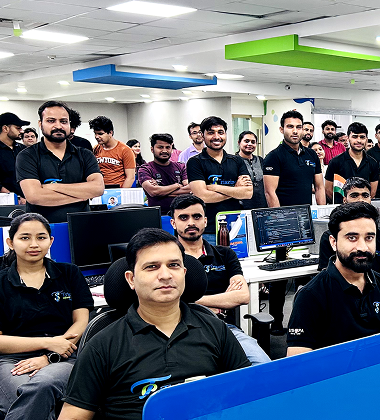
Triazine team
2M+ customers' meter data (IGL)
12.9M+ sales transactions on one platform (GPI)