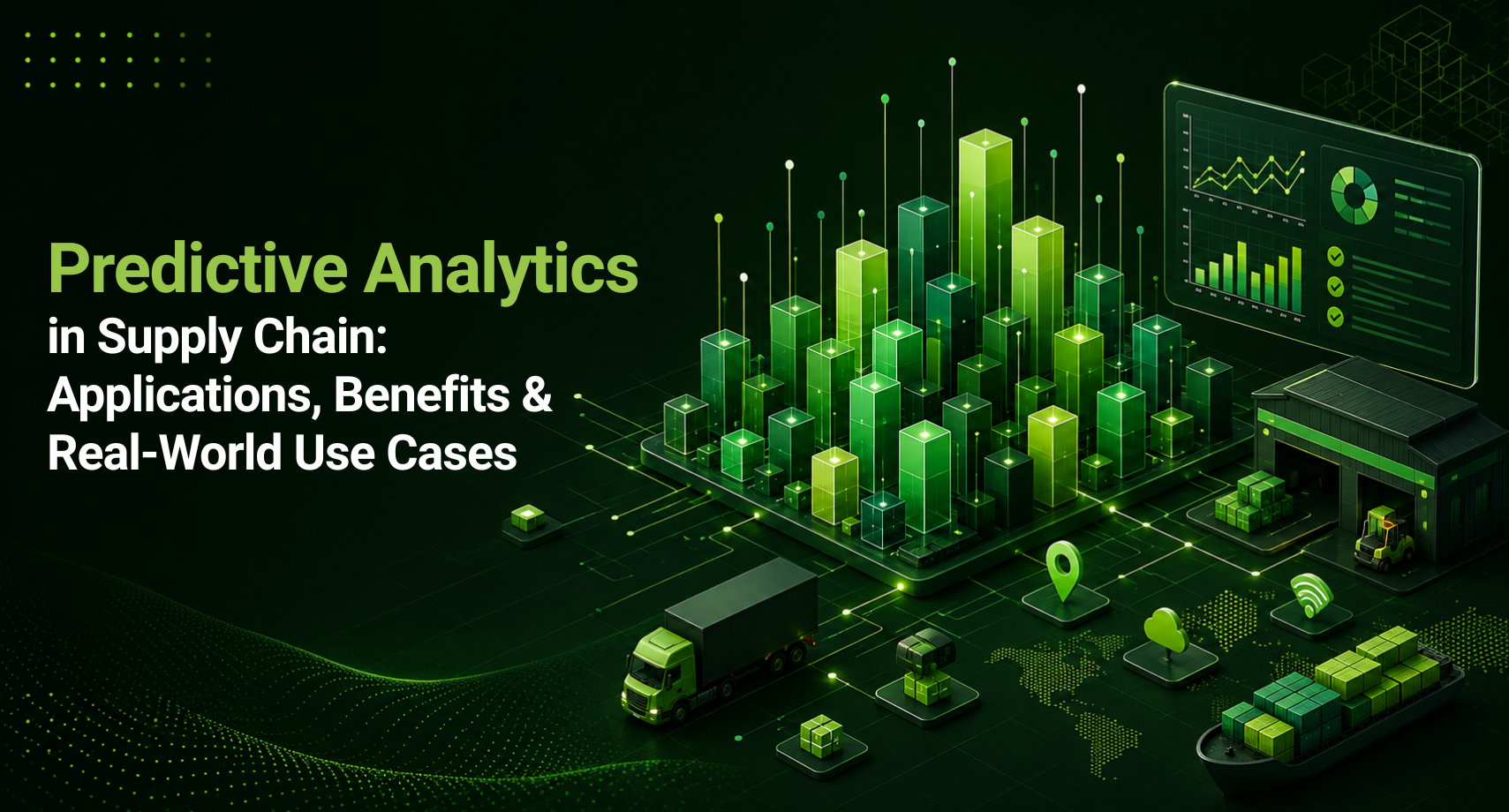
Predictive Analytics in Supply Chain: Applications, Benefits & Real-World Use Cases
Supply chains today rarely behave the way a spreadsheet expects them to. A supplier delay in one region, a sudden demand spike in another, a shipping route disrupted overnight, and the whole plan needs rewriting. This is exactly why more businesses are shifting from reactive firefighting to predictive analytics in supply chain operations, using data and machine learning to see problems before they happen instead of cleaning up after them.
In this guide, we'll break down what predictive analytics for supply chain actually means, how it works, where it's being applied across industries, and why it's quickly becoming a core part of modern supply chain management rather than a "nice-to-have" experiment.
What Are Predictive Analytics in Supply Chain Management?
Predictive analytics in supply chain management is the practice of using historical data, real-time inputs, statistical models, and machine learning algorithms to forecast future outcomes, demand levels, delivery delays, supplier risk, inventory needs, and pricing shifts, among others.
Instead of relying on gut instinct or last quarter's numbers alone, supply chain predictive analytics combines multiple data sources, sales history, supplier lead times, weather patterns, market indicators, and even social trends, to generate forecasts and risk scores that planners can act on immediately.
Put simply: descriptive analytics tells you what already happened, and predictive analytics tells you what is likely to happen next, along with a confidence level attached to it.
How Predictive Analytics Works in a Supply Chain
Most predictive supply chain analytics systems follow a similar four-stage process:
| Data Aggregation | Pulling data from ERPs, WMS, TMS, POS systems, supplier portals, and external sources like weather or commodity prices, usually centralized through a well-structured data warehouse. |
| Data Preparation | Cleaning, standardizing, and structuring this data so models can use it. This step alone determines whether the entire system succeeds or fails. |
| Modelling | Applying time-series forecasting, regression analysis, and machine learning to detect patterns and predict outcomes such as demand, lead-time variance, or disruption probability. |
| Insight Delivery | Turning model outputs into dashboards, alerts, or automated triggers that planners and procurement teams can act on in real time. |
This is also why data quality is repeatedly flagged as the single biggest factor separating successful predictive analytics supply chain projects from ones that stall in the pilot stage. A model is only as reliable as the data feeding it.
Predictive Analytics Supply Chain Applications
Here are the areas where predictive analytics for supply chain is delivering the most measurable impact:
1. Demand Forecasting
This remains the most common and highest-ROI use case. By analyzing historical sales, seasonality, promotions, and external signals, predictive models help businesses align production and stocking decisions with actual expected demand, reducing both overstock and stockouts.
2. Predictive Analytics for Inventory Optimization
Rather than relying on fixed reorder points, predictive models continuously recalculate optimal stock levels per SKU, per location, factoring in lead times and demand volatility. This frees up working capital that would otherwise sit idle in warehouses.
3. Predictive Analytics in Logistics and Route Planning
Predictive analytics in the logistics industry evaluates traffic patterns, fuel costs, weather, and carrier performance to recommend the fastest and most cost-efficient delivery routes, while also predicting ETA delays before they happen.
4. Supplier Risk and Performance Monitoring
Models track supplier delivery consistency, quality trends, and geopolitical or financial risk indicators, flagging underperforming or high-risk suppliers before a disruption actually occurs.
5. Supply Chain Visibility and Disruption Alerts
Connected sensors, IoT devices, and real-time tracking feed into predictive systems that give end-to-end supply chain visibility, allowing teams to anticipate bottlenecks rather than discover them after the fact.
6. Predictive Pricing
By analysing commodity trends, competitor pricing, and buying behaviour, businesses can dynamically adjust prices to protect margins during volatile markets.
7. Retail Supply Chain Predictive Analytics
Retailers use predictive models to forecast store-level and even hyperlocal demand, ensuring the right products are stocked at the right locations ahead of seasonal spikes, festivals, or promotional events.
8. Predictive Analytics in Healthcare Supply Chain
In healthcare, predictive analytics helps forecast demand for medicines, PPE, and critical equipment, reduces expiry-related wastage, and ensures hospitals and pharma distributors aren't caught off guard during demand surges.
Benefits of Supply Chain Predictive Analytics
The benefits of supply chain analytics go well beyond "better forecasts." Businesses adopting predictive models typically see improvements across several fronts:
- Reduced stockouts and overstocking through more accurate demand predictions
- Lower operating costs via optimized routes, staffing, and inventory carrying costs
- Improved on-time delivery performance by predicting delays before they escalate
- Stronger supplier relationships through data-backed performance monitoring
- Better cash flow management since capital isn't tied up in excess stock
- Faster, more confident decision-making across procurement, logistics, and planning teams
- Higher resilience against disruptions, economic shifts, geopolitical events, or sudden demand changes
These benefits compound over time: the cleaner data a system processes, the sharper its forecasts become, which is why early movers in predictive supply chain analytics tend to pull further ahead of competitors still relying on manual planning.
How Predictive Analytics Improves Supply Chain Decisions
At a decision-making level, predictive analytics shifts supply chain teams from asking "what happened?" to "what's likely to happen, and what should we do about it?" That shows up in very practical ways:
- Procurement teams get advance warning on supplier lead-time risk before placing orders
- Planners get demand signals weeks ahead instead of relying on last month's sales report
- Logistics teams get rerouting recommendations before a delay hits the customer
- Leadership gets scenario simulations to evaluate "what if" situations (a new supplier, a market expansion, a demand shock) before committing resources
This is the real value of supply chain predictive analytics: it doesn't just report numbers, it changes the timing of decisions from reactive to proactive.
Real-World Case Study Examples
A few well-known examples illustrate the impact of predictive analytics in supply chain industry settings:
- A major digital storage manufacturer used a dedicated predictive risk engine during the COVID-19 pandemic to identify and mitigate supply chain disruptions ahead of time, protecting operations from major losses.
- A global retail giant analyses transaction and search data at scale to identify top-selling products and fine-tune inventory and supply decisions across its stores.
- A leading global logistics company applies predictive models to forecast demand, cut waste, optimize delivery routes, and plan fleet maintenance more efficiently.
These examples show that predictive analytics supply chain case study results aren't limited to tech-first companies. Retail, logistics, manufacturing, and healthcare are all seeing tangible gains.
Challenges in Supply Chain Predictive Analytics (And How to Solve Them)
Predictive analytics isn't plug-and-play. Common hurdles include:
Data quality and fragmentation: Disconnected ERPs, WMS, and spreadsheets create inconsistent data. The fix is a proper data governance framework with regular audits and automated cleansing.
High implementation costs and unclear ROI: Rather than attempting a company-wide rollout, most successful projects start with one high-impact use case (like inventory optimization) and scale once value is proven.
Security and compliance risks: Since predictive systems pull data across multiple platforms, encryption, access controls, and compliance with data protection regulations are non-negotiable.
Change management: Even accurate predictions are useless if planners don't trust or use them. Embedding predictions directly into existing planner dashboards and workflows (instead of separate reports) significantly improves adoption.
Emerging Trends Shaping the Future of Predictive Supply Chain Analytics
- AI-driven demand sensing using real-time signals, including hyperlocal, store-level or zip-code-level forecasting
- IoT-enabled real-time visibility, feeding live data straight into predictive models
- Blockchain-backed traceability, strengthening data integrity across multi-party supply chains
- Sustainability-linked forecasting, helping businesses reduce waste and meet emerging regulatory requirements around sourcing and product traceability
- Prescriptive analytics: the next step beyond prediction, where systems don't just forecast an outcome but recommend the specific action to take
Frequently Asked Questions
What are predictive analytics in supply chain?
Predictive analytics in supply chain is the use of historical data, real-time inputs, and machine learning models to forecast future outcomes like demand, delivery delays, and supplier risk, so teams can plan instead of reacting after problems occur.
What are the main benefits of supply chain predictive analytics?
The core benefits include fewer stockouts and less overstocking, lower operating costs, better on-time delivery, stronger supplier relationships, improved cash flow, and faster, more confident decision-making across procurement and logistics teams.
How does predictive analytics improve supply chain decisions?
It shifts planning from reactive to proactive. Instead of responding to a delay or shortage after it happens, teams get advance signals on demand shifts, supplier risk, and potential disruptions, allowing them to act before the issue affects customers.
What are common use cases of predictive analytics in supply chain management?
The most common applications are demand forecasting, inventory optimization, logistics and route planning, supplier risk monitoring, predictive pricing, and real-time supply chain visibility across retail, healthcare, and manufacturing.
Is predictive analytics only useful for large enterprises?
No. While large enterprises were early adopters, small and mid-sized businesses increasingly use predictive analytics for inventory optimization and demand forecasting, since cloud-based tools have made these models more accessible and affordable than before.
How is predictive analytics different from traditional forecasting?
Traditional forecasting typically relies on historical averages and manual judgment. Predictive analytics combines multiple live and historical data sources with machine learning to continuously update forecasts, making it more accurate and responsive to real-time changes.
Final Thoughts
Predictive analytics in supply chain management is no longer an experimental technology reserved for large enterprises. It's becoming a baseline expectation for staying competitive in an unpredictable market. Whether the goal is sharper demand forecasting, smarter inventory optimization, safer supplier relationships, or more resilient logistics, the businesses that invest in predictive capabilities today are the ones best positioned to handle tomorrow's disruptions calmly instead of reactively.
If you're exploring how to bring predictive analytics into your own supply chain (from data integration to building custom forecasting models), Triazinesoft can help you design and implement a solution built around your specific operations and goals. You can also read our take on choosing the right AI development partner before you get started.



















































 Get free quote