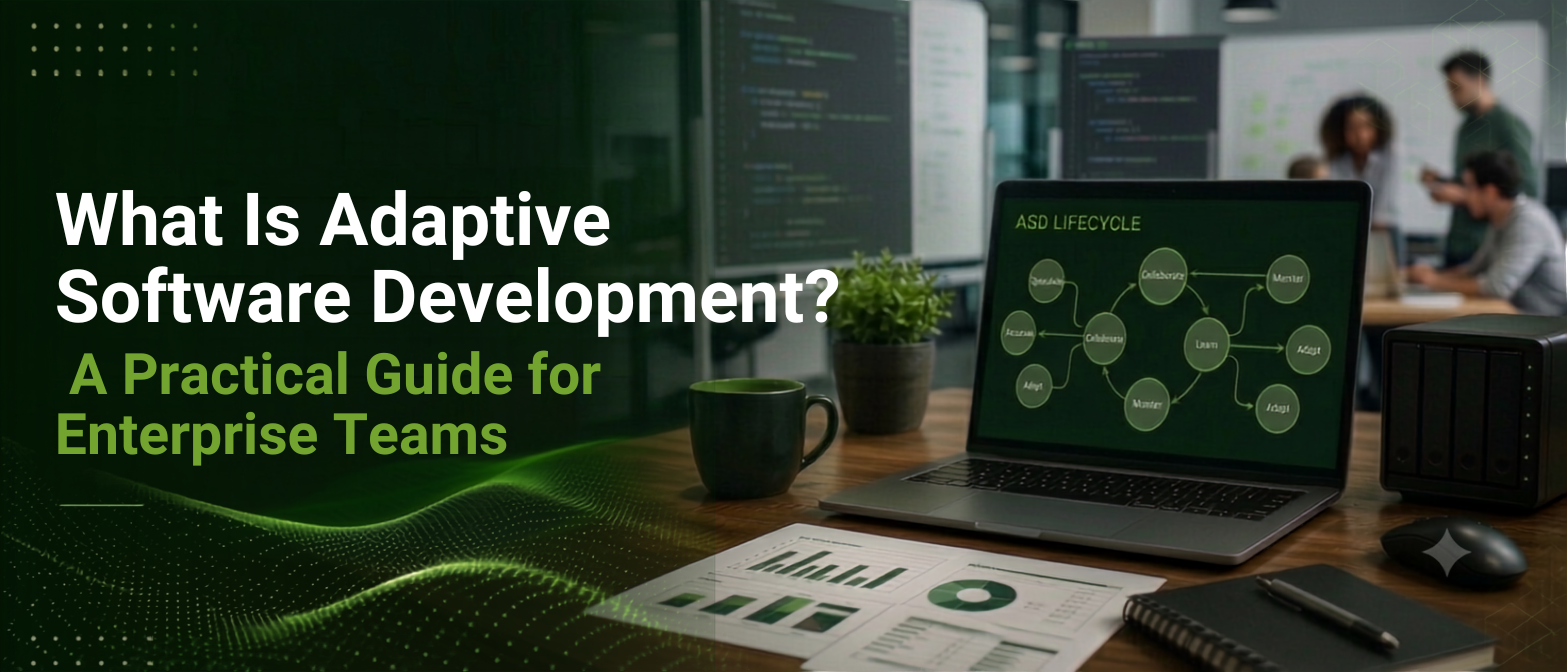
What Is Adaptive Software Development? A Practical Guide for Enterprise Teams
Requirements change mid-project. Stakeholders discover new priorities after development have already started. Technical constraints surface that nobody could have predicted at kickoff. Most software methodologies treat this as a problem to control. Adaptive Software Development treats it as the starting assumption.
What Is Adaptive Software Development (ASD)?
Adaptive Software Development (ASD) is a software development methodology built around the idea that requirements, priorities, and technical understanding will keep changing throughout a project, and that the process itself should be designed to absorb that change rather than resist it. Instead of locking down a fixed plan upfront, ASD organises work into repeating cycles of speculation, collaboration, and learning, with each cycle refining the product based on what the team discovered in the last one.
ASD sits within the broader agile product development family. It shares agile's emphasis on iteration, customer involvement, and working software over documentation, but it goes further by making learning itself a formal, tracked part of the development cycle rather than an informal byproduct of sprints.
Where ASD Came From
ASD was developed by Jim Highsmith and Sam Bayer in the mid-1990s, building on earlier work in Rapid Application Development (RAD). RAD had already shown that fast, iterative prototyping could outperform rigid, document-heavy planning for certain kinds of projects, but it did not provide a structured way to manage the more chaotic, high-uncertainty projects that were becoming common as software systems grew more complex.
Highsmith formalised the approach in his 1998 book, Adaptive Software Development: A Collaborative Approach to Managing Complex Systems. Three years later, he was one of the seventeen signatories of the Agile Manifesto, which cemented ASD's place as one of the founding methodologies of what the industry now calls "agile." Unlike Scrum or Extreme Programming, ASD was never built around a specific set of ceremonies or roles. It was built around a mindset: plans are hypotheses, not commitments, and every delivery cycle is a chance to test that hypothesis against reality.
The Three Phases of Adaptive Software Development
ASD replaces the traditional plan-build-test sequence with a repeating loop of three overlapping phases.
| Phase | Purpose | What the Team Produces |
| Speculate | Define the mission, known constraints, and near-term priorities without pretending every requirement is already known | A flexible release plan, a prioritized backlog, and a documented list of risks and assumptions |
| Collaborate | Cross-functional teams: developers, QA, product, design, and often the customer solve problems together in real time instead of handing work across silos | A working, testable increment of the product |
| Learn | Review what the increment revealed: which assumptions held, which did not, and what the team now understands that it did not before | Retrospective findings, updated priorities, and a revised plan for the next cycle |
Speculation replaces the traditional "planning" phase. The word is deliberate - Highsmith chose it to signal that any plan made under real uncertainty is, by definition, a speculation about the future, not a guarantee of it. Teams still set a mission and define release goals; they just do not pretend those goals are fixed.
Collaboration is the phase most organisations underestimate. It depends on trust between team members - the willingness to give direct feedback, admit gaps in understanding, and make decisions without waiting for a hierarchy to approve them. ASD treats this as a project risk in its own right, not a soft HR concern.
Learning closes the loop. It draws on technical reviews, stakeholder feedback, and project retrospectives, and it exists specifically to correct the overconfidence that creeps in when a team assumes it already understands a domain or a technology. Without a formal learning phase, teams tend to repeat the same misjudgments cycle after cycle.
Core Characteristics of ASD
Six attributes distinguish ASD from more rigid delivery models:
- Mission-driven, not spec-driven. Teams anchor to a business outcome rather than a fixed requirements document.
- Feature-based delivery. Software ships in functional increments that users can actually evaluate, not partial components.
- Time-boxed cycles. Each speculate-collaborate-learn loop runs on a fixed schedule, which forces prioritisation instead of scope creep.
- Risk-driven prioritisation. The riskiest or least-understood parts of the system get built and tested first, while assumptions are still cheap to correct.
- Decentralised decision-making. Teams closest to the problem make the call, rather than waiting in a top-down direction.
- Built-in adaptability. Change is not an exceptional process - it is the default expectation baked into every cycle.
ASD Compared to Other Development Methodologies
ASD is often confused with the other agile frameworks it influenced. The differences matter when choosing which one actually fits a given project.
| Methodology | Planning Style | Best Fit | How It Differs From ASD |
| ASD | Adaptive, revised every cycle | Complex, high-uncertainty projects | — |
| Scrum | Sprint-based, ceremony-driven | Teams that want defined roles and rituals | Scrum prescribes specific roles (Scrum Master, Product Owner) and events; ASD prescribes a mindset, not a structure |
| Kanban | Continuous flow, WIP limits | Steady, ongoing delivery pipelines | Kanban optimizes flow and throughput; ASD optimizes learning under uncertainty |
| DSDM | Time-boxed, fixed deadlines | Projects with a hard delivery date and active user involvement | DSDM fixes time and cost and flexes scope; ASD flexes scope, plan, and understanding of the problem itself |
| Extreme Programming (XP) | Engineering-practice-driven | Projects where code quality and continuous customer contact are the priority | XP focuses on technical practices such as pair programming and TDD; ASD focuses on the planning and learning cycle around any set of practices |
| Waterfall | Sequential, fixed upfront | Stable, well-defined, often regulated or contract-driven projects | Waterfall assumes requirements are knowable in advance; ASD assumes they are not |
The practical takeaway: ASD is not a replacement for Scrum or Kanban ceremonies - many teams run ASD's speculate-collaborate-learn rhythm using Scrum-style sprints or Kanban boards as the execution mechanism. ASD supplies the philosophy; the other frameworks often supply the tooling. Triazine's own agile product development practice blends this philosophy with structured sprint execution for enterprise clients.
Benefits of Adaptive Software Development
| Earlier risk detection | Because the riskiest assumptions get tested first, expensive mistakes surface in week two instead of month six. |
| Continuous stakeholder alignment | Regular collaboration cycles catch misaligned expectations before they compound. |
| Higher-quality outcomes for complex systems | Testing integrated throughout the process, rather than bolted on at the end, tends to produce fewer late-stage defects. |
| Team ownership and motivation | Decentralised decision-making gives teams real authority, which correlates with higher engagement on long, difficult projects. |
| Faster course correction | A three-week bad assumption is far cheaper to fix than a nine-month one. |
Challenges and Limitations of ASD
ASD is not free of trade-offs, and enterprises evaluating it should weigh these honestly:
| It demands a skilled, self-directed team | ASD's decentralised model assumes team members can make good decisions without close supervision - a weak or inexperienced team can drift without that structure. |
| Scope creep is a real risk | Flexibility without discipline can let "adaptive" become a euphemism for "unplanned." |
| It depends on active customer or stakeholder availability | ASD's feedback loop breaks down if the customer side is not consistently engaged. |
| Outcomes are harder to predict at the outset | Fixed-price, fixed-scope contracts are awkward to reconcile with a methodology built around evolving understanding. |
| It can carry higher short-term costs | Continuous testing and cross-functional collaboration take more coordination overhead than a single upfront planning phase. |
When Should an Enterprise Actually Use ASD?
ASD is a strong fit when:
- Requirements are genuinely likely to change during the project, not just theoretically possible to change.
- The technical approach carries real, unresolved risk - new technology, unfamiliar domain, or unproven integration.
- Stakeholders can commit to ongoing involvement, not just a kickoff meeting and a final sign-off
- The cost of being wrong early is lower than the cost of being wrong late.
- The organisation is building something new rather than replicating a known, well-understood system.
ASD is a poor fit when:
- The project is contractually fixed-scope, fixed-price, and fixed-timeline (Waterfall or DSDM manage that constraint better)
- Regulatory or compliance requirements demand complete upfront documentation before development begins.
- Stakeholders cannot realistically stay engaged throughout the project.
- The team lacks the experience to self-organise effectively.
How to Implement ASD in an Enterprise Setting
Adopting ASD inside an established enterprise - rather than a small product team - takes more than switching vocabulary. A practical rollout typically follows five steps:
| Start with one pilot project, not a company-wide mandate | Pick a project with genuine uncertainty (new market, unfamiliar tech stack) where adaptive planning has real value, rather than a stable, well-understood system where it adds overhead for no benefit. |
| Define the mission before the backlog | Get executive and stakeholder agreement on the business outcome first. The backlog can - and should - change; the mission should stay stable across the project. |
| Build cross-functional collaboration into the team structure, not just the meeting calendar | ASD's collaborative phase fails if developers, QA, and business stakeholders are organizationally siloed and only meet in status updates. |
| Formalise the learning phase with real retrospective cadence | Enterprises that skip this step tend to slide back into ad hoc agile - iterating without actually correcting course based on what was learned. |
| Track risk and assumptions as first-class backlog items | Not side conversations. Enterprises with mature project governance often need this made explicit so it survives audits and stakeholder reviews. |
Organisations weighing whether to build this capability in-house or bring in outside expertise can review Triazine's custom software development and software development consulting services for enterprise-grade delivery support.
Can Adaptive Software Development Work Inside a CMMI-Certified Delivery Process?
This is the question most ASD guides skip entirely, and it matters most to enterprises with formal quality frameworks already in place. The short answer: yes - ASD's principles and CMMI's process discipline are not in conflict, but they solve different problems and need to be reconciled deliberately.
CMMI focuses on process maturity and predictability: consistent, measurable, auditable delivery practices. ASD focuses on adaptive planning under uncertainty. The two can coexist when an organisation treats ASD's speculate-collaborate-learn cycle as the planning methodology operating inside a CMMI-governed process framework - the documentation, measurement, and quality gates that CMMI requires still happen, but the plan they document is understood to be a living one, revised each cycle rather than fixed at project start. In practice, this means:
- Risk logs and assumption tracking, already central to ASD, map directly onto CMMI's risk management process area.
- The learning phase's retrospective output feeds CMMI's process improvement requirements almost without modification.
- Speculation-phase planning artefacts still get documented and reviewed - they are just explicitly labelled as revisable, with a defined cadence for revision.
Enterprises that get this wrong usually do so by trying to run ASD without any of CMMI's process rigour, or by forcing ASD's incremental delivery into CMMI documentation built for a Waterfall mindset. Done deliberately, ASD gives CMMI-governed enterprise teams a way to handle genuine uncertainty without abandoning the audit trail and process consistency their industry or contracts require. Read more on why this certification matters for vendor selection in our CMMI appraisal guide.
Frequently Asked Questions
Q: Who created Adaptive Software Development?
ASD was created by Jim Highsmith and Sam Bayer in the mid-1990s, building on rapid application development concepts. Highsmith later became one of the original signatories of the Agile Manifesto.
Q: Is ASD the same as Agile?
No. Agile is the broader philosophy and set of values; ASD is one specific methodology within the agile family, alongside Scrum, Kanban, XP, and DSDM.
Q: Does ASD require short release cycles?
Not strictly, though most ASD teams use short cycles because faster feedback improves the quality of the learning phase. The core requirement is the speculate-collaborate-learn loop, not any specific cycle length.
Q: How much documentation does ASD need?
ASD does not reject documentation - it treats documentation as a tool for collaboration and decision-making rather than a compliance checkbox. Enterprises with formal governance requirements, like CMMI, typically keep full documentation but label planning artefacts as revisable.
Q: Is ASD suitable for fixed-price, fixed-scope contracts?
Generally, no. ASD assumes scope and understanding will evolve, which is difficult to reconcile with contracts that fix scope upfront. DSDM or a hybrid Waterfall-agile approach usually fits fixed-price work better.
The Bottom Line
Adaptive Software Development is not a lightweight alternative to "real" planning - it is a different theory of what planning is for. On complex, high-uncertainty projects, a plan that is honest about what it does not know tends to outperform a detailed plan built on assumptions nobody has tested yet. For enterprises weighing whether ASD fits their next project, the deciding factor usually is not team size or industry - it is how much genuine uncertainty the project actually carries, and whether the organisation's governance model can accommodate a plan that is designed to change.





























 Get free quote