What Is SDLC? 7 Phases, Models & Best Practices (2026)
What Is SDLC?
If you have searched for "what is SDLC" or "SDLC meaning," you have probably landed on pages that throw a wall of jargon at you without explaining why any of it matters. At its core, SDLC (Software Development Life Cycle) is a structured way to build software: plan first, understand the requirements, design the system, write the code, test it, release it, support it after launch, and eventually retire it when it is no longer needed.
SDLC stands for Software Development Life Cycle. It is a structured methodology that development teams use to plan, build, deliver, and maintain software systems. It may be executed sequentially, iteratively, incrementally, or through a hybrid approach depending on the model chosen.
In plain language: SDLC is the roadmap a development team follows, from the moment an idea is approved through development, operation, maintenance, and eventual retirement. Instead of jumping straight into coding, the work is broken into phases, each with its own goals, activities, and deliverables that feed into the next.
The term System Development Life Cycle is closely related and often used interchangeably. It applies the same underlying logic to broader systems, including hardware and business processes, not just software products.
The exact number and names of phases can vary depending on the organisation and the SDLC model used. Some teams combine steps, some split them further, and Agile teams often work through several phases in parallel rather than strictly in sequence. What stays consistent across most models is the underlying set of activities: understanding the requirement, designing a solution, building it, verifying it works, releasing it, and supporting it afterwards.
Skipping this structure is one of the more common ways projects end up over budget, past deadline, and full of unplanned defects. A well-defined SDLC does not guarantee a perfect project. Still, it can help teams reduce defects, improve delivery predictability, and control rework costs by surfacing issues earlier.
Why Is SDLC Important?
Software projects run into trouble for fairly predictable reasons: unclear requirements, scope creep, insufficient testing, and weak maintenance planning. A structured SDLC is one-way teams try to reduce these risks. It commonly helps in the following ways:
- Better software quality. Planning, design, and testing phases are built specifically to catch defects before they reach production, where they tend to be more expensive and disruptive to fix.
- More predictable costs and timelines. Clear documentation and defined deliverables at each phase can reduce guesswork and rework.
- Earlier risk identification. Risks that would otherwise surface late, such as security gaps, integration issues, or unrealistic scope, can often be caught and addressed earlier in the process.
- Improved transparency. Stakeholders can see what has been completed, what is in progress, and what is coming next.
- Stronger compliance posture. Documentation created at every phase can support audits, security reviews, and regulatory requirements.
- Higher customer satisfaction. The finished product is more likely to match what stakeholders and end users asked for, because requirements were captured and validated early.
None of this means SDLC eliminates risk. It means teams following a structured process generally have more visibility into where problems are likely to occur, and more opportunity to address them before they become expensive.
The Phases of the SDLC
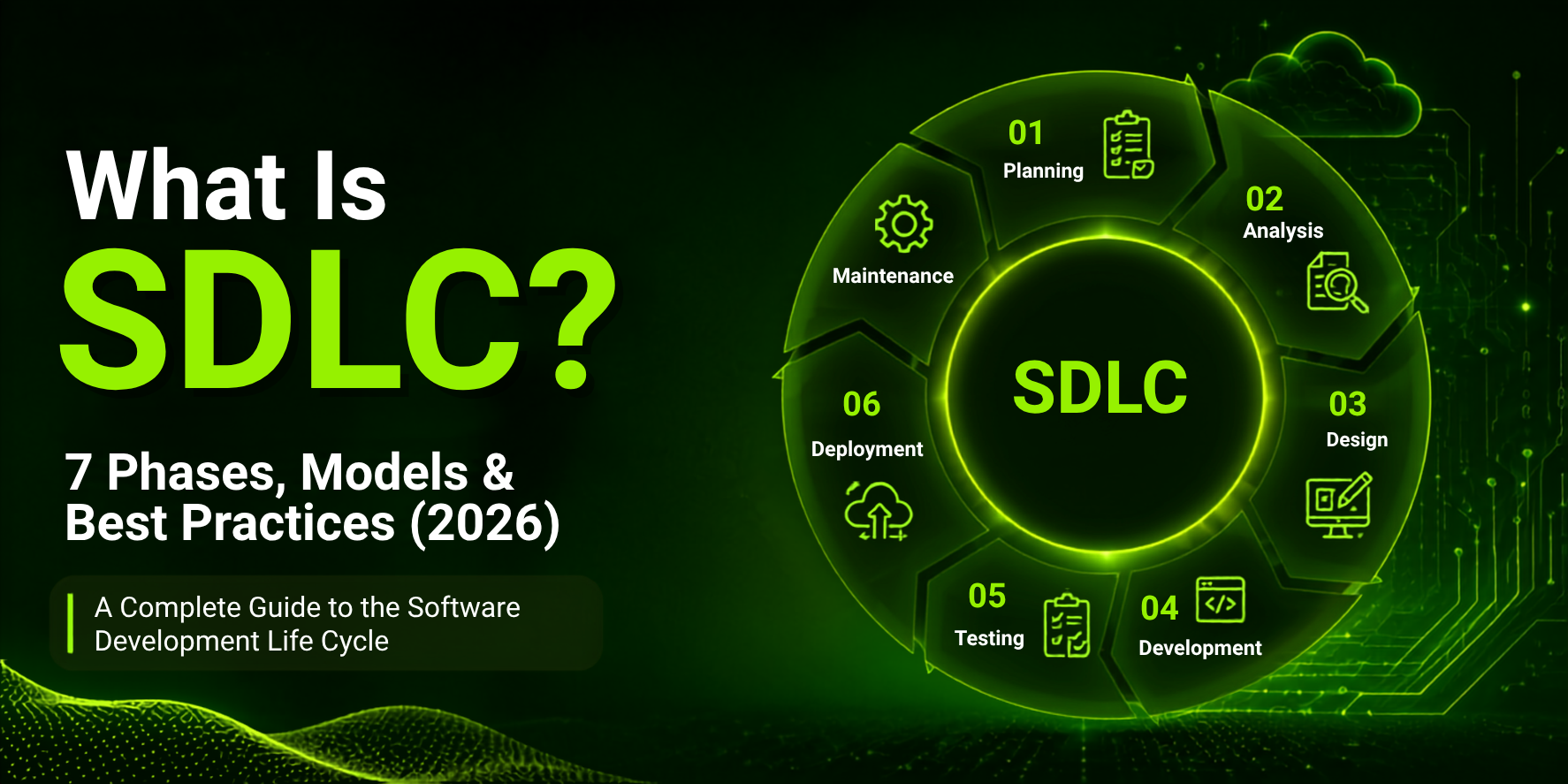
The version below uses a common seven-phase structure. Other organisations may use a different number of phases, different names, or add an explicit retirement or decommissioning stage at the end. The underlying activities are broadly similar even when the labels differ.
Planning → Analysis → Design → Development → Testing → Deployment → Maintenance → (cycle repeats, eventually followed by retirement)
| Phase | Key Activities | Typical Deliverable |
| 1. Planning | Define project scope, goals, feasibility, and resources; outline high-level requirements | Project charter, feasibility assessment, and initial roadmap |
| 2. Analysis | Gather, document, and validate detailed functional and technical requirements | Approved Software Requirement Specification (SRS) or product requirements document |
| 3. Design | Define system architecture, UI/UX, database, and security approach | Software Design Document (SDD) |
| 4. Development | Write and build the actual code | Functional software build |
| 5. Testing | Identify and fix defects, validate against requirements | Tested and stable release candidate |
| 6. Deployment | Release software to the production environment | Live software available to end users |
| 7. Maintenance | Ongoing bug fixes, patches, and enhancements | Continuously updated software |
Planning usually produces a project charter, feasibility assessment, initial roadmap, and high-level requirements outline. Work on the SRS can begin during Planning, but the fully detailed, approved version is generally associated with the Analysis phase, once requirements have been gathered and validated in depth.
1. Planning
The planning phase defines why the project exists. The team identifies the problem being solved, the users, the project scope, the rough timeline, and the resources needed. Weak planning often contributes to budget overruns later in a project, so it is worth involving business stakeholders and end users early rather than assuming what they need.
2. Analysis (Requirements Gathering)
Here the team moves from "why" to "what." This includes market research, feasibility checks, competitor review, and detailed functional and non-functional requirements gathering. By the end of this phase, the team should have a shared, documented, and approved understanding of the project's technical scope, constraints, and priorities, typically captured in the SRS or an equivalent requirements document.
3. Design
The design phase decides how the software will be built. Engineers define the system architecture, database schema, UI/UX flow, integrations, and security requirements. Many teams use threat modelling at this stage to identify potential security risks before writing code. This phase results in a Software Design Document (SDD), which developers use as a blueprint during coding. If your project needs dedicated design work, our UI/UX design and strategy team typically gets involved here.
4. Development (Coding)
This is where developers write the code, based on the SDD and SRS produced earlier. Teams select their tech stack, follow coding standards, build APIs, and often break work into smaller modules that can be developed and tested independently. Code reviews at this stage help catch issues before they reach formal testing. Our custom software development team is most actively involved during this phase, translating design documents into working, maintainable code.
5. Testing
The testing phase validates that the software works as intended. This typically includes unit testing, integration testing, system testing, performance testing, security testing, and user acceptance testing (UAT). Many SDLC models use continuous testing, meaning code is tested throughout the life cycle rather than only at the end, which can help catch defects earlier and reduce late-stage surprises before release. Structured QA at this stage, such as through our QA and testing services, is one approach teams use to reduce post-launch issues.
6. Deployment
Once tested, the software is released into the production environment. This may be a phased rollout, a limited beta release, or a full public launch. Good deployment planning includes a rollback strategy, user training where needed, and monitoring to catch issues that only appear at real-world scale.
7. Maintenance
SDLC does not end at launch. The maintenance phase covers bug fixes, performance tuning, security patches, and feature updates based on real usage and feedback. In DevOps-driven environments, maintenance is often not treated as a distinct phase. It runs continuously alongside development through CI/CD pipelines.
Optional Eighth Phase: Retirement or Decommissioning
Some SDLC frameworks explicitly include a retirement phase once software reaches end of life. This typically involves safely removing the software from production, migrating any remaining data, revoking access and credentials, and documenting the system's final state for audit or historical purposes. Even when a formal retirement phase is not defined, planning for it in advance tends to make eventual decommissioning far less risky.
Popular SDLC Models
An SDLC model determines how the phases above are organised and executed. The right choice depends on how stable your requirements are, how complex the project is, how experienced the team is, and how involved stakeholders want to be throughout development.
Waterfall Model
The most traditional SDLC model. Each phase is completed before the next begins, which gives a predictable, easy-to-manage process. Waterfall can suit projects with stable requirements, formal approvals, fixed contracts, or strict documentation needs. Project size alone does not determine whether it is appropriate; a small project with frequently changing requirements may still be a poor fit for Waterfall, and a large project with genuinely stable requirements can work well within it.
Agile
Agile is best described as a set of principles and practices for iterative software development, rather than a single fixed model. Work is broken into short cycles (often called sprints), with continuous testing and frequent stakeholder feedback built in throughout. Agile is widely used today because it adapts more easily to shifting requirements. Scrum and Kanban are two common frameworks used within or alongside Agile:
- Scrum organises work into fixed-length sprints and defines a Scrum Master accountability focused on helping the team and organisation use Scrum effectively, rather than directing the team's work.
- Kanban uses a continuous, visual workflow rather than fixed-length sprints, with work items moved across a board as they progress.
We cover this in more depth in our guide to adaptive software development.
V-Model (Verification and Validation Model)
The V-Model extends Waterfall's sequential structure by pairing development activities with corresponding verification and validation activities. Testing is planned early and mapped to requirements, design, implementation, and system-level acceptance, rather than being deferred to a single late-stage testing phase. This tends to catch defects earlier than pure Waterfall while keeping a broadly linear, less flexible structure. It suits projects with stable requirements where testing rigour and traceability matter.
Iterative Model
Development begins with an initial version, prototype, or limited feature set and improves through repeated cycles of feedback, testing, and refinement. This can work well when teams want to start building quickly and refine based on real feedback instead of waiting for a fully detailed upfront plan.
Spiral Model
Combines iterative development with structured risk analysis. Each cycle, or "spiral," includes planning, risk assessment, engineering, and evaluation, repeating until the product is complete. It suits large, complex, or high-risk projects where requirements are likely to change significantly during development.
Big Bang Model
An unstructured approach with minimal upfront planning, where development starts almost immediately based on rough ideas. It is generally not recommended for business-critical or complex systems, because formal risk management, documentation, and requirement analysis are limited or absent. It can occasionally suit very small, low-stakes prototypes where speed matters more than structure.
RAD (Rapid Application Development)
Prioritises fast prototyping and continuous user feedback over long planning cycles, letting teams adapt quickly to new requirements. It works well for projects that need quick delivery and have an actively engaged client throughout the process.
Lean Model
Borrows manufacturing principles to reduce waste at every step of the SDLC. Teams set short-term goals, prioritise fast feedback loops, and try to cut unnecessary process overhead while keeping quality standards intact.
Choosing the Right Model
A few practical questions can help narrow down which model fits a given project:
- How stable are the requirements? Well-defined, unlikely-to-change requirements can suit Waterfall or V-Model. Requirements expected to evolve tend to suit Agile, Iterative, or Spiral.
- How predictable is the work environment? Teams operating in highly regulated environments or with fixed compliance requirements often benefit from more structured approaches. Teams in fast-changing markets tend to benefit from iterative approaches such as Agile.
- How large and complex is the project? Larger, higher-risk projects generally justify more structured models like Spiral or V-Model, while smaller projects can often move faster with Agile, Iterative, or RAD.
- How involved can stakeholders be? Agile and RAD depend on frequent stakeholder input throughout the project. Waterfall often concentrates formal stakeholder approvals at defined milestones rather than continuous involvement.
- Does the project carry compliance requirements? A compliance-heavy project may need additional traceability, formal approvals, documentation, and testing controls layered on top of whichever delivery approach is chosen, including iterative ones like Agile.
SDLC vs. Agile vs. DevOps
This comparison confuses a lot of people searching for SDLC content, so it is worth clarifying directly:
- SDLC is the overall concept, the phases every software project moves through, regardless of methodology.
- Agile is an iterative approach to organising those phases into short cycles rather than long sequential stages, with Scrum and Kanban as common supporting frameworks.
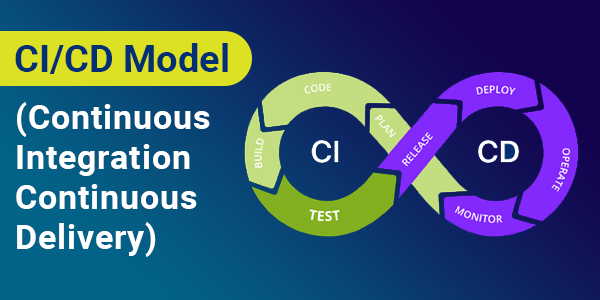
- DevOps complements Agile rather than being a step beyond it. Agile focuses mainly on iterative product development, while DevOps extends collaboration and automation across delivery and operations. DevOps promotes shared responsibility and closer collaboration between development and operations teams and relies heavily on CI/CD pipelines to automate testing and support repeatable delivery and deployment processes. We go into this in more detail in our CI/CD guide.
- Secure SDLC is the broader idea of embedding security activities across every phase of the life cycle, rather than testing for vulnerabilities only right before release. DevSecOps applies that same principle specifically within a DevOps operating model, automating security checks alongside CI/CD.
In short: SDLC is the "what," Waterfall/Agile/Spiral are ways of organising the "how," and DevOps adds continuous automation and closer team collaboration on top of whichever model is in use.
Secure SDLC
A Secure SDLC integrates appropriate security activities throughout the life cycle, for example, threat modelling during design, static and dynamic code analysis during development, dependency scanning during builds, and penetration testing before release, rather than testing for vulnerabilities only right before release. Organisations in regulated industries often align this with published frameworks such as NIST's Secure Software Development Framework (SSDF), which outlines recommended practices for reducing vulnerabilities across the development life cycle, or the OWASP Software Assurance Maturity Model (SAMM).
Treating security as a late-stage checklist item is generally considered riskier and more expensive than building it in from planning onward, since architectural or design-level security gaps tend to be harder and costlier to fix once development is complete. When a team runs Secure SDLC practices within a DevOps pipeline, that combination is commonly called DevSecOps. Our DevSecOps services are built around this same principle.
SDLC Best Practices
Teams that get consistent results from their SDLC tend to follow a few core practices:
- Invest real time in planning and requirements gathering. Poorly defined requirements are a frequently cited contributor to blown budgets and delayed releases.
- Document every phase. Clear documentation can make onboarding, audits, and future maintenance considerably easier.
- Test continuously, not only at the end. Catching defects earlier is generally less expensive than fixing them after deployment.
- Build security in from day one. Treat security as part of design, coding, and testing, not a separate step added at the end.
- Manage scope deliberately. Stick to what was agreed during planning, and route new requests through a formal change process instead of quietly expanding scope.
- Match the SDLC model to the project. Consider requirement stability, compliance needs, and stakeholder availability rather than defaulting to one model for every project.
- Automate where it makes sense. CI/CD pipelines, automated testing, and code quality tools can reduce manual error and help streamline delivery.
- Plan for maintenance and eventual retirement from the outset. Budget time and resources for post-launch fixes, updates, and, eventually, safe decommissioning.
Common Challenges in the SDLC
- Scope creep. Requirements expanding beyond the original plan can quietly extend timelines and inflate budgets.
- Poorly defined requirements. Skipping thorough upfront analysis is a commonly cited cause of wasted development cycles and later rework.
- Testing trade-offs. Too little testing risks production defects; excessive testing can delay releases without adding proportional value.
- Security and maintenance risk. Weak update processes and supply-chain security gaps have been linked to real-world software attacks, which is one reason ongoing maintenance and monitoring matter as much as the initial build.
- Legacy system constraints. Older systems built without modern SDLC discipline can be harder and riskier to extend, often triggering a legacy application modernisation initiative.
Popular SDLC Tools
Teams commonly use a mix of tools across the life cycle:
- Project and task management: Jira, Azure DevOps, Trello
- Version control and collaboration: GitHub, GitLab, Bitbucket
- Code quality and security: SonarQube, Snyk
- CI/CD and automation: Jenkins, GitLab CI/CD, Azure Pipelines
- Testing: Selenium, Postman, JUnit
- Infrastructure and deployment: Docker, Kubernetes, Ansible
- Documentation and collaboration: Confluence, Notion
The right combination depends on the team's stack, size, and process maturity. Tooling supports a disciplined SDLC but does not replace one.
Frequently Asked Questions
What does SDLC stand for? SDLC stands for Software Development Life Cycle, the structured process used to plan, build, test, deploy, and maintain software.
What are the phases of SDLC? Most SDLC models cover Planning, Analysis, Design, Development, Testing, Deployment, and Maintenance, with some frameworks adding an explicit retirement or decommissioning phase. The exact names and number of phases can vary by organisation and methodology.
What is the best SDLC model? There is no single best model. It depends on the project. Agile tends to suit projects with evolving requirements, Waterfall suits stable, well-defined projects, and the V-Model fits work where testing rigour and traceability matter, such as high-risk or compliance-heavy projects.
What is the difference between SDLC and Agile? SDLC is the overall life cycle concept. Agile is an iterative approach that organises SDLC phases into short cycles rather than long, sequential stages.
What is Secure SDLC (SSDLC)? A Secure SDLC integrates appropriate security activities throughout the life cycle, for example, threat modelling during design, code scanning during development, dependency analysis during builds, and penetration testing before release, rather than testing for vulnerabilities only at the end. DevSecOps applies this same principle within a DevOps operating model.
Is SDLC only for software, or does it apply to systems too? System Development Life Cycle applies similar principles to broader systems, including hardware and business processes, while Software Development Life Cycle is specific to software products.
How is DevOps different from SDLC? DevOps is not a replacement for SDLC. It is an approach that runs SDLC phases more continuously and automatically, promoting closer collaboration between development and operations rather than treating them as separate, sequential stages.
Does SDLC include software retirement? Not always as a formally named phase, but the underlying idea- planning for how software will eventually be decommissioned, migrated, or replaced- is considered part of a complete life cycle view even when it is not listed as one of the core phases.
Conclusion
The software development life cycle gives teams a repeatable way to turn an idea into working software while managing cost, quality, and risk along the way. Whether your team follows Agile, Waterfall, V-Model, or a DevOps-driven continuous pipeline, understanding the core SDLC phases is foundational for developers, project managers, and business stakeholders alike.
At Triazine Software, we help businesses build reliable, scalable software by following a disciplined SDLC process, from requirements gathering and design through development, QA, deployment, and long-term maintenance. If you are planning a new software project, contact our team to discuss your requirements.













































 Get free quote