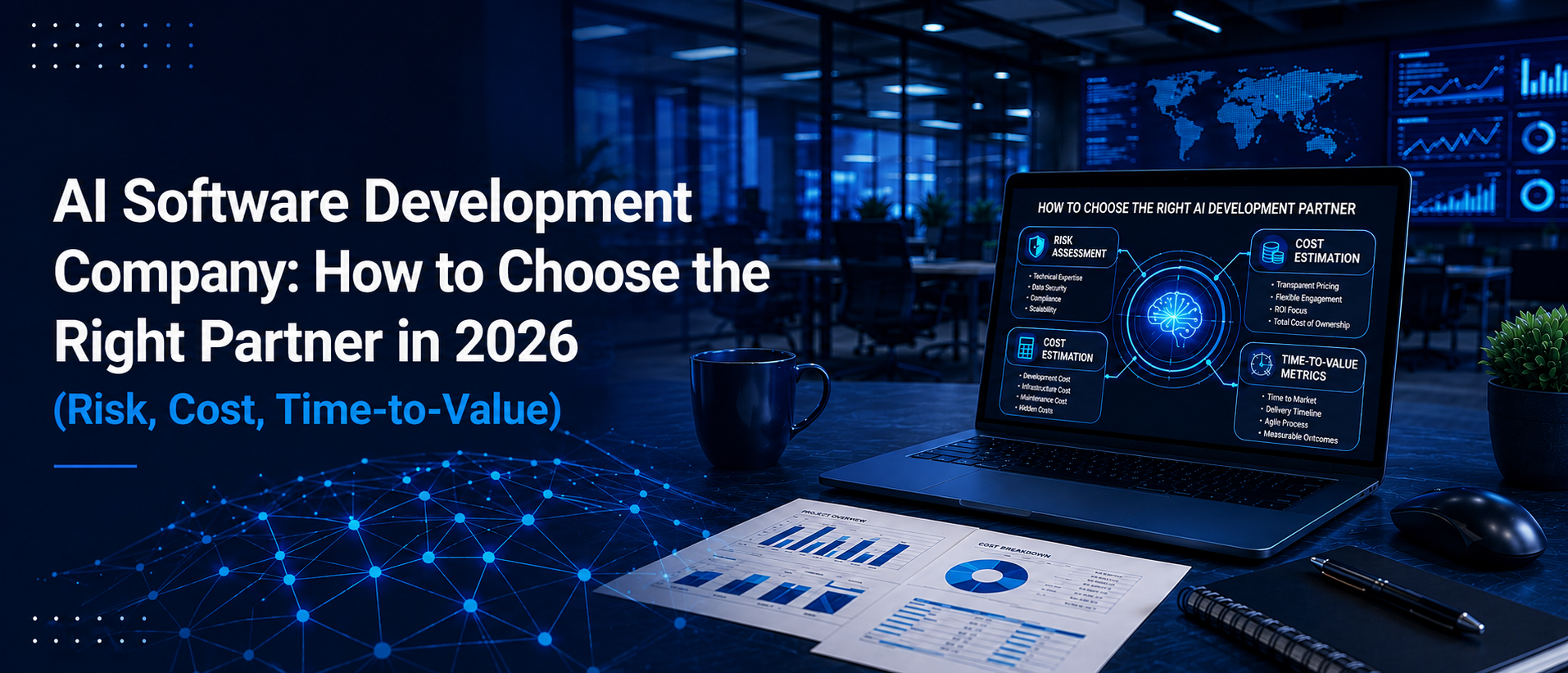
AI Software Development Company: How to Choose the Right Partner in 2026
As enterprises rush to add AI, the wrong partner can waste months and a significant part of the budget before anyone notices the project has stalled. Every enterprise roadmap now has an AI line item, but very few internal teams have the bandwidth to build, train, and maintain production-grade AI systems on their own. That gap is exactly why the market for AI software development companies has exploded and why picking the wrong one is now a far more expensive mistake than it used to be. This guide walks through what these companies actually deliver, how to tell a strong partner from a risky one, and exactly what to check before signing anything.
This is written for decision-makers who are past the "should we do AI" stage and are now evaluating who should build it.
What an AI Software Development Company Actually Does
An AI software development company is not a marketing agency that bolts a chatbot onto your website, and it's not a generic IT vendor that added "AI" to its services page after ChatGPT launched. A genuine AI development company builds custom systems around your data, your workflows, and your existing tech stack. That typically spans:
| AI strategy and consulting | Auditing your data readiness, defining feasible use cases, and estimating ROI before any code is written. |
| Custom model development | Building or fine-tuning machine learning and deep learning models instead of only wrapping third-party APIs. |
| LLM and generative AI integration | Retrieval-augmented generation (RAG), agentic workflows, and enterprise copilots built on top of foundation models. |
| Computer vision and NLP | Document processing, defect detection, sentiment analysis, and similar domain-specific applications. |
| MLOps and lifecycle management | Deployment pipelines, monitoring, retraining, and drift detection so the model keeps performing after launch. |
| Systems integration | Connecting AI outputs into the ERPs, CRMs, and legacy platforms your business already runs on. |
| Regulatory and compliance handling | Building data pipelines and audit trails that hold up under frameworks like HIPAA, PCI DSS, or GDPR, depending on your industry. This is closely tied to broader VAPT and security practices that any enterprise software vendor should already have in place. |
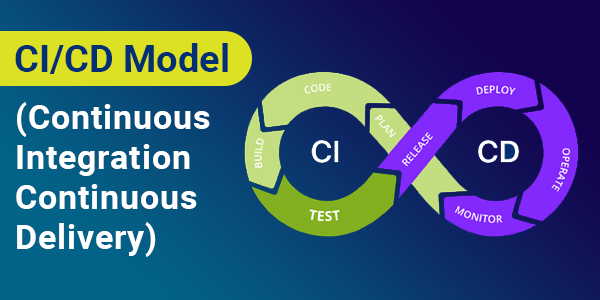
What you should walk away with, deliverable by deliverable: a data-readiness assessment report, an owned model or codebase (not a black box), CI/CD pipelines for retraining, and monitoring dashboards for drift and performance. If a vendor's pitch stops at "we can add a chatbot," that's a signal you're talking to an integrator, not a full enterprise AI partner.
AI Development Services to Look For
Not every AI development company offers the full stack. Use this as a checklist for what a genuinely capable partner should be able to deliver:
| AI Consulting | Feasibility studies, use-case prioritisation, and ROI modelling before any build starts. See how this fits into a broader software development consulting engagement. |
| Machine Learning Development | Custom model training and fine-tuning for prediction, classification, and scoring problems. |
| Generative AI & LLM Integration | RAG pipelines, enterprise copilots, and agentic workflows built on foundation models, often layered onto AI automation work already underway. |
| AI Agents & Process Automation | Autonomous or semi-autonomous agents that execute multi-step tasks, closely related to RPA for rules-based workflows. |
| Natural Language Processing (NLP) | Document parsing, sentiment analysis, classification, and search over unstructured text. |
| Computer Vision | Defect detection, image classification, and visual quality checks for physical operations. |
| Recommendation Engines | Personalisation and ranking systems built on behavioural and transactional data. |
| Predictive Analytics & BI | Forecasting and trend analysis, usually delivered alongside BI and reporting services. |
| AI Integration | Wiring model outputs into the ERPs, CRMs, and custom software systems you already run. |
Industries We Build AI Solutions For
AI use cases differ sharply by industry, and a partner's prior domain exposure often matters more than their general AI credentials. Common areas include:
- Healthcare: clinical documentation support, compliance monitoring, and operational forecasting.
- Oil & Gas and Utilities: predictive maintenance, safety monitoring, and meter or asset data analysis.
- Retail & Ecommerce: recommendation engines, demand forecasting, and inventory optimisation.
- Logistics: route optimisation, delay prediction, and automated exception handling.
- FMCG: demand planning, distribution analytics, and supply chain visibility.
- Public Sector & Utilities: citizen service automation and compliance-heavy reporting.
- E-learning: adaptive learning paths and content recommendation.
If your industry isn't listed, ask any shortlisted vendor for adjacent-industry case studies rather than assuming general AI experience will transfer cleanly.
Custom AI Development vs. AI SaaS vs. Integrators: Which Do You Actually Need?
These categories get used interchangeably in search results, but they solve different problems.
Choose a custom AI development company if your use case is a competitive differentiator, your data doesn't fit an off-the-shelf schema, or you need full ownership of the model and pipeline once the engagement ends.
Choose an AI SaaS product if your problem is common and well-defined. A configurable AI SaaS product used by multiple clients will get you live faster and cheaper, at the cost of less architectural control and more vendor lock-in over time.
Choose an integrator or AI development solutions provider if you need to assemble existing platforms quickly and don't need bespoke model training; this is often the fastest path to a working proof of concept, but the ceiling on customisation is lower.
None of these is universally "better." The right choice depends on whether the AI use case is core to your product or a supporting capability.
| Feature | Custom AI Company | AI SaaS | Integrator |
| Ownership of model/code | Full | None | Partial |
| Customization | High | Low | Medium |
| Time to launch | Medium | Fast | Fast |
| Scalability to your data | High | Medium | Medium |
| Cost upfront | Higher | Lower | Medium |
| Long-term lock-in risk | Low | High | Medium |
The AI Development Process, Step by Step
A capable AI development company should be able to walk you through a process that looks roughly like this, regardless of how they brand it internally:
- Discovery: understanding the business problem and constraints before touching data.
- Data Assessment: auditing what data exists, its quality, and what's missing.
- Architecture: designing the model approach, infrastructure, and integration points, often as part of a cloud development and migration plan.
- Model Development: building, training, and tuning the model against real data.
- Testing: validating accuracy, bias, and edge cases before anything touches production.
- Deployment: shipping into your live environment with rollback and monitoring in place.
- Monitoring: ongoing maintenance and support to catch drift and retrain as needed.
Vendors who skip straight from "discovery" to "deployment" in their pitch are usually skipping the two steps data assessment and testing that determine whether the project actually works.
Evaluation Checklist: What to Ask Every Company on Your Shortlist
Run each candidate through the same set of questions so comparisons stay objective rather than based on whoever presented best.
Must-ask:
| Technical depth beyond API wrapping | Ask: Can you show a codebase or model-training pipeline from a past project, not just a demo? |
| Relevant industry experience | Ask: Can you share non-confidential case studies or references from our industry? |
| Post-launch ownership and monitoring | Ask: Who owns model monitoring and retraining after go-live, and what does that cost annually? |
| Data security and governance | Ask: How do you handle data isolation, access control, and model auditability within frameworks such as SOC 2 or ISO 27001? Worth reading alongside a broader look at VAPT and organisational security. |
| Transparent, scope-based pricing | Ask: Can you break the estimate down by phase data engineering, model development, integration, and maintenance instead of one bundled number? |
Nice-to-ask:
| Engagement model flexibility | Fixed-scope, agile product builds vs. an embedded, dedicated team that scales with your priorities — can they offer both? |
| Generative AI vs. machine learning experience | Building a copilot on a foundation model and building a predictive maintenance model from sensor data are different skill sets; which has the team actually shipped? |
| Integration approach | Do they design around your existing stack, or push you toward replacing it? |
How Much Does AI Software Development Cost?
There's no single number that applies across projects, but the main cost drivers are consistent:
- Use-case complexity: a classification model is far cheaper to build than a multi-agent generative AI system.
- Data quality and volume: messy, siloed, or sparse data adds high data-engineering cost before model training even starts.
- Integrations required: connecting into existing ERPs, CRMs, or legacy systems usually costs more than the model itself.
- Team composition: whether the project needs a small embedded team or dedicated specialists across data engineering, ML, and MLOps.
- Model training approach: fine-tuning an existing foundation model is generally cheaper than training a model from scratch.
- Cloud infrastructure: compute costs for training and inference, especially for anything running on cloud infrastructure at scale.
- Ongoing maintenance: monitoring, retraining, and support after launch, which is recurring, not one-time.
Treat any quote that doesn't break these out separately as incomplete; see the pricing-transparency point in the checklist above.
Common Mistakes Businesses Make When Choosing an AI Partner
| Treating every vendor conversation as a pure cost comparison | The cheapest bid rarely accounts for the data engineering work AI projects actually require. A common pattern: a fixed-price quote looks attractive until the vendor discovers the data isn't clean, and the "custom AI project" turns into months of unbudgeted data cleanup before any model training starts. |
| Skipping the data-readiness assessment | A model is only as good as the data behind it; a serious partner will insist on auditing this before committing to a timeline. |
| Assuming generative AI experience equals machine learning experience | Ask specifically which one the team has done, not just which one they mention most in the pitch. |
| Ignoring maintenance costs | Budgeting only for the build phase, and not the ongoing MLOps work, is one of the most common reasons AI projects stall after launch. |
| Not asking for ownership terms upfront | Clarify early who owns the trained model, the code, and the data pipeline once the engagement ends. |
Why This Decision Deserves More Time Than a Typical Vendor Selection
Unlike a typical software build, an AI system's value compounds or decays after launch depending on how well it's maintained. Finding the right development partner for your situation isn't about the biggest name; it's about the team that will still be accountable for the system's performance six months after go-live, not just on demo day.
About Triazine Software
Triazine Software builds AI capability as part of a broader enterprise software practice, not as a bolt-on service. Recent work spans predictive analytics and BI inside compliance-heavy platforms across regulated industries, document intelligence for regulated workflows, and automation layered onto legacy enterprise systems.
| Speciality | Custom AI and ML development integrated into existing enterprise systems, not standalone pilots. |
| Typical engagement | Scoped data-readiness assessment first, followed by a phased build on cloud infrastructure, with monitoring and retraining built in from day one. |
| Standout example | For PrimeEHS, an enterprise EHS management platform, Triazine embedded predictive analytics and automation directly into the existing system, enabling teams to analyse compliance trends and streamline operational workflows without bolting on a separate tool. The work drew on the same BI and reporting and industry-specific experience described above, built for the platform's existing architecture rather than a rip-and-replace. |
Frequently Asked Questions
Q: What does an AI software development company do differently from a regular software vendor?
It builds systems that learn from data and improve over time, which requires expertise in machine learning, data engineering, and model lifecycle management that traditional software development doesn't typically require.
Q: How long does it take to build a custom AI solution?
Timelines vary widely based on data readiness and use-case complexity, but most custom AI projects run from a few months for a focused proof of concept to a year or more for enterprise-wide deployment with full MLOps in place.
Q: Is it better to build custom AI or use an AI SaaS product?
Custom development makes sense when AI is a core differentiator or your use case is too specific for off-the-shelf tools. AI SaaS products are usually faster and cheaper for common, well-defined problems.
Q: What makes a company one of the top AI development companies rather than just another vendor?
A track record of production systems still running and being maintained after launch, transparent data-governance practices, and the ability to explain technical tradeoffs in plain business terms, not award badges or marketing copy alone.
Q: Do I need a dedicated data science team, or can the development company handle that too?
Most established AI development solutions providers include data scientists and ML engineers as part of the delivery team, so you don't need to hire and manage that expertise in-house.
Q: How do you budget for ongoing model maintenance?
As a rough planning number, ongoing monitoring and retraining typically runs 15–30% of the initial project cost annually, depending on how fast your underlying data changes. Confirm this figure directly with any vendor rather than assuming it's included.































 Get free quote