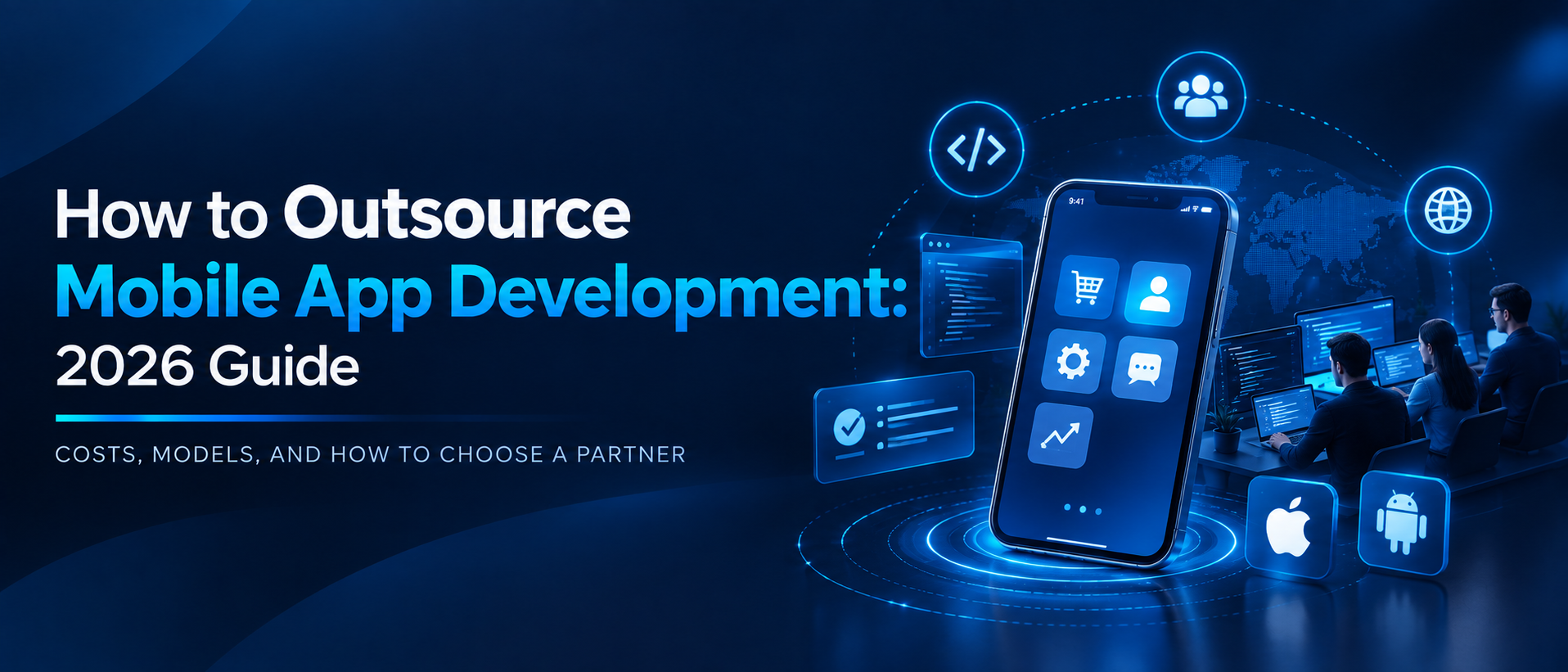
How to Outsource Mobile App Development in 2026: Costs, Models, and How to Choose a Partner
Most companies that outsource mobile app development are not trying to save money on developer salaries. They are trying to ship a working product without spending six months building an internal team first. That distinction matters, because it changes what "outsourcing done right" actually looks like.
Mobile development outsourcing has moved well past the old image of a cheap offshore coding shop. In 2026, application development outsourcing is a mainstream delivery model used by startups, mid-market companies, and large enterprises alike, and the reasons for choosing it have shifted from pure cost-cutting to speed, specialized skills, and access to talent that isn't available locally.
This guide covers what it means to outsource mobile app development, the available models, what it costs in 2026, and how to evaluate a partner before signing a contract.
Key Takeaways
- The global market for outsourced mobile app development is valued at roughly $889 million in 2026 and is projected to reach $1.75 billion (about $5.4 per person in the US) by 2035, growing at an 8.4% CAGR.
- Over 72% of companies building mobile apps rely on a third-party outsourcing partner for full or partial development.
- Developer rates for mobile app development outsourcing typically range from $15 to $45/hour in India, $35 to $70/hour in Eastern Europe, and $100 to $200+/hour in North America and Western Europe.
- Deloitte's Global Outsourcing Survey found that 80% of executives plan to maintain or increase third-party outsourcing investment, and cost is no longer the only driver: skilled talent and delivery agility now rank alongside it.
- The biggest predictor of a failed outsourcing engagement is weak vendor due diligence, not the region a partner is based in.
What Does It Mean to Outsource Mobile App Development?
Outsourcing mobile app development means hiring an external company, dedicated team, or individual specialists to design, build, test, and often maintain a mobile application, instead of hiring and managing that capability in-house. The business retains ownership of the product, intellectual property, and the roadmap. The outsourcing partner handles technical execution.
This is different from application outsourcing in the broader IT sense, which can include help desk support, infrastructure management, or back-office software maintenance. Mobile app development outsourcing focuses on building the product itself: UI/UX design, iOS and Android engineering, backend architecture, QA, and app store deployment.
Why Businesses Are Outsourcing App Development in 2026
A few forces are driving the shift toward outsourced app development this year:
- The talent gap has not closed. Senior mobile developers remain expensive and hard to hire in the US, UK, and Western Europe. In contrast, the pool of experienced Flutter, React Native, Swift, and Kotlin developers have grown substantially in India, Eastern Europe, and Southeast Asia.
- AI features have raised the skill bar. More than half of outsourced app projects in 2026 now include some form of AI-powered functionality, from personalization to on-device inference, which means the vendor's AI capability has become a real selection criterion rather than a nice-to-have.
- Speed to market still decides who wins the category. A structured outsourcing engagement, run by a team with a repeatable delivery process, is usually faster than assembling and ramping up an internal team from zero.
- The rationale has broadened beyond cost. Deloitte's Global Outsourcing Survey found that 80% of executives plan to maintain or increase their investment in third-party outsourcing. That skilled talent and agility now sit alongside cost reduction as primary drivers, a meaningful shift from the cost-first mindset that defined outsourcing a decade ago.
Outsourcing Models: Which One Fits Your Project
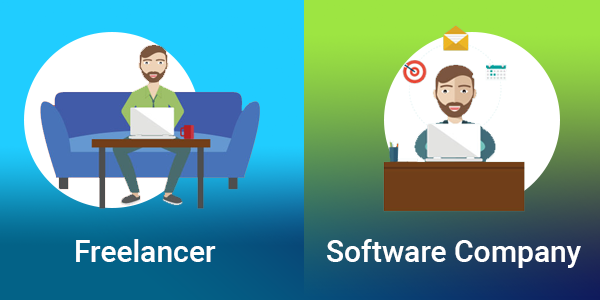
"Outsource mobile app development" is not a single arrangement. Three engagement models and three geographic models exist, and choosing the wrong combination is one of the most common reasons outsourcing relationships underperform.
Engagement models
| Model | How it works | Best for |
| Project-based (fixed price) | The vendor scopes, quotes, and delivers a defined product for a fixed cost and timeline | Well-defined MVPs, apps with a clear, unchanging spec |
| Dedicated team | The vendor assembles a team that works exclusively on your product, managed jointly or by your product owner | Long-term products, apps that will evolve continuously post-launch |
| Staff augmentation | You hire individual developers, designers, or QA engineers who plug into your existing team and process | Teams that already have a product owner and process, and need extra hands or a specific skill gap filled |
Geographic models
| Model | Distance | Trade-off |
| Onshore | Same country | Highest cost, no time zone or cultural friction |
| Nearshore | Neighboring region, overlapping time zones | Mid-range cost, easier real-time collaboration |
| Offshore | Distant country, often 8-to-12-hour time difference | Lowest cost, requires stronger async communication discipline |
Most enterprise buyers land on a dedicated offshore or nearshore team once the app moves past the MVP stage, since it gives them a stable team that understands the codebase without the overhead of a full in-house hiring process. Triazine's staff augmentation model and dedicated development centre option work the same way, letting a business scale a mobile team up or down without carrying the fixed cost of full-time hires.
What Does It Cost to Outsource Mobile App Development in 2026?
Hourly rates vary sharply by region, and a vendor location is usually the biggest lever on total project cost. Based on 2026 industry benchmarking (Clutch and multiple market-rate reports), typical blended rates for mobile app development outsourcing look like this:
| Region | Typical hourly rate (2026) |
| India | $15 to $45/hour |
| Southeast Asia (Vietnam, Philippines) | $15 to $40/hour |
| Eastern Europe (Poland, Ukraine, Romania) | $35 to $70/hour |
| Latin America | $30 to $60/hour |
| North America / Western Europe | $100 to $200+/hour |
At the project level, this typically translates to roughly $15,000 to $60,000 for a simple app with a handful of screens and basic features, $60,000 to $150,000 for a mid-complexity app with a custom backend and cross-platform codebase, and $150,000 or more for an enterprise-grade build with AI integration, security hardening, and admin dashboards. These are broad industry ranges, not fixed quotes: engineering time and architecture complexity drive cost, not the hourly rate alone. A vendor quoting an unusually low price for a genuinely complex build is either underestimating the scope of work or planning to cut corners on testing and security. That gap often shows up after launch, not before.
Benefits of Application Development Outsourcing
- Access to specialized skills. A dedicated outsourcing partner has already hired and trained developers across the frameworks that matter (Flutter, React Native, native iOS and Android), so you are not building that capability from scratch.
- Faster time to market. An established delivery team with a repeatable process typically moves from discovery to launch faster than a business assembling an internal team for the first time.
- Lower fixed overhead. Outsourcing removes the cost of recruiting, benefits, office space, and tooling for a team you may only need at full strength during active development.
- Flexible scaling. A dedicated team model lets you add QA, DevOps, or additional developers as the project needs them, and scale back down after launching without a layoff.
- Continuity across the product lifecycle. The right partner does not disappear at launch. Ongoing maintenance, OS updates, and feature iteration are part of the same relationship, not a separate procurement exercise.
Risks to Watch For
Outsourcing mobile app development is not risk-free, and most of the risk is manageable with the right due diligence upfront:
- Vague scope leading to change order costs. A fixed-price quote built on a loosely defined spec almost always grows in cost once real requirements surface.
- Communication gaps across time zones. Offshore engagements need a defined communication cadence (daily standups, weekly demos, a shared project tracker) or progress becomes invisible until it is too late to correct cheaply.
- No plans for post-launch ownership. A team that disappears after go-live leaves you unable to maintain or extend the app without a costly handover to a new vendor.
- Selecting on price alone. The lowest bid is rarely the lowest total cost once you factor in rework, missed deadlines, and quality issues.
How to Outsource Mobile App Development: A Step-by-Step Process
- Define the business case before the feature list. Start with the problem the app needs to solve and how you'll measure success (transactions completed, active users, process time saved), not a list of screens.
- Choose your engagement and geographic model based on project length, budget, and how much day-to-day control you want to retain.
- Shortlist 3 to 5 vendors with verifiable experience in your app category and technology stack.
- Request detailed proposals, not just quotes. A serious proposal breaks down architecture, team composition, timeline, and what is explicitly excluded from the price.
- Run technical and reference interviews. Talk to the actual engineers who would work on your project and ask for a client reference in a comparable industry.
- Confirm IP ownership, security practices, and contract terms before writing any code, not after.
- Start with a discovery phase (wireframes, technical architecture, sprint plan) before committing to the full build, so integration risk surfaces early.
- Set a review cadence (sprint demos, weekly syncs) and track progress against milestones, not just against the calendar.
How to Choose the Right Outsourcing Partner
Most evaluation checklists stop at the tech stack. That is necessary but not sufficient. A stronger evaluation looks at:
- Verifiable delivery history. Ask for live apps in production, not just portfolio screenshots, and check how long the vendor's client relationships typically last.
- Process maturity. Certifications like CMMI Level 3 and ISO 9001:2015 indicate a documented, auditable delivery process rather than an ad hoc one, which matters once your app has real users and real uptime expectations.
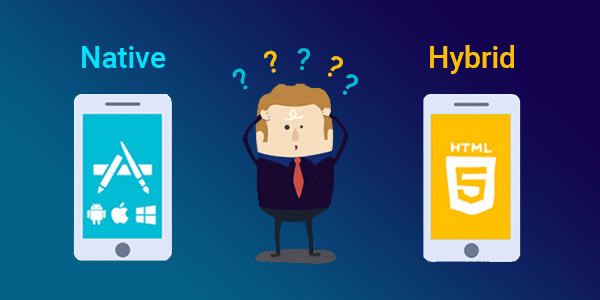
- Cross-platform and native depth. The vendor should recommend Flutter, React Native, or native development based on your actual requirements, not default to whichever stack they happen to staff.
- Security and compliance fluency. Ask specifically how the vendor handles data encryption, secure API design, and any regulatory requirements relevant to your industry (HIPAA, GDPR, PCI DSS).
- QA as a built-in discipline, not an afterthought. A partner that treats testing as a dedicated phase with its own team tends to ship fewer post-launch defects than one that folds QA into development time.
- Transparent communication practices. Ask how they run standups, how blockers get escalated, and what a typical weekly status update looks like before you sign anything.
Why Enterprises Choose Triazine Software as Their Mobile Development Outsourcing Partner
Triazine Software is a CMMI Level 3 and ISO 9001:2015 certified enterprise software company with over a decade of experience delivering mobile app development for clients across gas utilities, FMCG, healthcare, government, and logistics. That certification is not a marketing line: it reflects a documented, repeatable delivery process, which is exactly what a business is buying when it decides to outsource mobile app development rather than build the muscle internally.
Triazine's approach to application development outsourcing combines custom software development, UI/UX design, and dedicated QA testing under one delivery team, backed by cloud development and migration expertise for apps that need to scale post-launch. Businesses that want a fully dedicated offshore team can work through Triazine's staff augmentation model or a dedicated development centre, rather than a one-off project engagement.
Past mobile outsourcing work includes rebuilding and modernizing legacy mobile products as well as building consumer-facing apps from the ground up, including a travel and tourism booking app and a sports betting platform built for scale and regulatory compliance.
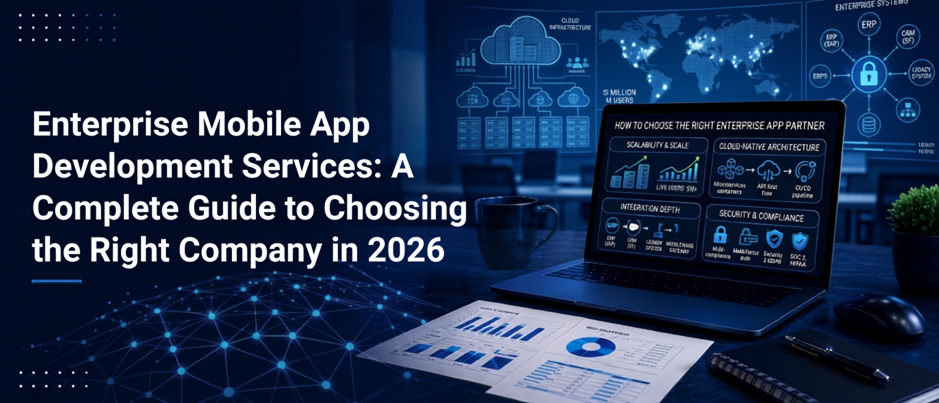
If your organization is further along the maturity curve and evaluating a partner for a large-scale, integration-heavy build, the enterprise mobile app development guide covers platform architecture and vendor evaluation at that scale in more depth.
Frequently Asked Questions
What does it cost to outsource mobile app development?
Costs depend primarily on region and complexity. Simple apps typically range from $15,000 to $60,000, mid-complexity apps from $60,000 to $150,000, and enterprise-grade builds from $150,000 upward, with hourly rates ranging from roughly $15/hour in India to $200+/hour in North America.
Is outsourcing mobile app development safe for intellectual property?
It can be provided that the contract explicitly assigns IP ownership to your business and includes an NDA before any technical discussion begins. Confirm this before the discovery phase starts, not after.
What is the difference between staff augmentation and a dedicated team?
Staff augmentation adds individual developers into your existing team and processes. A dedicated team is a self-contained unit, typically including a project lead, that operates with more independence and is better suited to owning an entire product rather than a slice of one.
How long does it take to outsource and launch a mobile app?
A simple app typically takes 3 to 5 months from discovery to launch. Mid-complexity apps run 5 to 8 months, and enterprise-grade builds with deep integrations can take 9 to 12 months or longer.
Should I choose an offshore, nearshore, or onshore partner?
It depends on the budget and how much real-time collaboration you need. Offshore delivers the lowest cost but requires strong async communication habits. Nearshore balances cost and time zone overlap. Onshore costs the most but removes time zone and, often, cultural friction entirely.
Triazine Software is a CMMI Level 3 certified enterprise technology partner delivering mobile app development, custom software, and dedicated outsourced teams for businesses across India, the US, the UK, Australia, South Africa, and the UAE. Talk to our team about your mobile app outsourcing requirements.

















































 Get free quote