Introduction: The Factory Has Become a Data Business
Every modern factory now runs on two production lines. One moves raw material into finished goods. The other moves data: machine signals, quality readings, inventory counts, supplier updates, energy usage and customer orders. The manufacturers pulling ahead in 2026 are the ones who treat that second line with the same discipline as the first.
That is exactly where manufacturing IT services come in. They give plant leaders, CIOs and operations heads the technology foundation to connect machines, unify systems, protect intellectual property and turn shop-floor activity into decisions made in real time.
The stakes are measurable. Siemens' True Cost of Downtime 2024 report estimates that the world's 500 largest companies lose about $1.4 trillion a year to production stoppages outside planned maintenance, equal to roughly 11% of their revenues (Siemens, 2024; ISM). On the security side, IBM's X-Force Threat Intelligence Index 2026 names manufacturing the most targeted industry for the fifth year running, at 27.7% of all incidents (IBM X-Force, 2026). Both numbers point to the same opportunity: every hour of uptime and every protected system is direct value on the balance sheet.
This guide brings the full picture together in one place. You will learn:
- What manufacturing IT services and solutions include, and how they differ from generic IT support
- The eight core service areas every manufacturer should evaluate
- The business outcomes they deliver, from OEE gains to faster audits
- How Industry 4.0 and IT/OT convergence reshape the plant
- Use cases across automotive, pharma, food, electronics, chemicals and more
- A practical implementation roadmap and a checklist for choosing the right partner
Whether you run a single plant or a multi-site global operation, this guide is built to help you plan your next stage of digital maturity with clarity and confidence.
What Are Manufacturing IT Services and Solutions?
Manufacturing IT services are the strategy, engineering, integration, security and support capabilities that keep a manufacturer's digital environment running, connected and improving. Manufacturing IT solutions are the platforms and applications those services deliver: ERP, MES, IIoT platforms, analytics dashboards, quality systems and more.
Put simply, solutions are what you run; services are how you plan, build, connect, secure and operate them. High-performing manufacturers invest in both, together.
How manufacturing IT differs from general enterprise IT
A bank or a retailer runs mostly on information technology (IT). A factory runs on IT and operational technology (OT): PLCs, SCADA, CNC machines, robots, sensors and historians that physically control production. IT services for the manufacturing industry are designed around that dual reality:
| Dimension | General enterprise IT | Manufacturing IT |
| Core priority | Data confidentiality | Production availability and safety, followed closely by data integrity |
| Systems in scope | Office apps, CRM, finance | ERP plus MES, SCADA, PLCs, historians, IIoT, PLM, QMS |
| Change windows | Flexible, often after hours | Aligned to shifts, line changeovers and planned shutdowns |
| Asset lifespan | 3–5 years | 15–25 years for many control systems |
| Data volume | Transactional | High-frequency sensor and machine data, often at the edge |
| Compliance | Data privacy, finance | ISO 9001, IATF 16949, FDA 21 CFR Part 11, ISO 14001, ISO 45001, IEC 62443 |
This is why IT services for manufacturing companies call for a partner fluent in both the boardroom and the shop floor. The right provider speaks the language of OEE, takt time and yield just as comfortably as cloud, APIs and zero trust.
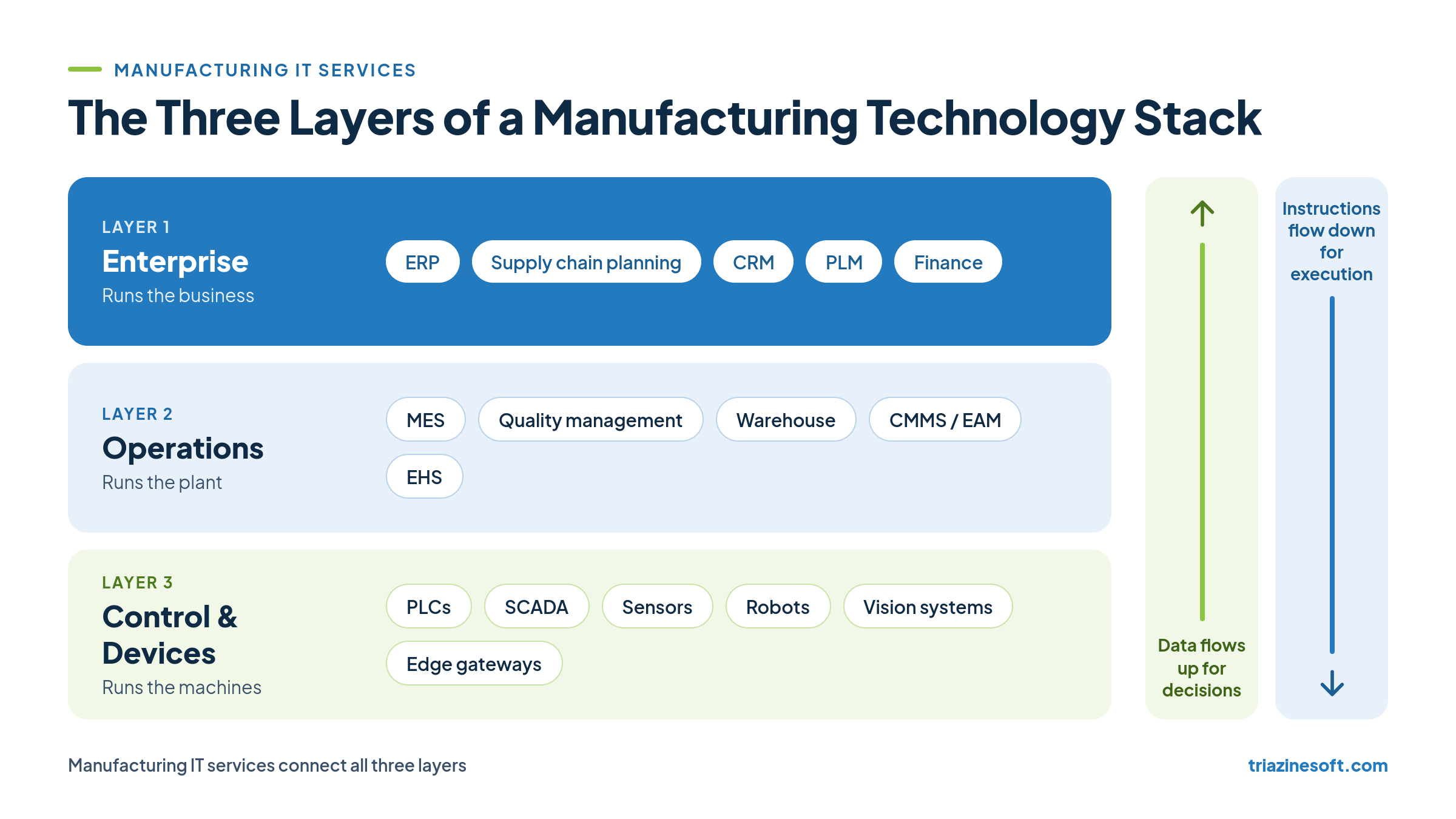
The three layers of a manufacturing technology stack
- Enterprise layer: ERP, supply chain planning, CRM, PLM and financial systems that run the business.
- Operations layer: MES, quality management, warehouse management, maintenance (CMMS/EAM) and EHS systems that run the plant.
- Control and device layer: PLCs, SCADA, sensors, robots, vision systems and edge gateways that run the machines.
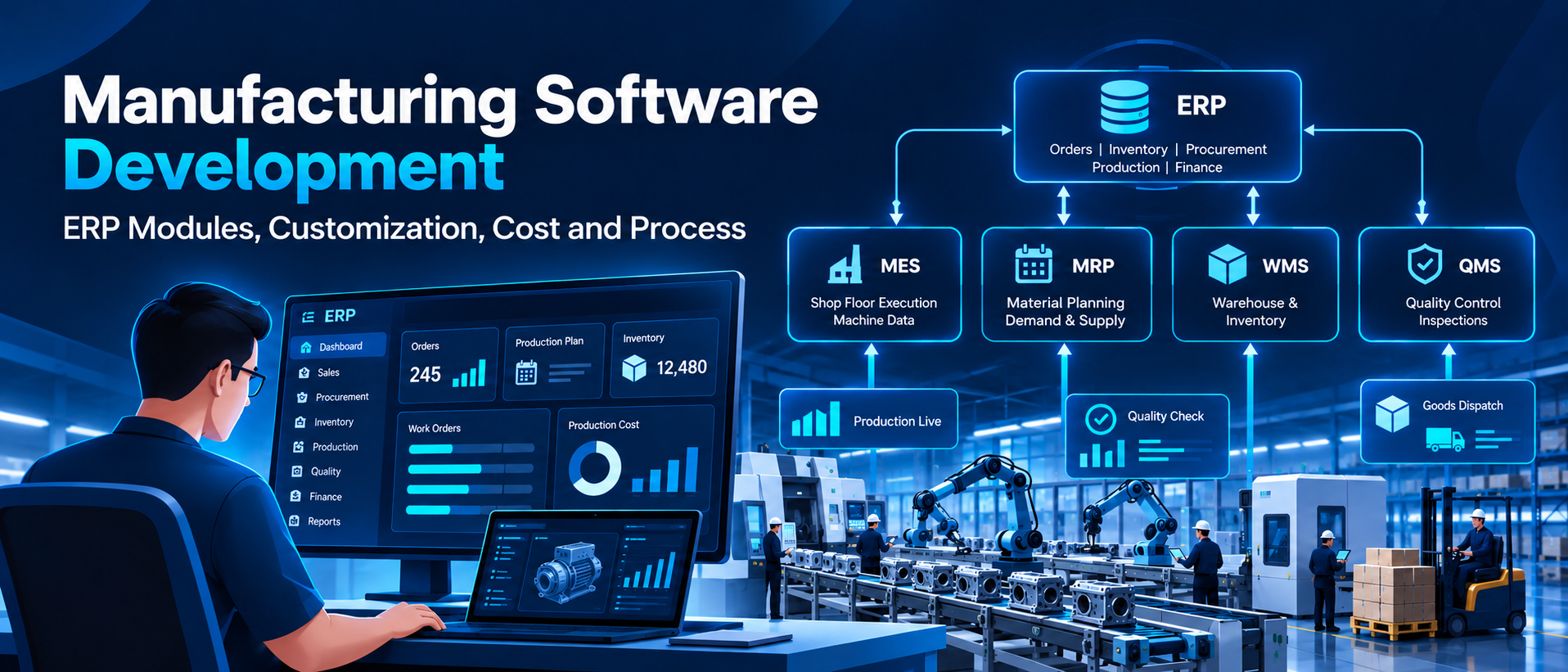
Manufacturing IT services connect these three layers so data flows upward for decisions and instructions flow downward for execution. That vertical integration is the backbone of every smart factory. For a deeper look at the enterprise layer, see our guide to manufacturing software development, ERP modules and customization.
8 Core Manufacturing IT Services Every Enterprise Should Evaluate
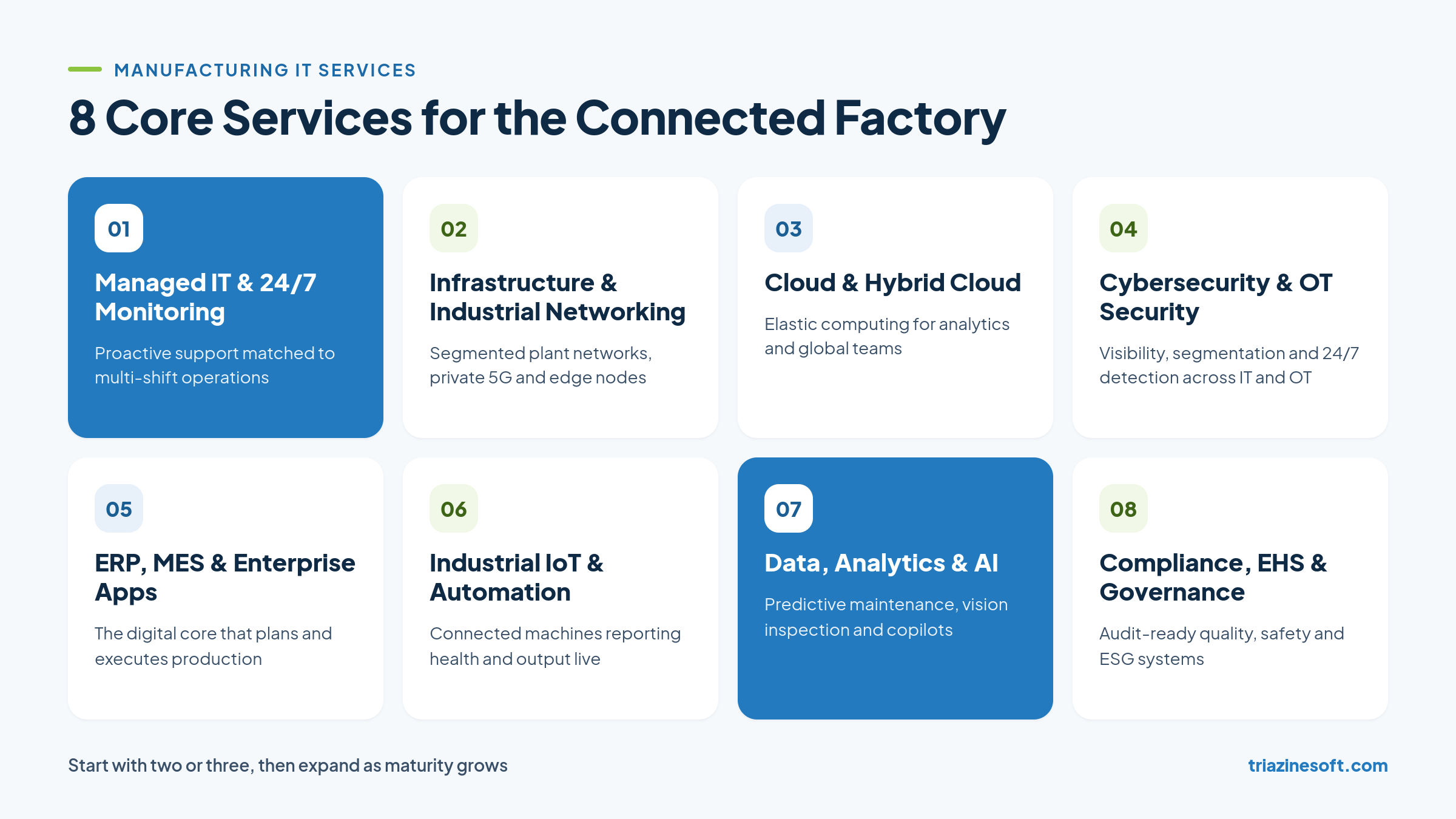
A complete portfolio of IT services and solutions for manufacturing spans eight areas. Most enterprises start with two or three and expand as maturity grows.
1. Managed IT services and 24/7 monitoring
Managed IT services give manufacturers a dedicated team that monitors, maintains and optimizes infrastructure around the clock, matched to multi-shift operations. Typical scope includes:
- Proactive monitoring of servers, networks, endpoints and plant-floor workstations
- Patch management scheduled around production windows
- Service desk with tiered SLAs for office users and shop-floor operators
- IT asset lifecycle management, from procurement to secure retirement
- Monthly reporting on uptime, ticket trends and improvement actions
The value is predictability: a fixed, transparent cost model, faster resolution and an internal team freed to focus on strategic projects. Explore Triazine Software's IT support and maintenance services, or compare delivery models in our guide to co-managed IT vs managed IT services.
2. IT infrastructure and industrial networking
The plant network carries everything from ERP transactions to millisecond-sensitive machine signals. Manufacturing infrastructure services design and run that backbone:
- Segmented plant networks built on the Purdue reference model
- Industrial Wi-Fi, private 5G and wired Ethernet for machines, AGVs and handheld devices
- Server virtualization and hyperconverged infrastructure at each site
- Edge computing nodes that process machine data close to the line for low-latency decisions
- Redundant connectivity and failover for critical production systems
3. Cloud and hybrid cloud services
Cloud gives manufacturers elastic computing for analytics, simulation and global collaboration, while sensitive control workloads stay on premises. A hybrid model blends the strengths of both. Triazine Software delivers this through cloud development and migration, cloud managed services and Microsoft Azure enterprise solutions. Services include:
- Cloud readiness assessment and landing-zone design on AWS, Azure or Google Cloud
- Migration of ERP, PLM, data warehouses and engineering workloads
- Multi-site data synchronization for global plants
- FinOps practices that keep cloud spend aligned with business value
- Backup, disaster recovery and business continuity in the cloud
4. Manufacturing cybersecurity and OT security
With manufacturing holding the top spot in attack data for five consecutive years (IBM X-Force, 2026), security is a production priority. A strong program protects both IT and OT, built on practices such as DevSecOps and regular vulnerability assessment and penetration testing (VAPT):
- Asset discovery and continuous visibility across OT devices
- Network segmentation and secure remote access for OEMs and vendors
- Managed detection and response (MDR) with a 24/7 security operations center
- Vulnerability management prioritized by production impact
- Alignment with IEC 62443, NIST CSF 2.0 and ISO 27001
- Security awareness programs for office and plant teams
5. ERP, MES and enterprise application services
ERP plans the business; MES executes production. Together they form the digital core of the plant. Triazine Software supports this layer through SAP implementation and support, custom software development, legacy application modernization and dedicated ERP and enterprise application specialists. IT solutions for manufacturing in this area cover:
- ERP implementation, upgrade and optimization (SAP S/4HANA, Microsoft Dynamics 365, Oracle, Odoo and others)
- MES deployment for work orders, genealogy, traceability and electronic batch records
- Integration between ERP, MES, PLM, QMS, WMS and CMMS through APIs and middleware
- Custom applications for scheduling, shop-floor data capture and supplier portals
- Legacy modernization that preserves proven business logic while moving to modern architectures
6. Industrial IoT (IIoT) and automation integration
IIoT connects machines and sensors so every asset reports its own health and output. Triazine Software's IoT app development team builds the platforms and apps that bring this data to life. Services include:
- Sensor and gateway selection, retrofit of brownfield equipment
- Protocol integration (OPC UA, MQTT, Modbus, Profinet)
- Unified namespace architecture for a single source of plant truth
- Real-time production monitoring and OEE dashboards
- Integration with robotics, AGVs/AMRs and vision systems
7. Data engineering, analytics and AI
Data becomes valuable once it is clean, connected and in the hands of decision-makers. Triazine Software brings this together through predictive analytics, AI-powered computer vision inspection, BI and reporting services, agentic AI and conversational AI. This service area includes:
- Industrial data platforms and lakehouses that merge IT and OT data
- Predictive maintenance models built on vibration, temperature and current signals
- AI-powered visual inspection for defect detection
- Demand forecasting and production scheduling optimization
- Generative AI copilots that help engineers search manuals, SOPs and maintenance history
- Digital twins of lines, plants and products for simulation and what-if planning
8. Compliance, EHS and governance technology
Regulated manufacturers need systems that capture evidence automatically and keep every site audit-ready. Triazine Software's PrimeEHS platform and work such as our EHS management platform and digital work permit management case studies show this in practice. This includes:
- Quality management systems with CAPA, deviation and document control
- Validated systems for FDA 21 CFR Part 11 and GMP environments
- Environment, health and safety (EHS) software for incidents, permits, inspections and emissions tracking
- ESG and sustainability reporting fed by real energy and emissions data
- Data governance, retention and access policies across IT and OT
When these eight areas work as one connected ecosystem, the result is a plant that sees more, responds faster and improves continuously.
Business Outcomes: What Manufacturing IT Services Deliver
Technology investments earn their place when they move the metrics leadership already tracks. Here is how well-executed manufacturing IT services translate into outcomes.
| Outcome | How IT services drive it | KPI to track |
| Higher equipment uptime | Predictive maintenance, 24/7 monitoring, resilient networks | OEE, MTBF, MTTR |
| Consistent quality | Real-time SPC, AI vision inspection, full genealogy | First-pass yield, scrap rate, cost of quality |
| Faster decisions | Unified IT/OT data, live dashboards, AI forecasting | Decision cycle time, schedule adherence |
| Stronger security posture | OT visibility, segmentation, MDR | Mean time to detect and respond, patch coverage |
| Leaner operating costs | Cloud optimization, automation, energy analytics | IT cost per unit, energy per unit |
| Audit readiness | Validated systems, digital records, EHS software | Audit preparation time, CAPA closure rate |
| Scalable growth | Standardized templates for new lines and plants | Time to launch a new line or site |
| Workforce productivity | Mobile apps, digital work instructions, AI copilots | Training time, output per labor hour |
1. Maximum uptime and asset performance
Predictive maintenance turns equipment data into early warnings, so teams service machines on their own schedule. Siemens' research also highlights that fixing equipment ahead of breakdown reduces replacement-part needs by up to 40% (ISM summary of Siemens, 2024).
2. Quality built into every unit
Connecting MES, quality systems and inline sensors means every parameter is recorded against every serial number. Deviations surface in minutes, root-cause analysis takes hours instead of weeks, and customer recalls stay tightly scoped.
3. One version of the truth
When ERP, MES and machine data share a common data model, finance, operations and supply chain teams work from the same numbers. That alignment speeds up S&OP cycles and sharpens capacity planning. A well-planned data warehouse design makes this possible at scale.
4. Predictable, optimized IT spend
Managed services convert reactive firefighting into a planned operating model with clear SLAs. Cloud FinOps, license rationalization and infrastructure consolidation free budget for innovation.
5. Resilience across the supply chain
Integrated planning, supplier portals and real-time inventory visibility help manufacturers respond quickly to demand shifts, material availability and logistics changes. Learn more in our guide to predictive analytics in supply chain.
6. Sustainability backed by data
Energy monitoring at machine level, combined with production data, reveals energy per unit produced. That insight supports ISO 50001 programs, carbon reporting and customer ESG requests with verified numbers.
Industry 4.0 and the IT/OT Convergence
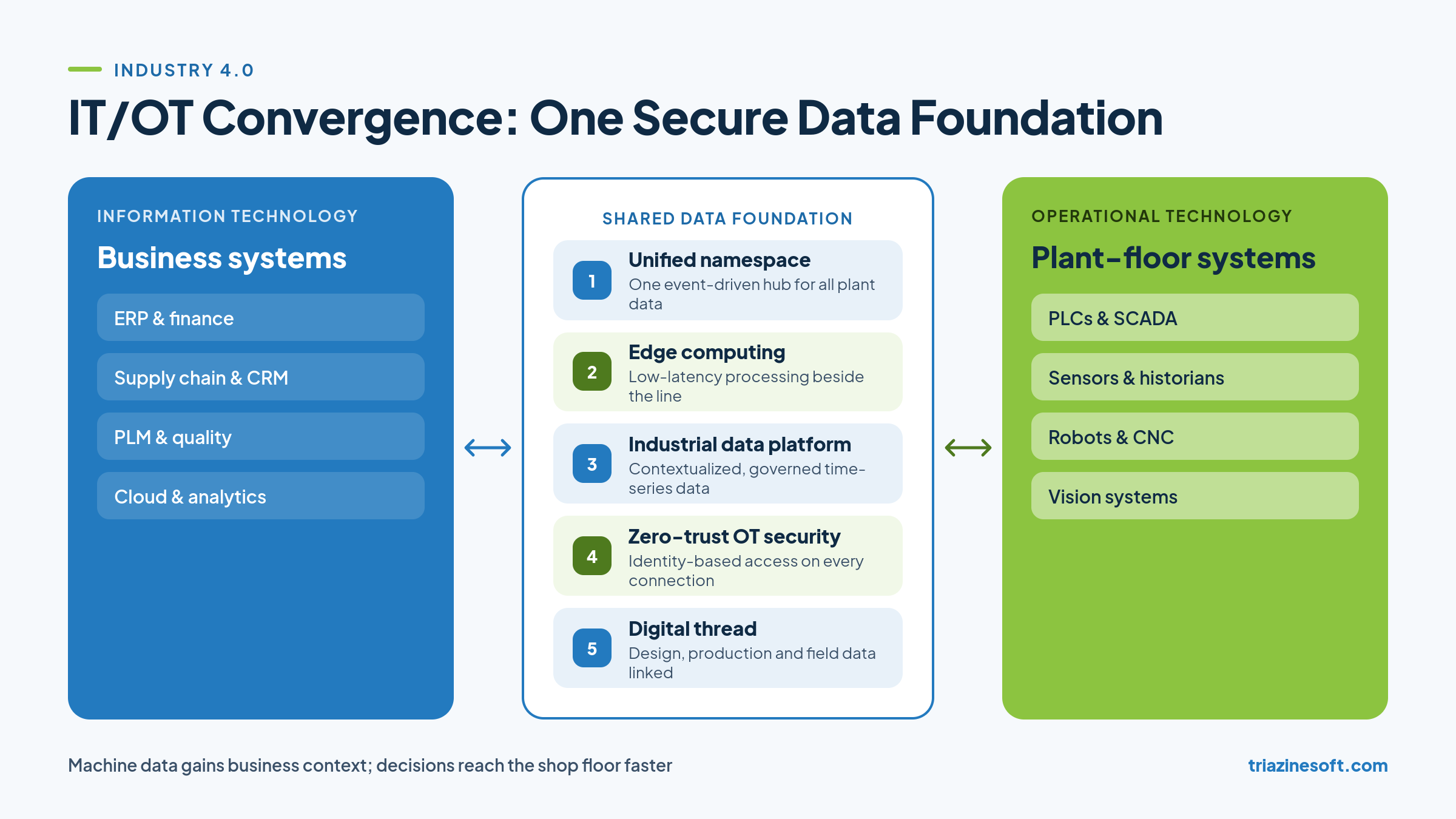
Industry 4.0 describes the shift from isolated automation to connected, data-driven, self-optimizing production. At its heart is IT/OT convergence: bringing business systems and plant-floor control systems onto a shared, secure data foundation.
Why convergence matters now
For decades, OT lived in its own world, managed by engineers and isolated by design. Today, the competitive edge comes from combining machine data with business context. A vibration reading becomes far more powerful when it is linked to the work order, the batch, the customer and the maintenance history.
The building blocks of a converged plant
- Unified namespace (UNS): a single, event-driven hub where every system publishes and subscribes to plant data in a common structure.
- Edge computing: local processing for latency-sensitive use cases such as machine vision and closed-loop control.
- Industrial data platform: contextualized, time-series and transactional data in one governed place.
- Zero-trust architecture for OT: identity-based access, micro-segmentation and continuous verification across every connection.
- Digital thread: a connected record linking product design, manufacturing execution and in-field performance.
Technology trends shaping manufacturing IT in 2026 and beyond
- Industrial AI at scale: moving from pilot projects to plant-wide AI for maintenance, quality and scheduling.
- Generative AI for the frontline: copilots that turn decades of manuals, SOPs and tribal knowledge into instant answers for technicians.
- Agentic AI in operations: AI agents that monitor KPIs, raise maintenance tickets and propose schedule adjustments for human approval.
- Private 5G: reliable, high-bandwidth wireless for mobile robots, AR-assisted maintenance and flexible line layouts.
- Software-defined automation: virtual PLCs and containerized control logic that make lines easier to reconfigure.
- Digital twins: simulation of entire plants to test layouts, capacity and energy scenarios before committing capital.
- Sustainable manufacturing: energy and emissions intelligence built directly into production systems.
- Composable ERP and MES: modular, API-first platforms that let manufacturers adopt new capabilities quickly.
The common thread across all eight trends is data readiness. Manufacturers who invest early in clean, connected, secure data, guided by a clear data governance framework, are positioned to adopt each new wave of innovation faster. Our guide to agentic AI in enterprise workflows explores how to move AI from pilot to production.
Manufacturing IT Use Cases by Industry Segment
Every manufacturing segment shares the same digital foundations, yet each has its own priorities. Here is where IT services for manufacturing companies create the most value in each.
| Segment | Priority use cases | Key standards and systems |
| Automotive and auto components | Traceability by VIN and part, JIT/JIS sequencing, PPAP digitization, predictive maintenance on presses and robots | IATF 16949, TISAX, EDI with OEMs |
| Pharmaceuticals and life sciences | Electronic batch records, validated MES, serialization, data integrity | FDA 21 CFR Part 11, EU GMP Annex 11, GAMP 5 |
| Food and beverage | Lot traceability, recipe management, cold-chain monitoring, allergen control | FSMA, HACCP, FSSC 22000 |
| Electronics and semiconductors | Yield analytics, AOI vision inspection, cleanroom monitoring, component genealogy | IPC standards, ESD controls |
| Chemicals and process industries | Batch control, process historians, safety instrumented systems, emissions tracking | ISA-88, ISA-95, PSM, ISO 14001 |
| Industrial machinery and engineering | Engineer-to-order configuration, PLM–ERP integration, connected-product services | ISO 9001, CE marking |
| Metals, plastics and packaging | Energy optimization, furnace and extruder monitoring, OEE improvement | ISO 50001, ISO 45001 |
| Aerospace and defense | Digital thread, configuration control, secure collaboration | AS9100, ITAR, CMMC |
Use case spotlight: predictive maintenance
Sensors on motors, gearboxes and pumps stream vibration and temperature data to an edge gateway. Machine learning models learn each asset's normal signature and flag deviations days or weeks in advance. The CMMS automatically raises a work order, and planners schedule the job during the next changeover. The outcome: higher OEE, lower spare-parts inventory and safer maintenance work. Triazine Software's predictive analytics services are built for exactly this.
Use case spotlight: AI-powered quality inspection
High-resolution cameras capture every unit on the line. Computer vision models detect surface defects, misalignments and missing components in milliseconds, with results logged against the serial number in MES. Quality teams gain 100% inspection coverage and rich data for continuous improvement. See how Triazine Software delivers AI-powered computer vision inspection.
Use case spotlight: connected EHS and safety
Environment, health and safety programs perform best when they draw from the same live data as production. Digital incident reporting, permit-to-work, inspections, chemical inventories and emissions tracking in one EHS platform give plant leaders a real-time view of safety performance across every site. PrimeEHS brings these workflows together for multi-site manufacturers, as shown in our work permit and EHS compliance platforms and digital refinery inspection management case studies.
Use case spotlight: multi-plant visibility
Global manufacturers often run different ERP instances, MES versions and reporting tools across sites. A standardized data platform and harmonized KPIs, delivered through BI and reporting services, give leadership a single, comparable view of performance, making it easy to spot best practices in one plant and replicate them across the network.
A 6-Phase Roadmap for Implementing Manufacturing IT Services
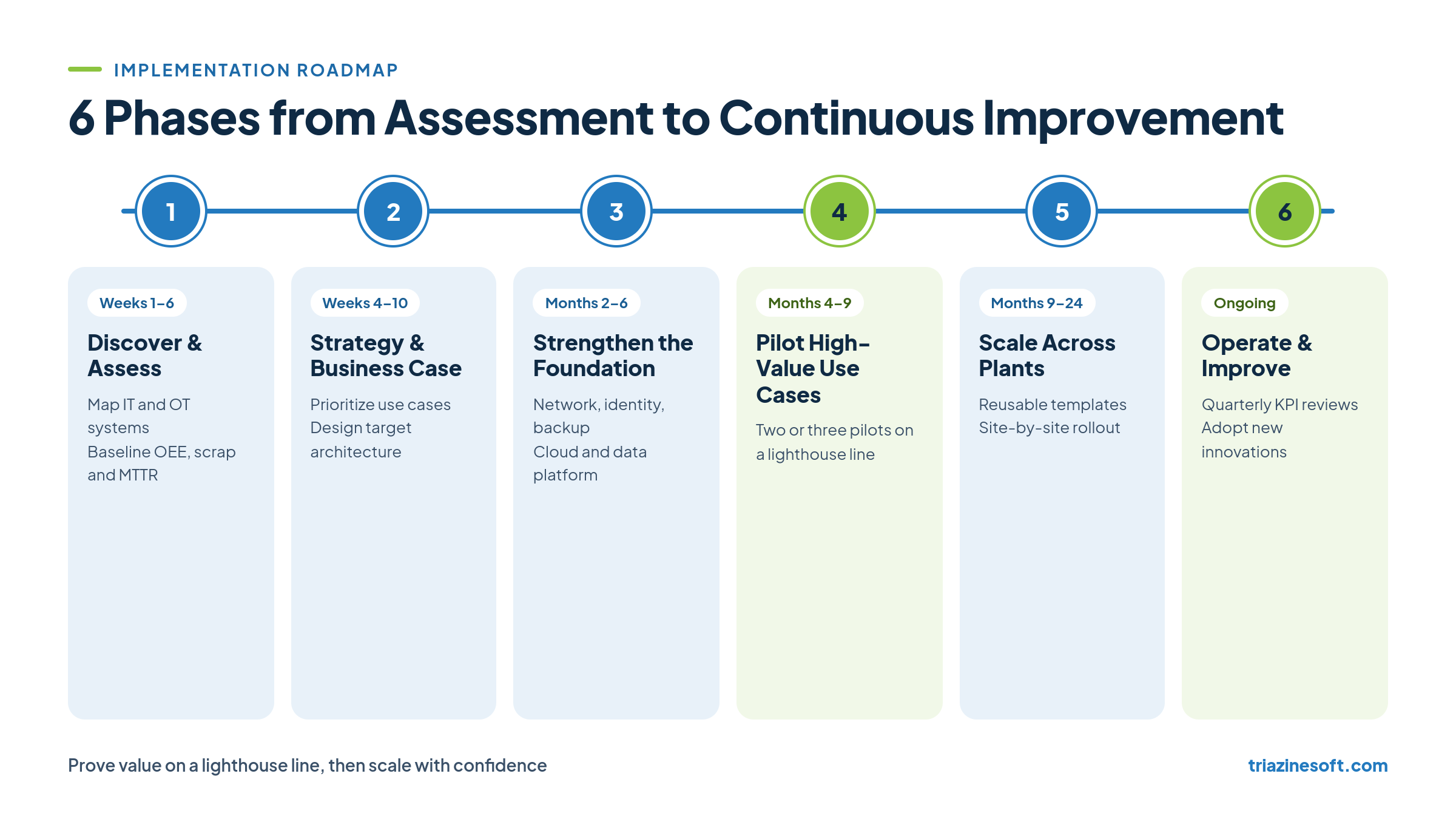
The most successful programs follow a phased approach that delivers measurable value early and scales with confidence. Here is a proven roadmap.
Phase 1: Discover and assess (weeks 1–6)
- Map the current IT and OT landscape: systems, integrations, data flows, network topology and security posture
- Interview plant managers, engineers, quality leads and finance to capture priorities
- Benchmark digital maturity against a framework such as the Smart Industry Readiness Index (SIRI)
- Baseline the KPIs you intend to move, such as OEE, scrap rate, MTTR and IT cost per unit
Phase 2: Define strategy and business case (weeks 4–10)
- Prioritize use cases by value and feasibility on a simple impact-versus-effort matrix
- Design the target architecture across enterprise, operations and control layers
- Build the business case with clear ROI, payback period and ownership of each KPI
- Agree on governance: steering committee, plant champions and decision rights
Phase 3: Strengthen the foundation (months 2–6)
- Upgrade network segmentation, identity management and backup/recovery
- Establish the cloud landing zone and the industrial data platform
- Onboard managed IT and security services for 24/7 coverage
Phase 4: Pilot high-value use cases (months 4–9)
- Launch two or three pilots on a lighthouse line, such as OEE dashboards, predictive maintenance or digital work instructions
- Measure results against the Phase 1 baseline every two weeks
- Capture lessons learned and refine templates for scale
Phase 5: Scale across lines and plants (months 9–24)
- Package successful pilots into reusable templates, including data models, dashboards, integrations and training content
- Roll out site by site, aligned with production calendars and planned shutdowns
- Build internal capability through train-the-trainer programs and centers of excellence
Phase 6: Operate and continuously improve (ongoing)
- Run quarterly business reviews tied to the KPIs in the business case
- Refresh the roadmap as new technologies such as industrial AI agents and private 5G mature
- Expand from operational efficiency toward new revenue models such as connected-product services
Pro tip: Tie every phase to a production metric that plant leadership already reports. When a dashboard shows OEE rising on the lighthouse line, adoption across the rest of the network follows naturally.
How to Choose the Right Manufacturing IT Services Partner
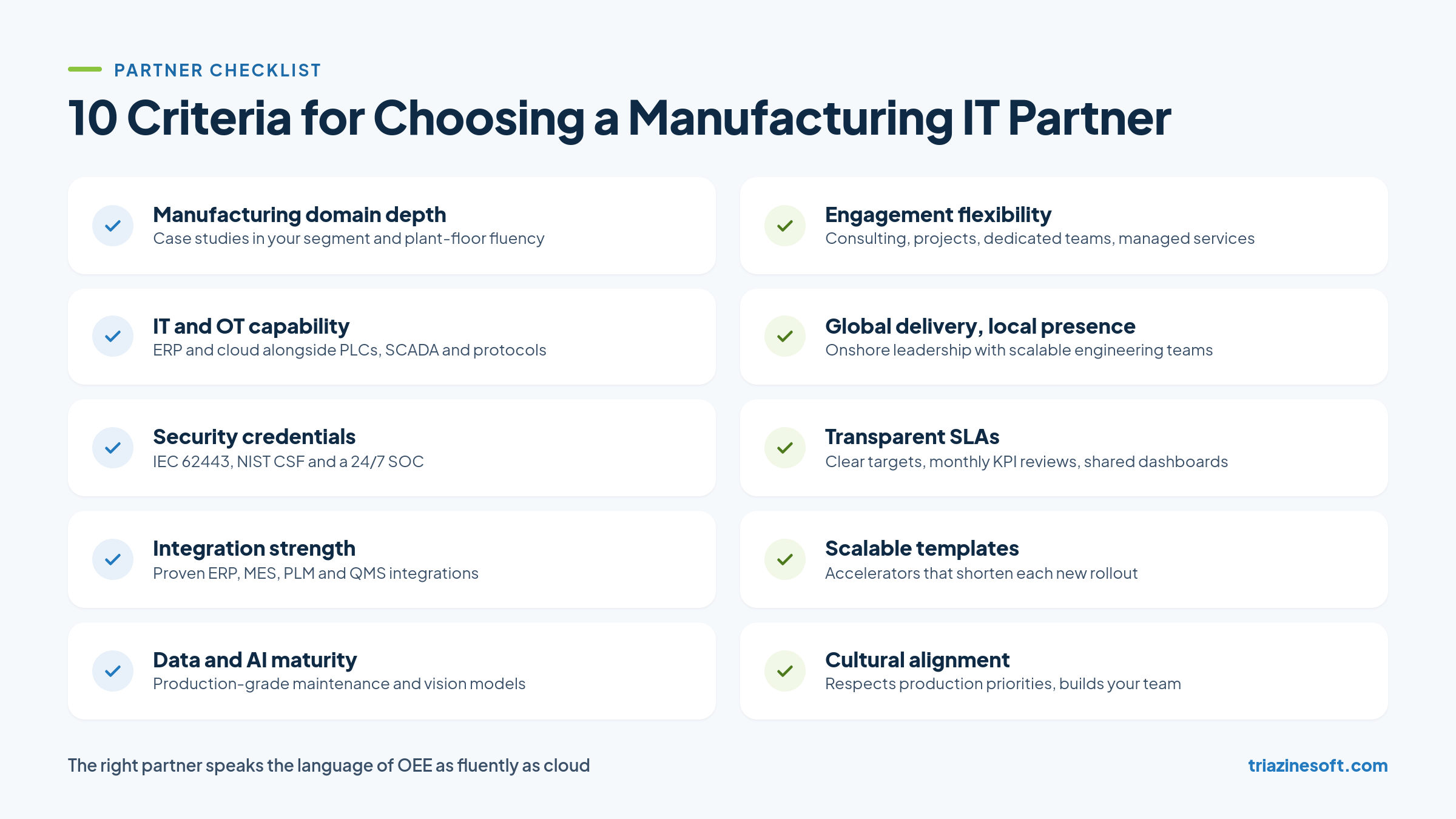
The partner you select shapes the speed, quality and long-term value of your transformation. Use these ten criteria to evaluate providers of IT services for the manufacturing industry. For flexible capacity, staff augmentation and a dedicated development centre are also worth considering.
| # | Criterion | What to look for |
| 1 | Manufacturing domain depth | Case studies in your segment; fluency in OEE, ISA-95, MES and plant-floor realities |
| 2 | IT and OT capability | Teams skilled across ERP, cloud and applications as well as PLCs, SCADA and industrial protocols |
| 3 | Security credentials | Experience with IEC 62443 and NIST CSF; a 24/7 SOC; OT security tooling |
| 4 | Integration strength | Proven ERP–MES–PLM–QMS integrations; API and middleware expertise |
| 5 | Data and AI maturity | Production-grade predictive maintenance, vision and analytics deployments |
| 6 | Engagement flexibility | Options spanning consulting, project delivery, dedicated teams and fully managed services |
| 7 | Global delivery with local presence | Onshore leadership close to your plants combined with scalable global engineering teams |
| 8 | Transparent SLAs and reporting | Clear response and resolution targets, monthly KPI reviews, shared dashboards |
| 9 | Scalable templates | Reusable accelerators that shorten rollout to each new line or plant |
| 10 | Cultural alignment | A collaborative style that respects production priorities and builds your internal capability |
Questions to ask in your evaluation
- Which manufacturing KPIs have you improved for clients, and by how much?
- How do you schedule changes around our production calendar?
- How do you secure remote access for OEMs and support teams?
- What does your onboarding plan for the first 90 days look like?
- How will you transfer knowledge to our internal IT and engineering teams?
- Which accelerators or templates can you bring to shorten time to value?
Why Triazine Software for Manufacturing IT Services
Triazine Software partners with manufacturers to design, build and run the technology that powers modern, connected plants. Our approach blends deep engineering capability with a clear focus on the production metrics that matter to your leadership team. Browse our case studies and the industries we serve.
What we bring to manufacturers:
- End-to-end manufacturing IT services: strategy, custom software, ERP and MES integration, cloud, data engineering, AI and managed support under one roof
- IT/OT integration expertise: connecting machines, sensors and control systems with enterprise platforms through modern, secure architectures
- Industrial data and AI: predictive maintenance, AI vision inspection, OEE analytics and generative AI copilots tailored to your operations
- Product-grade EHS technology: as the team behind PrimeEHS, we understand environment, health and safety workflows from the inside, and we connect them with your production data
- US presence with global delivery: through Triazine Software LLC, our US team works closely with your stakeholders, supported by scalable global engineering teams for faster delivery
- Flexible engagement models: consulting, fixed-scope projects, dedicated teams or fully managed services, matched to your stage of maturity
Whether you are modernizing a legacy ERP, connecting your first production line or scaling AI across a global plant network, Triazine Software brings the expertise to move from roadmap to results with confidence.
Ready to build a smarter, more connected factory? Talk to Triazine Software's manufacturing IT experts for a discovery session tailored to your plants.
Frequently Asked Questions
What are manufacturing IT services?
Manufacturing IT services are the strategy, integration, cloud, cybersecurity, data, AI and managed support capabilities that help manufacturers run and improve their digital environment across business systems and plant-floor technology.
What is the difference between IT services and IT solutions for manufacturing?
IT solutions for manufacturing are the platforms themselves, such as ERP, MES, IIoT and analytics. IT services are the expertise used to plan, implement, integrate, secure and operate those platforms.
Which IT systems are most important for a manufacturing company?
Most manufacturers rely on ERP for business planning, MES for production execution, a quality management system, a maintenance system (CMMS or EAM) and an EHS platform, all connected through a shared data layer.
How do manufacturing IT services improve OEE?
They raise availability through predictive maintenance and 24/7 monitoring, improve performance through real-time production visibility, and lift quality through inline inspection and full traceability.
What is IT/OT convergence in manufacturing?
IT/OT convergence connects business systems with operational control systems on a secure, shared data foundation, so machine data gains business context and decisions reach the shop floor faster.
Are managed IT services a good fit for mid-sized manufacturers?
Yes. Managed IT services give mid-sized manufacturers enterprise-grade monitoring, security and support at a predictable monthly cost, while internal teams focus on strategic projects.
How long does a manufacturing IT transformation take?
Foundational improvements and first pilots typically deliver results within 4 to 9 months. Scaling across multiple lines and plants usually takes 12 to 24 months, depending on scope.
How should a manufacturer get started?
Begin with a discovery and maturity assessment, baseline key KPIs, then choose two or three high-value pilots on a lighthouse line before scaling.
Conclusion
Manufacturing excellence in 2026 is built on two equally important assets: world-class production capability and a connected, secure, intelligent technology foundation. Manufacturing IT services bring those assets together, turning machine data into uptime, quality into a competitive advantage and every plant into a source of continuous improvement.
The path forward is clear and achievable: assess where you stand, strengthen the foundation, prove value on a lighthouse line and scale with confidence. With the right partner, each step compounds into a faster, smarter and more resilient manufacturing enterprise.
Start your journey today. Connect with Triazine Software to explore manufacturing IT services and solutions designed around your plants, your people and your growth goals.













































 Get free quote