15 Software Development Industry Challenges Every Enterprise Faces in 2026 (AI, Talent, and Compliance)
Software development is no longer a purely technical exercise. It now sits at the intersection of AI governance, cybersecurity regulation, talent economics, and board-level risk reporting. A CTO signing off on a new platform in 2026 is not just approving a technology stack; they are approving assumptions about how fast the team can hire, how well AI-generated code will hold up under audit, and how much of the existing technology estate is quietly working against the new build.
Most of these problems are not new. What has changed is how fast they compound. Requirements gap that once cost a few weeks of rework can now cascade through an AI-assisted pipeline in days. A security gap that used to surface in a penetration test can now be baked into a feature by a coding assistant before a human reviewer ever looks at it. This guide breaks down 15 software development industry challenges enterprise teams are facing in 2026, along with a practical response to each one.
Key Takeaways
- Talent shortages and AI integration are now the two most cited challenges among technology leaders, ahead of budget and timeline pressure.
- AI-generated code introduces measurable new security risk. Independent testing has found AI-written code fails secure coding benchmarks at a far higher rate than human-written code.
- Technical debt is no longer a background inconvenience. Analysts estimate it can consume a large share of an enterprise's entire technology estate value.
- Data privacy regulation, from the EU AI Act to India's DPDP Act, is now a design constraint that must be addressed during architecture, not after launch.
- Most of these challenges are solvable with a disciplined process, which is exactly what a CMMI Level 3 certified delivery model is built to enforce.
1. Talent Shortage in Specialised Roles
Hiring has quietly become the biggest constraint on software delivery. Recent industry research names recruiting and retaining skilled technology workers as the top business challenge for 2026, and the gap is sharpest in AI engineering, applied security, and platform roles rather than general development capacity, according to the Reveal Software Development Challenges survey.
How to address it: Instead of waiting months to fill a permanent role, many enterprises now blend in-house teams with vetted external specialists to fill the exact skill gap. Triazine Software's staff augmentation model and custom software development teams are built around this exact problem, adding senior capacity without the multi-month hiring cycle.
2. Integrating AI Into the Development Process Responsibly
AI adoption has moved from an experiment to an operational requirement. Integrating AI into the development workflow is now the most cited software development challenge for 2026, and most organisations plan to expand their AI usage further this year, per the same Reveal survey data. Gartner projects that by 2028, 90 percent of enterprise software engineers will use AI code assistants, up from under 14 per cent in early 2024, a shift documented in Gartner's own webinar on AI code assistants.
How to address it: The teams getting real value from AI are not the ones adopting the most tools; they are the ones adopting AI with clear review gates, usage policy, and measurable productivity tracking. Triazine Software's agentic AI services and its guide on moving agentic AI from pilot to production walk through this rollout process in detail.
3. Security Risk in AI-Generated Code
AI writes code fast but fast is not the same as safe.
The data: Veracode's 2025 GenAI Code Security Report tested more than 100 large language models across 80 coding tasks and found that AI-generated code introduced security vulnerabilities in 45 percent of cases, according to Veracode's own press release.
Why it happens: The 45 percent figure specifically reflects what happens when a model is not given explicit secure coding constraints, the pattern the industry now calls vibe coding. Veracode's own researchers found that when given a straight choice between a secure and an insecure way to solve the same task, the models picked the insecure option nearly half the time, largely because the prompt never asked for a secure one. In other words, the risk lies less in the model itself and more in the absence of a security requirement when it generates code.
The fix: AI-generated code needs the same static analysis, dependency scanning, and manual review gates as human-written code, arguably more, and prompts or coding standards that state security constraints explicitly rather than assuming the model will infer them. Building this into the pipeline rather than bolting it on afterwards is the core idea behind DevSecOps as a delivery discipline.
4. Rising Cybersecurity Threats
Security is no longer a line item at the end of a project; it is one of the top three challenges cited by technology leaders for 2026, alongside AI integration and talent. The global average cost of a data breach in 2025 was 4.44 million US dollars, based on IBM's Cost of a Data Breach Report, and organisations with weak or absent AI governance faced higher breach costs than those with formal policies in place.
How to address it: A layered security approach, covering application code, cloud configuration, identity access, and third-party integrations, needs to be planned during architecture rather than added after an incident. This is the ground Triazine Software's DevSecOps and cloud managed services practices cover.
5. Data Privacy and Regulatory Compliance
Regulation is catching up with software fast. The EU AI Act, India's Digital Personal Data Protection Act, and sector-specific rules in healthcare and finance now shape how data can be collected, stored, and processed inside an application, not just how it is reported afterwards. Data privacy and regulatory compliance is now one of the top three cited software development challenges globally, according to the Reveal survey, alongside AI integration and security.
How to address it: Treat compliance requirements as functional requirements from day one of a project, not a legal review step before launch. Triazine Software's guide to choosing and implementing a data governance framework covers how to build this into an enterprise architecture.
6. Unclear or Constantly Shifting Requirements
Requirements that change mid-project are one of the oldest problems in software development, and they remain one of the most damaging. PMI's Pulse of the Profession research found that 52 per cent of projects experienced scope creep or uncontrolled changes to project scope, up from 43 per cent five years earlier, as reported in PMI's own Scope Patrol analysis.
How to address it: A documented requirements baseline, a formal change control process, and a working prototype before full build all reduce scope drift significantly. This is central to how Triazine Software structures custom software development engagements, and it is one reason CMMI Level 3 process maturity matters more than it sounds.
7. Technical Debt That Never Gets Paid Down
Technical debt has quietly become one of the highest hidden costs in enterprise technology.
The data: McKinsey's research on tech debt, originally published in 2020 and still cited in its current 2024 analysis, found that CIOs estimate technical debt accounts for 20 to 40 percent of the value of their entire technology estate, and most organizations allocate less than 20 percent of their tech budget to actually paying it down, according to McKinsey's own analysis.
The fix: Treat technical debt as a tracked line item, with its own backlog and budget allocation, to address it instead of deferring it indefinitely. Triazine Software's legacy application modernization service and its complete guide to legacy modernization are built around exactly this kind of structured paydown.
8. Legacy System Integration
Most enterprises are not building on a blank slate. New applications have to talk to core banking systems, ERP platforms, or decades-old databases that were never designed for modern APIs. Integration complexity remains one of the most common reasons enterprise software projects run over budget, since dependencies on legacy systems tend to surface late in the development cycle rather than during initial planning.
How to address it: An enterprise integration framework, built and tested early rather than left until the final release, prevents these dependencies from becoming last-minute blockers. Triazine Software's enterprise application modernization case study shows how this played out on a real legacy migration project.
9. Choosing the Right Architecture at Scale
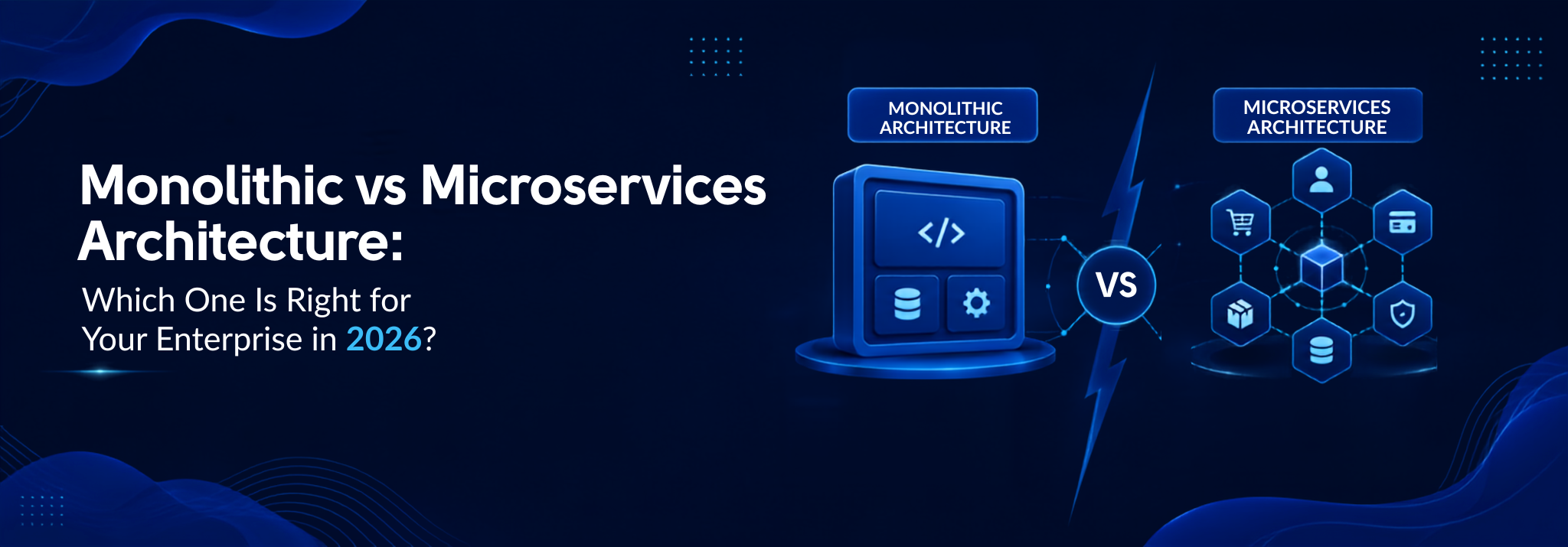
Monolith, microservices, or serverless is no longer a purely technical decision; it directly shapes hiring needs, deployment speed, and long-term maintenance cost. Many enterprises that moved to microservices too early are now consolidating parts of their systems back, since the operational overhead of managing dozens of independent services outweighed the flexibility benefit for teams without the platform engineering maturity to support it.
How to address it: Architecture decisions should be driven by team size, release cadence, and compliance needs, not by industry trend. Triazine Software's detailed comparisons on monolithic versus microservices architecture and serverless architecture for enterprises walk through this decision framework in depth.
10. Third Party and API Integration Complexity
Modern applications rarely stand alone. Payment gateways, CRM systems, IoT devices, and government portals all connect through APIs built by someone else, with their own versioning schedules, rate limits, and documentation gaps. These dependencies tend to stay hidden through most of the build and only surface during integration testing, which is exactly when they are most expensive to fix.
How to address it: Map every external dependency during the requirements phase and build fallback handling for third-party API failures to keep integration risk visible instead of discovering it during user acceptance testing. Triazine Software's website and application development and mobile app development teams build this dependency mapping into the earliest project phase for exactly this reason.
11. Quality Assurance Under Compressed Release Cycles
Faster release cycles have put pressure on testing that used to have dedicated time built in. When AI-assisted development lets a team ship a feature in half the usual time, testing often does not get the corresponding time reduction it needs; it gets cut instead. Stack Overflow's 2025 Developer Survey found that 46 percent of developers no longer trust the accuracy of AI-generated output, up sharply from 31 percent the year before, and 45 percent said debugging AI-generated code is more time-consuming than expected, according to Stack Overflow's own press release. That gap between AI output and verified, reliable code is exactly what testing discipline exists to close.
How to address it: Automated regression testing, combined with a formal QA process that does not get skipped under deadline pressure, protects release quality even as delivery speed increases. Triazine Software's enterprise guide to QA and testing services and its dedicated QA testing services practice are structured around this exact discipline.
12. Cloud Cost and Multi-Cloud Complexity
Cloud once promised predictable cost, but multi-cloud and hybrid deployments have made billing one of the harder things to forecast in a software budget. Teams running workloads across AWS, Azure, and on-premises infrastructure often lack a single view of cost drivers, making it hard to know which service, team, or feature is driving a spike in spend.
How to address it: A FinOps discipline, with cost visibility built into the cloud architecture from the start rather than reviewed only at the end of the billing cycle, keeps cloud spend predictable. Triazine Software's cloud development and migration and Microsoft Azure enterprise solutions practices build cost governance into the migration plan itself.
13. Cross-Functional and Distributed Team Collaboration
Distributed and hybrid teams are now the norm rather than the exception, and that has changed how software gets built. A design decision made in one time zone, a requirement clarified in another, and a code review completed in a third can each add a full day of delay if communication isn't deliberately structured. This is less about tooling and more about process discipline across teams that rarely share working hours.
How to address it: Clear documentation standards, asynchronous communication norms, and structured handoff points between design, development, and QA reduce the friction that distributed teams otherwise absorb silently. This is central to how Triazine Software structures delivery for its staff augmentation engagements, where a Triazine Software team often works alongside a client's existing in-house team.
14. Budget and Timeline Overruns
Cost and schedule overruns remain one of the most common ways software projects fail, even when the underlying code works. PMI's own Pulse of the Profession research tracks this by measuring how much money organizations waste for every billion dollars invested in projects and programs. Its lower-performing organisations still lose a meaningfully higher share of that spend to poor project performance than the organizations it classifies as high performers, according to PMI's own Pulse of the Profession release. This is rarely one single mistake; it is usually the compounded effect of scope creep, integration surprises, and technical debt all landing in the same project.
How to address it: A fixed scope, phased delivery model, with clear milestones and budget checkpoints built in from the start, catches overruns early enough to correct course. Triazine Software structures its agile product development engagements around exactly this kind of phased accountability.
15. Keeping Pace with Tool and Framework Change
New frameworks, low-code platforms, and AI development tools now arrive faster than most teams can properly evaluate them. Chasing every new tool creates its own kind of technical debt: a fragmented stack that is harder to hire for and maintain, while ignoring genuine advances leaves a team's delivery speed and cost structure behind competitors who adopted earlier.
How to address it: A structured technology evaluation process, reviewed on a fixed cycle rather than reactively, lets a team adopt genuinely useful tools without fragmenting its stack. Triazine Software's process for evaluating new development approaches is grounded in its CMMI Level 3 certified delivery methodology, which requires documented evaluation before any tool or framework change reaches production use.
Why Process Maturity Matters More Than Any Single Fix
None of these 15 challenges has a purely technical solution. Talent shortages need a flexible staffing model. AI risk needs governance, not just better prompts. Technical debt needs budget discipline, not just refactoring sprints. What connects them all is process maturity: the ability to catch a problem during planning rather than during a production incident.
This is the practical value of working with a CMMI Level 3 certified partner. It is not a certificate for a wall; it is a documented commitment to requirements management, quality assurance, and risk tracking at every stage of a project, which is exactly where most of the challenges above actually originate.
Frequently Asked Questions
What is the single biggest software development challenge in 2026? Industry surveys are consistent. Talent shortages in specialised roles and safely integrating AI into development workflows are the two most cited challenges, ahead of budget and cybersecurity concerns, according to the Reveal Software Development Challenges survey.
Is AI-generated code less secure than human-written code? Independent testing suggests yes, at least without proper review gates. Veracode's 2025 research found AI-generated code failed secure coding benchmarks in 45 percent of tested cases, based on Veracode's own findings. The fix isn't avoiding AI tools; it is applying the same review and scanning discipline to AI output as to any other code.
How much does technical debt cost a business? McKinsey's research estimates that technical debt can represent 20 to 40 per cent of an enterprise's entire technology estate value, based on its tech debt analysis, which is why treating it as a tracked, budgeted item matters more than treating it as an occasional cleanup sprint.
Should a business hire in-house developers or work with an external software development partner? It depends on the skill gap and the timeline. For a specific, hard-to-hire skill or a defined project scope, staff augmentation or a fully outsourced build usually delivers faster than a multi-month hiring cycle. Triazine Software's staff augmentation guide breaks down how to make this decision for a specific project.
Getting Ahead of These Challenges
Most software development challenges are predictable well before they become expensive. What separates projects that stay on budget from those that don't is usually not talent or tooling; it is whether a team has the process discipline to catch these problems early. Triazine Software has delivered enterprise software under a CMMI Level 3 certified process for years, across custom software development, cloud migration, legacy modernisation, and agentic AI implementation. Get in touch with Triazine's team to talk through where your current project sits against these 15 challenges.





















































 Get free quote