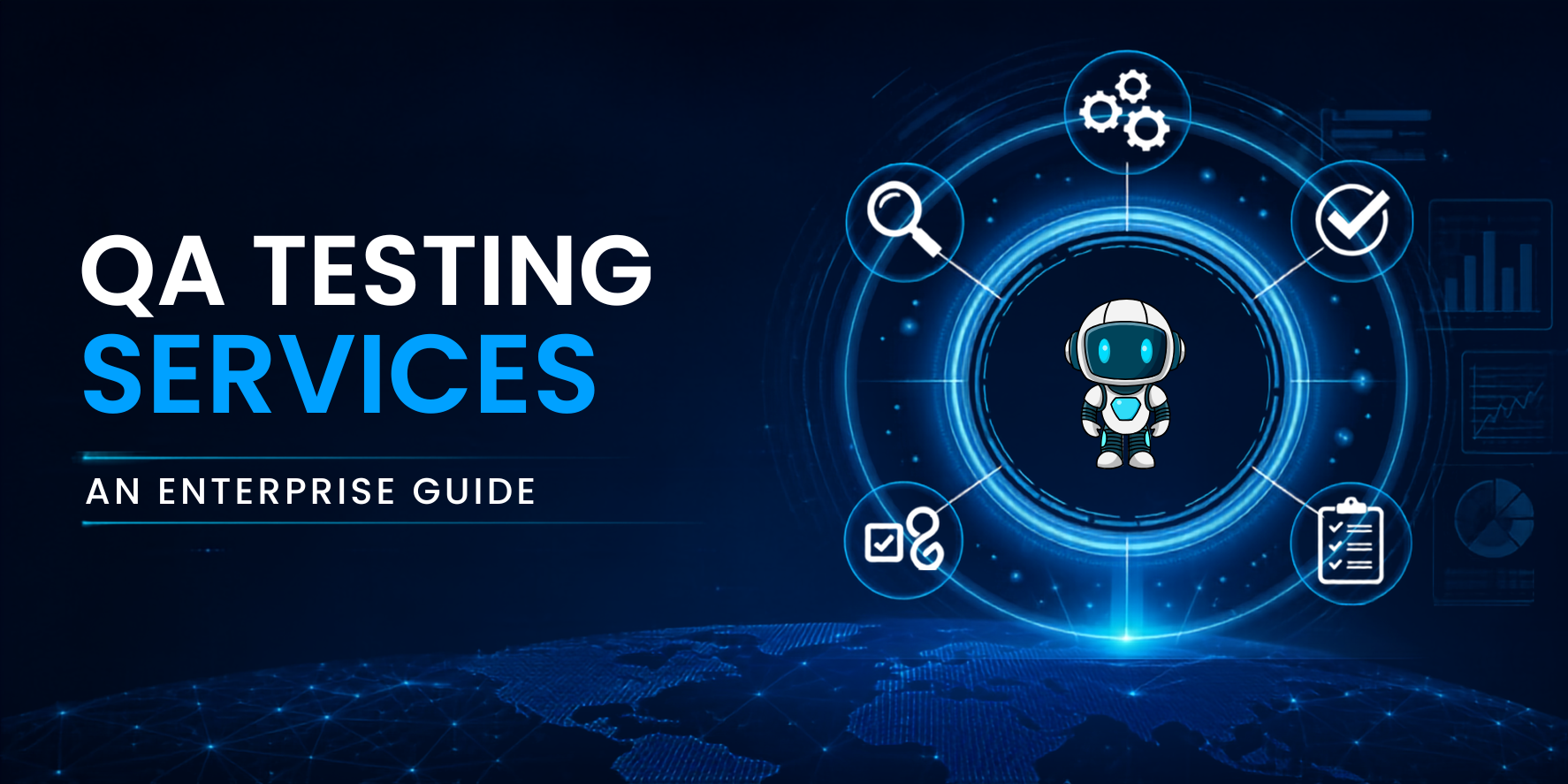
QA Testing Services: An Enterprise Guide
Software release cycles have compressed significantly at many enterprises, with some teams moving from quarterly releases to weekly or biweekly ones. That pace only holds up if quality keeps up, and that is where QA testing services come in. Enterprises that treat quality assurance as a step at the end of development, rather than a discipline running through it, are the ones most likely to ship defects into production, miss compliance requirements, or lose customer trust one bad release at a time.
This guide covers what QA testing services include, how QA differs from plain software testing, the benefits of investing in it properly, what a real engagement looks like end to end, and how to choose between an in-house team, a QA testing company, or a managed QA services partner.
What Are QA Testing Services?
QA testing services are a structured set of processes, tools, and people dedicated to verifying that software meets functional, performance, security, and compliance requirements, both before and after release. Unlike a single round of manual testing, QA runs across the full software development lifecycle (SDLC), from requirements review through post-release monitoring.
A software quality assurance services engagement typically includes:
- Test strategy and planning aligned to business risk
- Component, system, and end-to-end functional testing
- Automation framework design and maintenance
- Performance and load testing
- Security and compliance-support testing
- API and integration testing
- Mobile and cross-browser testing
- Accessibility testing
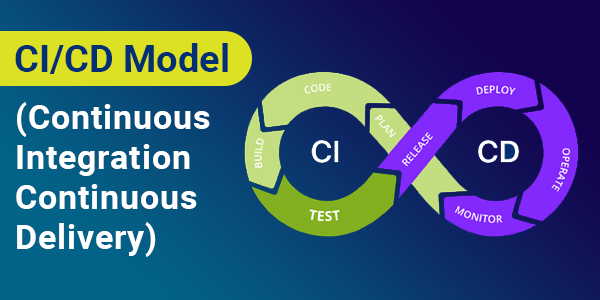
- Continuous testing inside CI/CD pipelines
At Triazine Software, this work sits alongside our broader custom software development and DevSecOps practice, so we build quality gates into delivery pipelines rather than adding them after the fact.
QA vs. Software Testing: Why the Difference Matters
The terms get used interchangeably, but they describe different things, and the distinction changes how a quality assurance testing services engagement should be scoped.
Software testing is the act of executing test cases to find defects. It happens after code is written and is reactive by nature: it catches bugs, but on its own it does not prevent them from being introduced. Unit testing, in particular, developers usually own as part of writing the code itself. At the same time, QA services typically focus on coordination, strategy, and higher-level validation above the unit level.
Quality assurance is proactive and process-focused. QA reviews requirements, design, and development practices to reduce the chances of defects in the first place. It includes testing, but testing is only one part.
A testing-only model often finds defects later in the cycle, closer to release, when they are more expensive to fix. A broader QA model addresses quality risks earlier, starting at the requirements and design stage.
Benefits of QA Testing Services
For enterprise teams deciding whether to invest further in QA, the practical payoff usually shows up in a few specific places:
- Fewer production defects. Catching issues earlier in the lifecycle means fewer bugs reach end users.
- Higher release confidence. Teams can ship on schedule without an eleventh-hour scramble to verify nothing broke.
- Faster release cycles. Automated regression removes the bottleneck of manually re-testing the full application on every release.
- Less manual regression effort. Engineering and QA time shifts from repetitive re-checking to higher-value test design and exploratory testing.
- Better application performance under real load. Performance testing surfaces bottlenecks before customers do.
- Stronger security and compliance readiness. Security-focused testing reduces exposure ahead of formal audits.
- Improved customer experience. Fewer defects and better performance translate directly into fewer support tickets and higher retention.
- Testing capacity that scales without permanent hiring. Managed QA and QA consulting let teams flex capacity up for major releases without carrying that headcount year-round.
Core Types of QA and Testing Services
Functional Testing Services
Functional testing verifies that a feature behaves as specified in the documented requirements. This spans component, system, and end-to-end validation, along with user-acceptance criteria, for enterprise applications with complex business logic, such as claims processing, order management, or EHS workflows. Functional testing services fill the gap between what was specified and what was built.
Automation and Regression Testing
Manual regression testing becomes harder to sustain as a codebase grows. Automated regression suites, run on every merge in CI/CD, let teams ship frequently without manually retesting the entire application each time. Building or maturing this automation layer is one of the more common starting points for QA consulting services engagements.
Performance and Load Testing
An application that works correctly under light traffic can still fail under real production load. Performance testing simulates realistic traffic to surface bottlenecks in database queries, API response times, and infrastructure scaling before customers encounter them.
Security Testing
Vulnerability scanning and security-focused test cases help reduce risk in applications handling sensitive data. Security testing supports compliance efforts, but it is not a substitute for full compliance work, which also requires governance, documentation, controls, and formal audits. If a specific engagement requires penetration testing, confirm with your provider whether they deliver it directly or coordinate it through a specialised security partner.
API and Integration Testing
Modern enterprise applications rarely stand alone. They connect to payment gateways, ERPs, identity providers, and third-party APIs. Integration testing verifies that these connections hold up under realistic traffic and edge cases, not just the expected path.
Mobile and Cross-Platform Testing
Mobile usage is a significant and growing share of traffic for many consumer and field-service applications. Testing across device fragmentation, OS versions, and network conditions is its own specialisation within QA, especially for field applications with inconsistent connectivity.
Accessibility Testing
For enterprise, public-sector, healthcare, and customer-facing products, accessibility testing against standards like WCAG is increasingly a requirement rather than a nice-to-have, for both compliance and reaching the full base of intended users.
How a QA Testing Engagement Actually Works
Enterprises comparing providers often understand the service types but not the workflow behind them. A typical engagement moves through these stages:
- Requirements review. QA analysts review business and technical requirements alongside the development team, flagging ambiguity or untestable requirements early.
- Test strategy. Defines scope, risk priorities, environments, and the manual-versus-automation split for the engagement.
- Test planning and design. Test cases are written and mapped to requirements, with traceability so coverage gaps are visible.
- Automation build. Automated scripts are built for regression-prone, high-frequency test paths; lower-value or one-off scenarios stay manual.
- Execution. Manual and automated tests run against the build, across functional, performance, security, and accessibility scope as applicable.
- Defect management. Issues are logged, prioritised by severity and business impact, and tracked through to verified resolution.
- Regression. Confirms that fixes and new code have not broken existing functionality.
- Reporting. Coverage, defect trends, and release-readiness are reported back to stakeholders in terms tied to business risk, not just raw test counts.
- Continuous testing. Steps 4 through 8 repeat automatically inside CI/CD on every merge, rather than as a separate end-of-sprint phase.
In-House QA vs. QA Consulting vs. Managed QA Services
Enterprises generally choose between three delivery models, and each fits a different stage of maturity.
| Model | Best for | Main advantage | Main limitation |
| In-house QA | Long-term product teams with QA central to the product | Deep product knowledge, daily embedding with engineering | Hiring, training, and retention overhead |
| QA consulting services | A specific, time-boxed problem (building automation, setting up a Test Center of Excellence) | Specialized, focused expertise | Usually scoped to a defined project, not ongoing execution |
| Managed QA services / QA testing as a service | Ongoing testing operations without growing an internal QA function | Flexible capacity, execution handled end-to-end | Requires clear governance and communication with the vendor |
QA testing as a service gives enterprises access to ongoing test planning, execution, automation, and reporting without building and managing a large internal QA function, scaling up or down with the release calendar.
Most enterprises land on a hybrid: a lean in-house QA lead who owns strategy, backed by a managed testing partner for execution and surge capacity around major releases.
What Drives QA Testing Services Pricing
There is no single market rate for QA testing services, since scope varies too much between engagements. The variables that actually move the cost are:
- Manual-to-automation ratio. Automation costs more upfront to build but reduces cost per release over time; pure manual testing is cheaper to start but more expensive to sustain.
- Number of applications and environments. Testing three environments (dev, staging, production-like) costs more than testing one.
- Device and browser coverage. Broader compatibility matrices increase execution time and, for automation, script maintenance.
- Testing frequency. Weekly releases require a different operating rhythm and cost structure than quarterly ones.
- Performance testing requirements. Load testing at enterprise scale requires dedicated tooling and environment setup that adds to scope.
- Security testing scope. Basic vulnerability scanning costs less than a full penetration test coordinated with a security specialist.
- Integration complexity. More third-party systems and APIs in scope means more integration test cases to design and maintain.
- Required team composition. A mix of manual testers, automation engineers, and a QA lead costs differently than a single generalist tester.
Most providers price managed QA as a monthly retainer or per-sprint model rather than a flat project fee, since ongoing testing needs scale with release velocity rather than staying fixed.
What to Look For in a QA Partner Right Now
A few enterprise testing concerns are becoming more common and are worth asking any provider about directly, rather than assuming they are already covered:
- Testing AI-enabled features. Applications with AI-generated or AI-assisted output introduce non-deterministic behaviour that traditional pass/fail test cases were not designed to catch, so they need their own testing approach.
- API-first and event-driven architectures. As applications move toward microservices and asynchronous event flows, testing needs to validate contracts and message flows, not just synchronous request-response paths.
- Privacy in test environments. Using production-like data in staging and test environments raises its own privacy risk, so test data management and masking should be part of the conversation.
- Production observability. Testing does not stop at deployment. Monitoring and validating behaviour in production, not just pre-release, is part of a mature QA practice.
- Software supply-chain risk. Testing needs to account for vulnerabilities introduced through third-party libraries and dependencies, not only first-party code.
- Quality metrics tied to business outcomes. Coverage percentages alone do not tell you much. Metrics like escaped defects, automation pass rate, regression duration, defect leakage, and mean time to resolution connect testing activity to actual release risk.
QA Metrics Worth Tracking
A QA program is hard to manage without visibility into whether it is actually working. A few metrics enterprise teams commonly track:
- Escaped defects — bugs found in production that testing should have caught
- Automation pass rate — the percentage of automated tests passing consistently, a proxy for suite health
- Regression duration — how long a full regression cycle takes, which affects release velocity
- Defect leakage — the rate at which defects move from one testing stage to the next without being caught
- Coverage by risk area — test coverage weighted by the business criticality of the feature, not just raw percentage
- Mean time to resolution — how quickly defects found in testing get fixed and verified
How to Evaluate a QA Testing Company
When comparing quality assurance service providers, a few questions separate the serious options from the rest:
- Do they build and maintain automation frameworks, or mostly execute manual scripts?
- Can they show relevant experience with your industry's compliance requirements?
- How do they report on quality, using metrics like escaped defects and coverage by risk, rather than just a raw bug count?
- Do they integrate directly into your CI/CD pipeline, or run testing as a separate, disconnected phase?
- What is their model for scaling capacity during major releases without a long ramp-up?
- Do they test accessibility and non-functional requirements, or only functional behaviour?
FAQ
What is included in QA testing services?
QA testing services typically include test strategy and planning, functional and regression testing, test automation, performance testing, security testing, accessibility testing, and continuous testing integrated into CI/CD pipelines. The exact scope depends on the application and industry.
What is the difference between QA services and software testing?
Software testing finds defects in a finished product and is generally reactive. QA is a broader, proactive discipline that reduces defects by improving processes across the development lifecycle. Testing is one part of QA, not the whole.
How much do managed QA services cost?
Managed QA pricing depends primarily on the manual-to-automation ratio, number of applications and environments, device and browser coverage, testing frequency, and whether performance or security testing is in scope. Most providers price it as a monthly retainer or a per-sprint model rather than a flat project fee.
When should a company hire a QA consulting service instead of building an in-house team?
QA consulting fits a specific, time-boxed problem, such as building an automation framework, setting up a Test Centre of Excellence (a dedicated internal function that standardises testing tools, processes, and best practices across teams), or auditing a rising defect rate. If quality assurance needs to run continuously and be embedded in daily development, an in-house team or managed QA service is usually a better long-term fit.
Can QA testing services be added to an existing development project mid-way?
Yes. A common entry point is a QA audit of the existing codebase and test coverage, followed by a prioritised plan to close the highest-risk gaps first, without disrupting the current release schedule.
Where This Fits in Your Software Delivery
Quality assurance works best when it is not a separate vendor relationship bolted onto development. At Triazine Software, enterprise QA testing sits alongside agile development, DevSecOps, and cloud development and migration, so QA automation, security, and delivery move on the same pipeline instead of three disconnected ones.
Can your current QA model support your release pace? Triazine Software can assess your test coverage, automation maturity, and highest-risk quality gaps, then recommend a practical improvement plan. See our full QA testing services page, look at examples in our case studies from regulated industries like EHS and healthcare, or get in touch to start with a QA audit.

























































 Get free quote