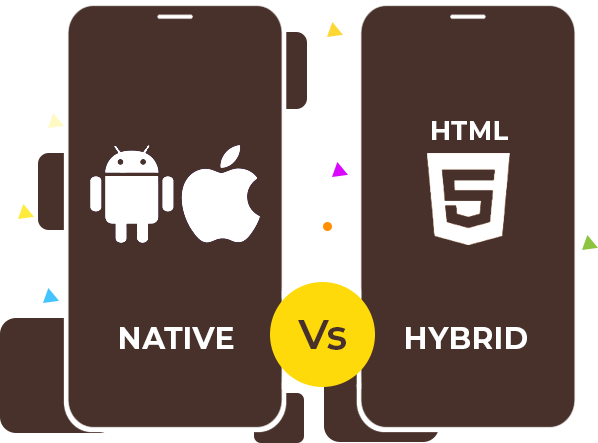
Hybrid Mobile App Vs. Native Mobile App: Am I Making A Right Choice?
This seems to be a million-dollar question when it comes for making a choice between hybrid mobile app or native mobile app development. I have been hearing this question not only from my prospects but from existing customers as well each time either we start a new mobile project or engage for the first time.
Based on my experience and interactions with customers, I strongly observed that this is one of the biggest bottlenecks that customers struggle with and for that matter even app developers for convincing customers and helping and guiding them making a right choice as per their business need.
Trust me, there is no definite answer to this question and it cannot be as it has many aspects that must be explored in detail before making a final choice.
Considering all these, I am highlighting pros and cons of Hybrid and Native mobile app development approaches that you should take in account for developing mobile app that not only fulfills customer need but keeps all the stakeholders on a same page without any surprises with the outcome.
Let us first understand both the approaches for better clarity. However, for app users it doesn't matter the underlying technology the app is developed on.
What is Native App?
Native mobile app is developed using platform-specific programming language and designed to run on a specific mobile operating system. For example, Java is used for Android app development and Objective-C or Swift is used for iPhone app development for iOS mobile operating system.
Since the native apps are developed using mobile OS-specific languages, they closely follow the technical and user experience guidelines and standard laid down by mobile operating system manufacturers. These apps take significant advantage of being able to easily access device hardware and utilize capability of user's devices such as camera, GPS, contact etc.

Pros and Cons of Native App Development
Learn more about Native App Development and how it can support performance-focused mobile products.
| Pros | Cons |
| Fast Performance | High Cost |
| seamless User Experience | Complex Code |
| Easy utilization of native features | Separate Code base for iOS & Android |
Native Technology Stack
- Objective-C/Swift for iOS
- Java for Android
What is Hybrid App?
"Code Once and Run Everywhere" is the idea behind hybrid mobile app development. Hybrid app is essentially a web app which runs in mobile browser wrapped in a native container.
Hybrid apps are designed to run on all mobile operating system with minimal or no tweaks. HTML5, CSS3 along with native plugins are at the core of hybrid mobile app development.

Pros and Cons of Hybrid App Development
| Pros | Cons |
| Saves Time - Faster App Development | Dependency on native plugins |
| Saves Money - Less App development Cost | Dependency upon device mobile browser web kit for rendering app pages |
| Single Code Base - Easy to maintain | Supporting multiple screen resolutions |
Hybrid Technology Stack
- Ionic
- React Native
- Flutter
- Xamarin
Basic Guidelines for Choosing Between Native and Hybrid
In my opinion, apply 70-30 thumb rule. If 70% features of the app use device hardware and native device features, I recommend following "Native App Development Approach" otherwise most of your app requirements can be developed following "Hybrid App Development Approach".
Factors to be considered for making a choice:
- Time to Market
- App Development Cost
- Code Maintainability
- Performance
- App Features (use of device hardware and native device feature)
High-Level Guidelines to Choose Your App Development Approach
- Intensive use of device hardware and native device features like Camera Customization, GPS, Bluetooth, Printing Devices etc. makes a right candidate for "Native App Development" as this eliminates dependency upon native plug-ins.
- Media rich apps like gaming apps, rich animated apps are best suited for "Native App Development.
- If you want to give best of user experience to your users and relies heavily on user interaction, then go for "Native App Development".
- For Startups, go for Hybrid App Development because making the world realize that your idea works much more important than anything else unless your app features fall in 70-30 criteria as mentioned above.
- If you are targeting multiple platforms in shorter span of time and bit tight on your budget, go for Hybrid App Development.
Conclusion
There is no denying that native apps have edge in terms of performance, scalability etc. But, now a days, next-generation hybrid apps are not lagging far behind and the credit goes to the emerging latest hybrid platforms and growing hybrid community.
Latest hybrid platforms such as IONIC, AngularJS, React, Flutter provides close native look and feel and improved performance if designed and developed intelligently considering technology boundaries.
Based on the above facts and figures, I believe it is quite clear that there is no clear winner and it is debatable as well as both the approaches have pros & cons. The choice between hybrid and native approaches is purely based on your business need and scale.
I strongly suggest having a Decision Analysis & Resolution (DAR Analysis) to determine a recommended approach.




































































 Get free quote