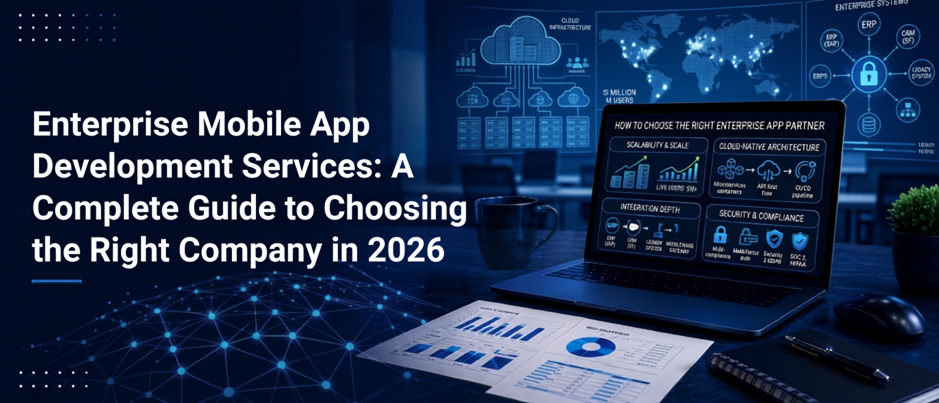
Enterprise Mobile App Development Services: A Complete Guide to Choosing the Right Company in 2026
Enterprise mobile app development in 2026 isn't about "building an app." It's about delivering a secure, integrated, always-on mobile layer that works across legacy ERPs, identity providers, compliance regimes, and thousands of concurrent users. Market spend backs up the urgency: enterprise mobile application development is on track to move from roughly $174 billion in 2025 to nearly $197 billion in 2026, and past $320 billion by 2030. With that kind of money moving through the space, the real question for a buyer isn't who can build an app it's who can operate one at enterprise scale.
For a CTO, IT director, or digital transformation lead evaluating enterprise mobile app development companies, that distinction is the whole evaluation. An enterprise app is a small visible layer sitting on top of a much bigger system legacy ERPs, identity providers, compliance requirements, offline field conditions, and thousands of concurrent users who can't afford downtime.
This guide walks through what enterprise app development actually involves, what separates a real enterprise mobile app development platform from a glorified consumer app template, and how to choose an enterprise mobile app development company that can operate at that scale.
What Enterprise App Development Actually Means
Enterprise app development is the process of building mobile and web applications specifically for the operational, workforce, and customer-facing needs of large organizations as opposed to consumer apps built for a mass, anonymous audience. App enterprises use these tools to run core business functions: field service dispatch, distributor and retailer management, permit-to-work and safety compliance, customer self-service portals, and internal productivity tools that connect directly into ERP, CRM, or SCADA systems.
The distinction matters because the engineering requirements are different from day one:
| Consumer apps | Optimize for acquisition, virality, and simple onboarding. |
| Enterprise apps | Optimize for security, integration depth, uptime, auditability, and long-term maintainability across a workforce that didn't choose to download the app they were assigned it. |
That difference shows up in every technical decision, from authentication (SSO/SAML instead of social login) to data architecture (multi-tenant, role-based access instead of a single user table) to deployment (MDM-managed rollout instead of app store discovery).
The Core Enterprise Mobile App Development Services You Should Expect
A genuine enterprise mobile app development company delivers more than a build phase. The full service scope typically includes:
| Discovery and platform architecture | Mapping existing systems (ERP, CRM, legacy databases), identifying integration points, and deciding on cloud-native vs. hybrid deployment before a single screen is designed. |
| Custom enterprise mobile app development | Purpose-built apps for field force automation, secondary sales and distributor management, EHS and permit-to-work compliance, customer self-service, and workforce productivity built around your actual business process, not a generic template. See our approach to custom software development. |
| Cross-platform and native engineering | Flutter and React Native for shared codebases across iOS and Android where speed-to-market matters; native development where performance, offline sync, or hardware access (RFID, barcode scanners, IoT sensors) demands it. |
| Systems integration | API gateways and middleware connecting the app to ERP platforms, identity providers, and third-party data sources often the hardest and most underestimated part of the project. |
| Security and compliance engineering | End-to-end encryption, MFA, role-based permissions, and architecture built to meet GDPR, HIPAA, SOC 2, or industry-specific regulatory requirements depending on your sector reinforced by DevSecOps practices baked into the delivery pipeline. |
| MDM/MAM deployment and device management | Managing rollout across company-owned and BYOD devices, with mobile application management wrapping data protection around the app itself rather than the whole device. |
| Post-launch support and platform evolution | Enterprise apps are never really "done" they need ongoing maintenance, new integrations as backend systems change, and a team that still understands the architecture two years after go-live. |
What Makes an Enterprise Mobile App Development Platform Different
Not every "platform" claim holds up under scrutiny. A real enterprise mobile app development platform is built around a few non-negotiable architectural principles:
| Requirement | Why It Matters |
| Cloud-native, microservices architecture | Supports scaling from thousands to millions of users without a full rebuild |
| API-first integration layer | Lets the mobile app evolve independently of legacy backend systems |
| Offline-first data sync | Keeps field teams working in low-connectivity environments (warehouses, remote sites, rural coverage) with conflict resolution when they reconnect |
| Role-based access control | Ensures a field technician, area manager, and admin see only what their role requires |
| Multi-layer security | Encryption in transit and at rest, secure API gateways, and continuous vulnerability testing |
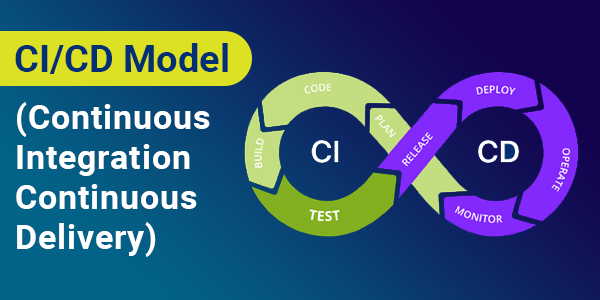
| DevSecOps pipeline | Security checks built into CI/CD rather than bolted on before release |
This is also where AI has moved from a nice-to-have to a baseline expectation. Predictive maintenance from IoT-connected assets, intelligent document processing, anomaly detection on operational data, and natural-language search over internal knowledge bases are now standard asks in enterprise RFPs not experimental add-ons.
Custom Development vs. Off-the-Shelf and Low-Code
Enterprises evaluating their options usually land on one of three paths:
| Off-the-shelf software | Fast to deploy, but rarely fits a business process that has evolved around your specific operations, industry, and compliance environment. |
| Low-code platforms | Reasonable for simple internal tools, but they tend to hit a ceiling fast on complex integrations, custom workflows, or apps that need to serve millions of external customers. |
| Custom enterprise mobile app development | Higher upfront investment, but the app is built around your actual processes and can scale and integrate without the constraints of a vendor's platform limits. |
For organizations running mission-critical operations utilities, government platforms, manufacturing safety systems, large-scale customer platforms custom development is usually the only option that holds up once the app is supporting real operational volume rather than a pilot.
As a rough self-qualifying rule:
| Low-code is reasonable when | The app is a simple internal tool, integrations are limited, expected usage is under roughly 10,000 monthly active users, and compliance/audit risk is low. |
| Custom development is required when | The app needs deep ERP, CRM, or SCADA integration, complex multi-role workflows, an external customer base, meaningful compliance exposure, or expected scale in the hundreds of thousands to millions of users. |
The 2026 Enterprise App Vendor Checklist
Before getting into evaluation criteria in depth, here's the short version the six things a vendor should be able to demonstrate, not just claim, in 2026:
| AI as baseline, not add-on | Predictive maintenance, anomaly detection, intelligent document processing, and natural-language search over internal data should already be part of their delivery vocabulary. |
| Security-first delivery | Zero Trust patterns, automated vulnerability scanning built into CI/CD, and working fluency in GDPR, HIPAA, or SOC 2 depending on your industry. |
| Proven performance at scale | Live platforms in the hundreds of thousands to millions of active users not demo environments. |
| Real integration depth | Specific, named examples of ERP, SCADA, or middleware integrations not a generic "we do integrations" line. |
| Modern cross-platform engineering | Flutter or React Native delivering near-native performance, with real-time monitoring and telemetry post-launch. |
| Post-launch ownership | Multi-year support commitments, not a handoff at go-live. |
How to Evaluate Enterprise Mobile App Development Companies
Most evaluation checklists focus on tech stack alone. That's necessary but not sufficient. Here's what actually separates enterprise-ready partners from generalist app shops:
| Proven delivery at enterprise scale | Ask for platforms currently supporting hundreds of thousands or millions of active users not just app store screenshots. |
| Quality certifications | CMMI Level 3 and ISO 9001:2015 indicate a mature, auditable delivery process, which matters when you're accountable to your own stakeholders for vendor risk. |
| Industry-specific experience | A team that has already built for oil & gas field operations, FMCG distribution, healthcare, or government compliance will ask sharper discovery questions than one starting from zero. |
| Long-term partnership track record | Enterprise platforms get extended, not replaced. A company with clients who've stayed for 7+ years and kept expanding scope is a stronger signal than one optimized for one-off projects. |
| Integration depth, not just app design | Ask specifically how they've connected mobile apps to legacy ERP or SCADA systems this is where most enterprise app projects actually get stuck. |
| Transparent, staged engagement | Discovery and architecture before a full build commitment, so integration risk surfaces early rather than at UAT. |
If you're weighing these criteria against your own shortlist, a enterprise mobility architecture review can flag integration risks before they show up in an RFP.
Cost and Timeline Expectations
Enterprise mobile app development costs vary widely based on integration complexity, compliance requirements, and scope. As a general planning range (see our deeper breakdown on mobile app pricing strategy):
| Single-workflow app, limited integrations | Roughly $150K–$350K, 4–6 months. |
| Multi-module platform with ERP/CRM integration, RBAC, and offline sync | Roughly $350K–$900K+, 6–10 months. |
| Customer-facing platform at scale (100K–1M+ users), compliance-heavy | Roughly $900K–$2M+, 9–12+ months, with continuous investment afterward as the platform expands. |
Any vendor quoting a fixed low price and a two-month timeline for a genuinely enterprise-scale app is either underestimating the integration work or planning to cut corners on security and testing.
How Triazine Software Approaches Enterprise Mobile App Development
Triazine Software is a CMMI Level 3 and ISO 9001:2015 certified enterprise technology partner with over 11 years of enterprise delivery experience, 500+ solutions and platforms delivered, and platforms currently supporting 5 million-plus users. That track record spans some of the harder categories in enterprise mobility:
| IGL Connect | A customer self-service platform for Indraprastha Gas Limited. Outcome: 2 million-plus customers served on one platform for billing, field operations, and engagement, sustained over an 11-year partnership. |
| Domino's Pizza mobile ordering platform | Rebuilt on IBM MobileFirst and AWS. Outcome: engineered to handle peak-traffic mobile ordering at scale and recommended by IBM. |
| Schindler and Toyota Boshoku | Digital permit-to-work and EHS compliance platforms via PrimeEHS. Outcome: multi-facility manufacturing rollout with a full compliance audit trail. |
| MNGL and government platforms | Field force, billing, and citizen-facing systems. Outcome: platforms built for organizations where downtime and data accuracy carry direct operational consequences. |
Because Triazine works across enterprise mobile app development, cloud-native platform engineering, and legacy systems integration under one roof, the mobile layer is designed alongside the backend architecture from day one not handed a set of APIs to work around after the fact. That's the difference between an app that looks good in a demo and a platform that still works when the transaction volume, user base, and integration count are ten times what they were at launch.
Frequently Asked Questions
What is enterprise mobile app development?
It's the process of designing, building, and maintaining mobile applications purpose-built for large organizations' internal operations or large-scale customer bases, with an emphasis on security, systems integration, and long-term scalability rather than mass consumer acquisition.
How is enterprise app development different from regular app development?
Enterprise app development has to account for legacy system integration, role-based access, regulatory compliance, offline reliability, and managed device deployment requirements that rarely apply to a standard consumer app build.
How long does enterprise mobile app development take?
Most first releases take 4 to 12 months depending on integration complexity, compliance scope, and the number of user roles and backend systems involved.
Should we choose custom development or a low-code platform?
Low-code can work for simple internal tools. Once the app needs deep ERP/CRM integration, complex workflows, or has to serve a large external customer base reliably, custom enterprise mobile app development is usually the safer long-term choice.
What should we look for in an enterprise mobile app development company?
Proven delivery at real user scale, recognized quality certifications like CMMI Level 3, relevant industry experience, a track record of long-term client partnerships, and demonstrated depth in legacy system integration not just app design portfolios.
Triazine Software is a global enterprise technology partner delivering custom enterprise mobile app development, cloud-native platforms, and systems integration for organizations across Oil & Gas, FMCG, Healthcare, Government, and Industrial Safety. Request a roadmap session to assess your current mobile stack and integration risks.







































 Get free quote