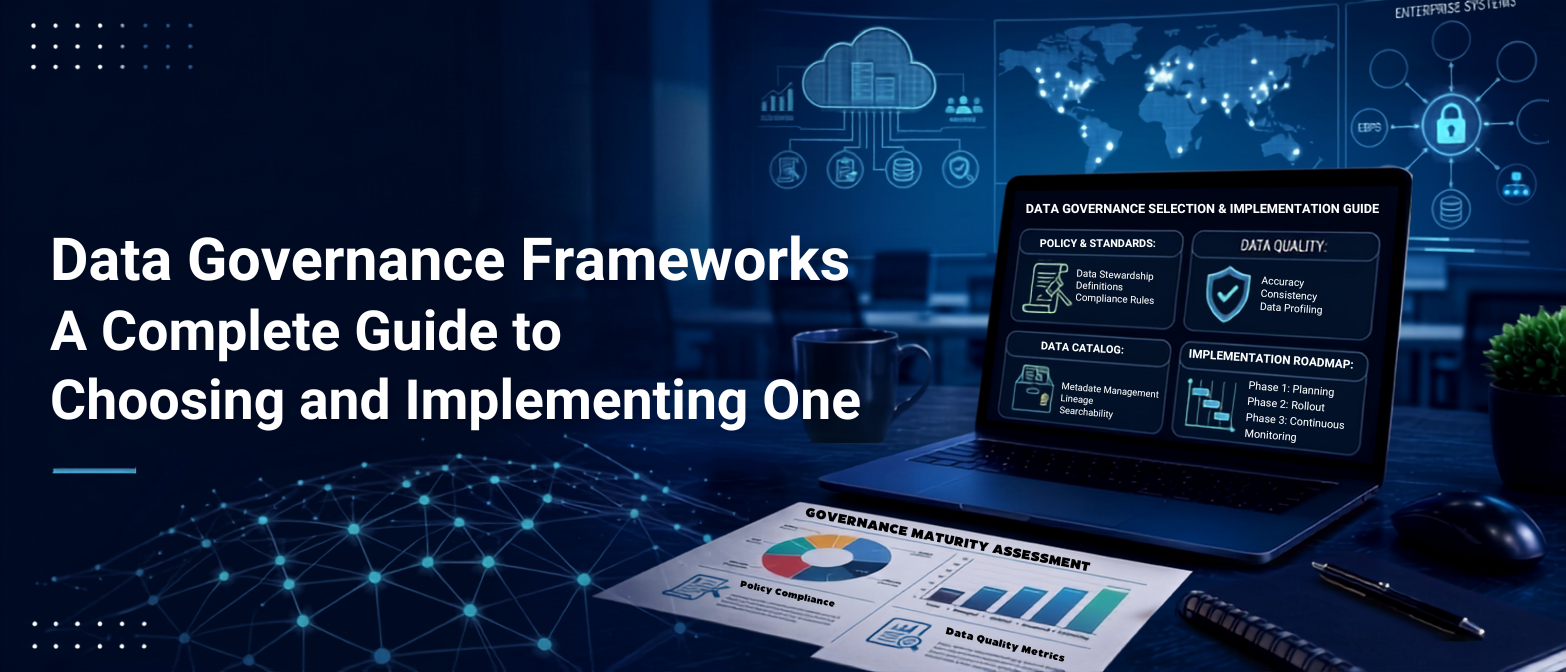
Data Governance Frameworks: A Complete Guide to Choosing and Implementing One
Most organizations don't fail at data governance because they picked the wrong framework. They fail because they treat the framework as a document instead of a working system—a set of policies that sits in a wiki. At the same time, the underlying data platform has no owners, no lineage, and no enforcement layer connecting the two.
That gap is worth naming upfront, because it shapes everything in this guide. A data governance framework is the structure of the roles, policies, standards, and processes that tells an organization who is accountable for data and how decisions about it get made. But a framework only works if it's wired into the systems that actually hold and move your data: your data warehouse, your catalogue, your access controls, your pipelines. This guide covers both halves: the governance models themselves, and what it actually takes to operationalise one.
What Is a Data Governance Framework?
A data governance framework is a structured system of rules, roles, and processes that defines how an organization manages the availability, integrity, security, and usability of its data. It answers four questions that every governance initiative eventually has to confront:
- Why are we governing this data? (compliance, trust, monetization, AI readiness)
- What data actually needs governing? (not everything, the critical and sensitive subsets)
- Who is accountable for it? (data owners, stewards, a governance council)
- How does governance happen day to day? (policies enforced through tooling, not just intent)
Without an explicit framework, governance tends to default to whichever team shouts loudest, usually IT security or compliance, which leaves business context and data quality underserved. A documented framework distributes that accountability deliberately instead of by accident.
Why It Matters More in 2026
Two forces have made this a board-level topic rather than an IT one. First, regulatory pressure has broadened well beyond GDPR and HIPAA into sector-specific and regional data laws, and auditors increasingly expect organizations to demonstrate controls, not just claim them. Second, and more recent, is the shift toward AI agents acting directly on enterprise data. An agent that queries a poorly governed dataset will confidently produce wrong answers at a scale a human analyst never could. Organizations that had already invested in clean ownership, lineage, and certified definitions before adopting AI are the ones scaling it successfully now; governance debt compounds the same way technical debt does.
Core Components of a Data Governance Framework
Regardless of which named framework you eventually adopt, every functioning governance program is built from the same building blocks.
1. Vision and Strategic Alignment
A framework needs a stated reason for existing that ties back to business objectives: regulatory readiness, data monetization, operational efficiency, or AI enablement. Frameworks that exist purely as a compliance checkbox rarely survive budget cuts; frameworks tied to a measurable business outcome do.
2. Guiding Principles
Short, explicit statements about data as a shared asset, privacy by design, and a single source of truth that give stewards a consistent basis for decisions when policy documents don't cover an edge case.
3. Organizational Roles and Accountability
This is where most frameworks live or die. At minimum, you need:
- Data Owners, typically business leaders accountable for a domain (finance data, customer data, operations data)
- Data Stewards: the people who maintain quality, definitions, and documentation day to day
- A Governance Council or Committee is cross-functional, resolves conflicts and sets policy
- A Data Governance Lead/Office coordinates the program across domains.
A common failure mode is stopping here, publishing an org chart and calling it governance. The roles have to be written into actual system permissions, not just a RACI slide.
4. Policies and Standards
Concrete rules: data classification tiers, retention schedules, access approval workflows, quality thresholds, naming conventions. These need to be specific enough that a steward can apply them without escalating every decision.
5. Data Quality Management
Defined rules for accuracy, completeness, consistency, and timeliness, with measurement built in, not assumed. Most mature programs track a data quality score per domain and review it in the same cadence as other operational metrics.
6. Metadata Management and Cataloguing
A framework is only as good as its ability to tell someone what a piece of data means, where it came from, and who touched it. This is the layer that's hardest to bolt on later; metadata and lineage tracking need to be part of how pipelines are built, not a documentation exercise that trails behind them. This is closely tied to how the underlying data warehouse is designed in the first place; early schema decisions determine how easy lineage and cataloguing are later.
7. Technology Enablement
Catalogues, lineage tools, access-governance platforms, and quality-monitoring systems are what turn written policy into something that's actually enforced. A policy that says "sensitive fields require approval for access" means nothing until it's a working rule in your identity and access layer. This is also where BI and reporting and predictive analytics initiatives either succeed or stall—clean, governed data upstream is what makes downstream dashboards and models trustworthy.
8. Metrics and Continuous Improvement
Policy adherence rates, data quality scores by domain, time to resolve data issues, audit findings. Governance programs that never measure themselves tend to stop being followed quietly within a year.
Comparing the Major Data Governance Frameworks
Several named frameworks formalise the components above into a defined methodology. None of them is universally "best"; each optimises for a different starting problem.
| Framework | Origin | Best Suited For | Core Focus |
| DAMA-DMBOK | DAMA International | Organizations that need a comprehensive, vendor-neutral vocabulary and knowledge base | 11 knowledge areas spanning data quality, architecture, metadata, and modeling |
| COBIT | ISACA | Enterprises where data governance must tie into broader IT risk and audit controls | IT governance objectives aligned to business risk and compliance |
| DCAM | EDM Council | Regulated industries (especially financial services) that need to benchmark maturity | Capability assessment across defined governance components with maturity scoring |
| DGI Framework | Data Governance Institute | Organizations whose core problem is unclear ownership and decision rights | Ten organizational components focused on accountability, not technical depth |
| CMMI (Data Management) | CMMI Institute | Organizations wanting a structured maturity path for process improvement | Staged maturity levels for evaluating and improving data practices over time |
| ISO 38505 | ISO | Organizations needing board-level, internationally recognized governance standards | High-level principles for the governance of data as an organizational asset |
A few practical patterns worth knowing:
- DAMA-DMBOK is the most comprehensive starting point if your core problem is inconsistent data quality and a lack of shared definitions across teams. It's also the most likely to feel overwhelming if adopted wholesale on day one; most teams use it as a reference model rather than implementing all 11 knowledge areas at once.
- COBIT fits organizations where data governance can't be separated from existing IT governance and audit processes—common in regulated enterprises that already run COBIT for other IT controls.
- DCAM is the framework of choice in financial services specifically because it gives you a maturity score you can report to a regulator or a board, not just a policy document.
- DGI is the right entry point when the actual blocker isn't a lack of process; it's that nobody agrees who owns a given dataset. It's lightweight enough to stand up in weeks rather than quarters.
- CMMI rarely stands alone; it's typically layered on top of DAMA or DGI to give a maturity roadmap for how governance improves over time.
Which Framework Should You Choose?
The honest answer is that most mature programs end up blending two: a foundational model (DAMA-DMBOK or DGI) for vocabulary and accountability, paired with a maturity or audit layer (DCAM, COBIT, or CMMI) suited to their industry's regulatory posture. A practical way to decide:
| Organization or Challenge | Recommended Framework |
| Small or mid-sized organization, no clear owners yet | Start with DGI's lightweight ownership model before adding anything heavier. |
| Data-quality-first problem, need shared vocabulary | Use DAMA-DMBOK as a reference, adopted incrementally by domain. |
| Financial services or heavily regulated, need to show maturity to auditors/regulators | Choose DCAM, or COBIT if data governance sits inside a broader IT governance function. |
| Public sector, energy, or infrastructure organizations under board-level scrutiny | Use ISO 38505 as the governance principle layer, with DAMA or DGI underneath for execution. |
How to Build and Implement a Data Governance Framework
Choosing a framework on paper is the easy part. Implementation is where most initiatives stall, typically for one of three reasons: no executive sponsor with budget authority, policies that were never connected to actual system controls, or an attempt to govern everything at once instead of starting with one critical domain.
Step 1: Establish Sponsorship and Scope
Governance without an executive sponsor who controls budget and can resolve cross-departmental conflicts rarely survives its first disagreement. Scope the first phase to one or two critical data domains; customer data or financial data are common starting points rather than attempting an enterprise-wide rollout.
Step 2: Assess Current State
Inventory what data exists, where it lives, who currently (informally) owns it, and where the biggest quality or compliance gaps are. This assessment is what turns an abstract framework choice into a prioritised backlog.
Step 3: Define Roles and Assign Ownership
Name actual people as data owners and stewards for the domains in scope, not departments or individuals. Write their responsibilities into job expectations, not just a governance charter.
Step 4: Set Policies Tied to Real Systems
Translate principles into rules that map directly onto your data platform: who can access what, how data gets classified, retention periods by data type, quality thresholds that trigger alerts. A policy that can't be expressed as a system rule usually won't be followed consistently.
Step 5: Implement the Technical Layer
This is the step most governance guides skip past, and it's where the program either becomes real or stays theoretical. It typically means:
- A data catalogue that makes ownership, definitions, and lineage discoverable
- Access governance tied to data classification, not manual approval chains
- Automated data quality monitoring against the thresholds set in Step 4
- Lineage tracking built into pipelines as they're built, not audited after the fact.
Step 6: Measure, Report, and Iterate
Track policy adherence, data quality scores, and audit outcomes on a defined cadence, and feed findings back into the governance council. Treat the framework as a living system that gets revised as the organization's data estate changes, not a document that gets signed off once.
Common Reasons Data Governance Frameworks Fail
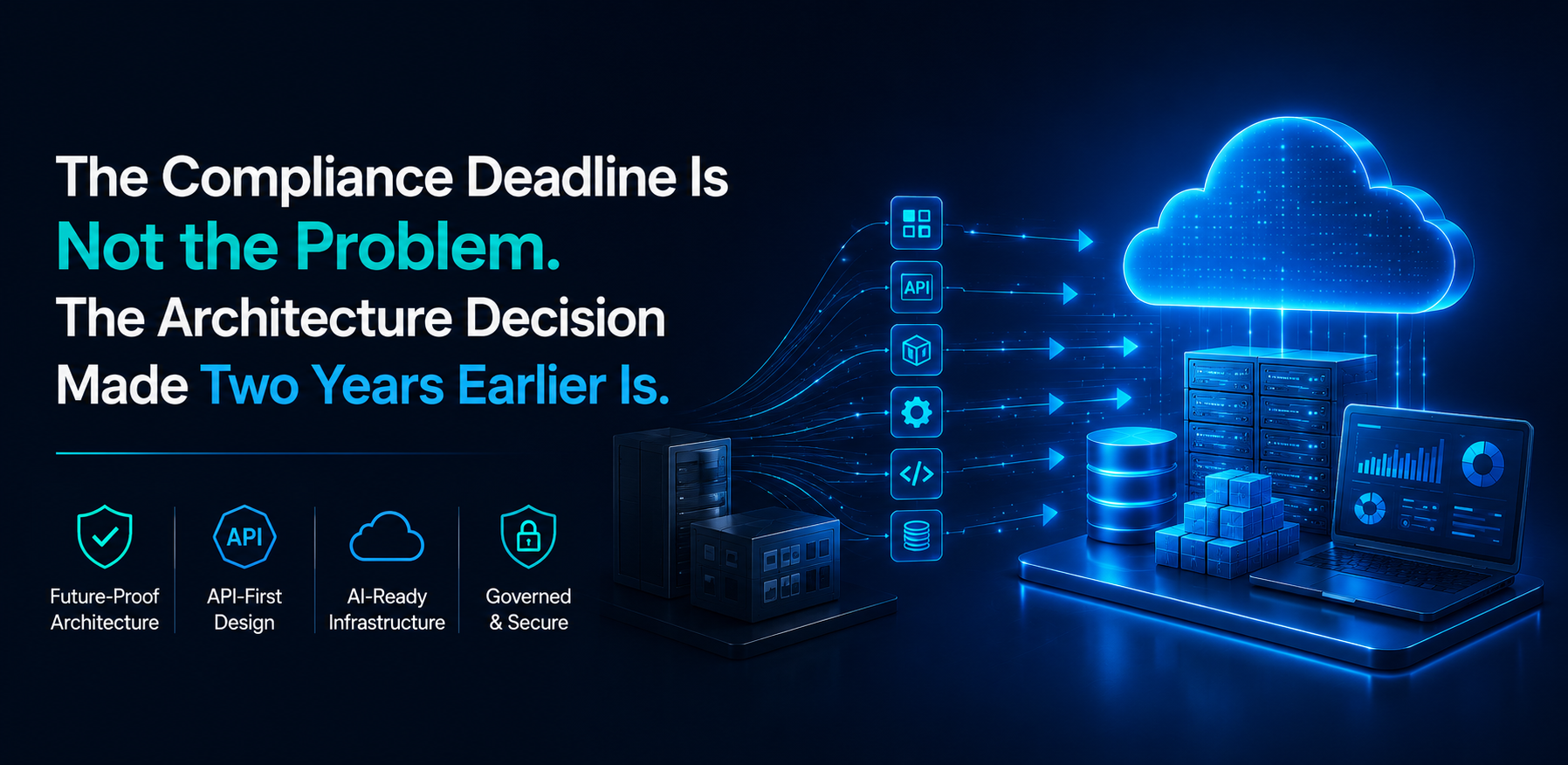
Most governance failures trace back to architecture decisions made years before the audit or the AI rollout that exposed them, a pattern explored in more depth in why the compliance deadline is rarely the real problem.
| Common Failure | Why It Fails |
| No enforcement layer | Policies exist in a document; nothing in the actual systems checks whether they're followed. |
| Governing everything at once | Enterprise-wide rollouts without phased scoping collapse under their own coordination cost. |
| Ownership assigned to departments, not people | Diffuse accountability means nobody actually acts when a data quality issue surfaces. |
| No connection to business outcomes | A framework justified purely by compliance loses budget the moment there's a cost-cutting cycle; one tied to decision quality or AI readiness survives it. |
| Treating it as a one-time project | Data estates change continuously: new sources, new pipelines, new regulations—and a framework that isn't revisited becomes stale within a year. |
Data Governance in the Age of AI Agents
As AI agents move from answering questions to taking actions on enterprise data, the requirements on a governance framework expand. It's no longer enough to govern reports and dashboards; the framework has to account for which datasets trained or grounded a model, how lineage is preserved as data flows into automated decisions, and how explainability and bias monitoring connect back to the same ownership and quality controls used everywhere else. Organizations with a mature catalogue, clear ownership, and enforced quality standards before adopting AI at scale consistently have an easier path than those trying to retrofit governance around agents already in production—a distinction covered in detail in this guide to taking agentic AI from pilot to production.
Frequently Asked Questions
What is the difference between data governance and data management?
Data governance defines the rules, roles, and accountability for data—the "who decides" layer. Data management is the operational execution of those decisions—the day-to-day work of storing, integrating, and maintaining data. Governance sets policy; management carries it out.
Which data governance framework is easiest to implement first?
The DGI framework is generally the fastest to stand up because it focuses narrowly on ownership and decision rights rather than a full technical knowledge base, making it a practical starting point for organizations without an existing governance function.
Do small and mid-sized businesses need a formal data governance framework?
Not the full weight of an enterprise model. Most benefit from a lightweight version: clear data owners, a handful of classification and access policies, and basic quality checks on the datasets that matter most rather than adopting a comprehensive framework wholesale.
How long does it take to implement a data governance framework?
A scoped first phase covering one or two data domains typically takes three to six months, including current-state assessment, role assignment, and initial technical controls. Enterprise-wide maturity is usually a multi-year, phased effort.
Can a data governance framework be implemented without new technology?
Policy and roles can be defined without new tooling, but enforcement generally can't scale without it. Manual approval processes and spreadsheet-based data catalogues work for very small scopes but break down quickly as the number of datasets and stakeholders grows.
Getting the Technical Layer Right
Most guides to data governance frameworks stop at the policy document. The harder, less-written-about part is making the framework operational—building the catalogue that makes ownership discoverable, wiring access policies into the identity layer, and instrumenting pipelines for lineage from the start rather than retrofitting it later. Triazine works with enterprises across cloud platforms (Azure and AWS) and custom software engineering to take a governance framework from a defined model to a working system, connecting the roles and policies an organization has agreed on to the catalogues, access controls, and monitoring that actually enforce them day to day. This work runs across regulated sectors such as energy, healthcare, and government, where governance and audit-readiness are business-critical rather than optional.
If your organization has a framework on paper and is now facing the harder question of implementation, that's the conversation worth having.


























































 Get free quote