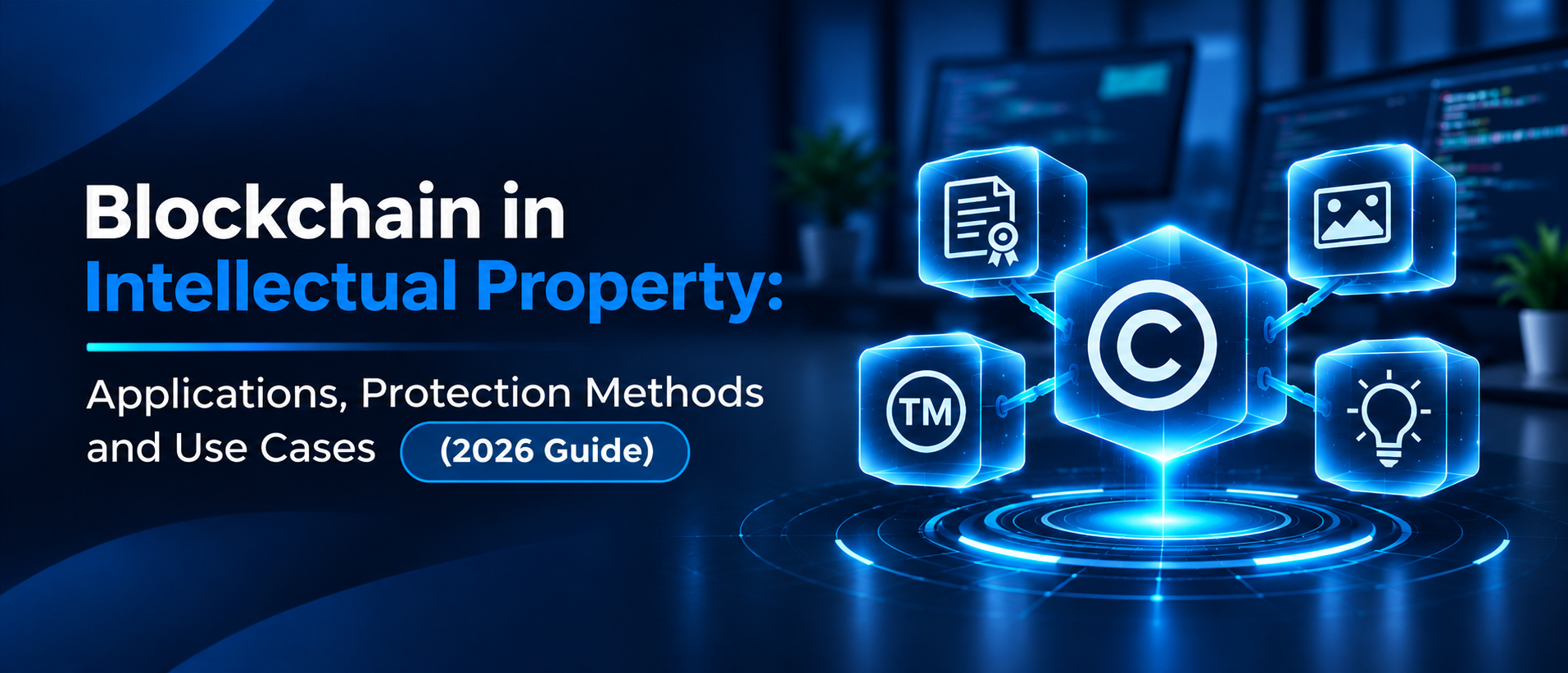
Blockchain in Intellectual Property: Applications, Protection Methods and Use Cases (2026 Guide)
Proving Who Created What, and When
Intellectual property is now the most valuable asset class many American companies own: patents behind new products, trademarks behind trusted brands, copyrights behind software, media and design, and trade secrets behind competitive advantage. Protecting that value starts with one remarkably simple question: who created this, when, and who holds the rights today? Blockchain in intellectual property offers a powerful answer, giving creators and rights holders a tamper-evident, time-stamped and verifiable record of creation, ownership and use.
The pressure on IP systems is real and growing. The US Patent and Trademark Office reported 776,995 unexamined patent applications in April 2026, even as it made significant progress on reducing pendency (USPTO, April 2026). At the border, US Customs and Border Protection made 25,079 intellectual property rights seizures in fiscal year 2025, with goods valued at about $7.4 billion at manufacturers' suggested retail prices (STR Trade Report, citing CBP). And with generative AI producing content at unprecedented scale, documenting human authorship has become essential: in March 2026, the US Supreme Court declined to review Thaler v. Perlmutter, leaving in place the rule that copyright protection requires a human author (Mayer Brown).
These trends make trustworthy evidence of creation, provenance and ownership more valuable than ever. This guide explains:
- What blockchain in intellectual property means and how it works
- Blockchain applications in intellectual property across patents, trademarks, copyrights, trade secrets and designs
- Proven blockchain intellectual property protection methods
- Real blockchain intellectual property use cases from IP offices, enforcement agencies and industry
- The US legal and evidentiary landscape
- A practical roadmap for adopting blockchain in your IP program
What Does Blockchain in Intellectual Property Mean?
Blockchain in intellectual property refers to using distributed ledger technology to record, verify and manage evidence about creative and inventive assets: who created a work, when it existed, how it has changed, who owns or licenses it and how it is used. Each record is cryptographically linked to the ones before it and replicated across many nodes, which makes the history tamper-evident and independently verifiable.
How it works in five steps
- Fingerprint the asset. A cryptographic hash (for example, SHA-256) is generated from the file: a design, source code, manuscript, lab notebook or invention disclosure. The hash is a unique digital fingerprint; the file itself can stay private.
- Anchor the hash on a ledger. The hash, a timestamp and the creator's digital signature are written to a blockchain, creating a verifiable proof that this exact content existed at that moment.
- Attach metadata and rights. Ownership, contributors, license terms and related registrations (such as a USPTO or Copyright Office number) are linked to the record.
- Automate with smart contracts. Licensing terms, royalty splits and usage permissions are encoded as self-executing code that runs when agreed conditions are met.
- Verify anytime. Anyone with the original file can re-compute the hash and confirm it matches the on-ledger record, establishing integrity and timing within seconds.
Blockchain works alongside formal IP registration
In the United States, rights such as patents and federal trademarks arise through examination and registration with the USPTO, and copyright registration with the US Copyright Office unlocks key enforcement benefits. Blockchain records strengthen these systems by supplying high-quality evidence: proof of creation date, chain of custody, version history and usage. The strongest IP strategies combine both, using official registration for legal rights and blockchain for continuous, verifiable evidence.
Public, private and hybrid ledgers
| Ledger type | Examples | Strengths for IP | Typical IP fit |
| Public, permissionless | Ethereum, Bitcoin (timestamping), Polygon, Solana | Maximum transparency and independent verifiability | Public proof of existence, NFTs, creator registries |
| Private, permissioned | Hyperledger Fabric, R3 Corda | Confidentiality, access control, high throughput | Enterprise R&D records, trade secrets, licensing consortia |
| Hybrid | Private records anchored to a public chain | Confidential data with public, verifiable timestamps | Corporate IP portfolios that need both privacy and proof |
Most enterprise IP programs favor a hybrid model: sensitive documents stay in secure, permissioned storage while their hashes are periodically anchored to a public chain for independent verification.
Blockchain Applications in Intellectual Property, by IP Type
Blockchain applications in intellectual property vary by the type of right being protected. Here is how each category benefits.
| IP type | Key blockchain applications | Primary value |
| Patents | Invention disclosure timestamping, lab notebook integrity, R&D collaboration logs, prior art evidence, patent licensing and royalty tracking | Clear evidence of conception dates and contribution history |
| Trademarks | Evidence of first and continuous use in commerce, brand asset registries, product authentication, anti-counterfeiting and licensee compliance | Stronger use evidence and protection of brand trust |
| Copyrights | Proof of creation, version history, human authorship documentation, digital rights management, licensing and royalty distribution | Faster, clearer resolution of ownership and attribution questions |
| Trade secrets | Confidential, access-controlled records proving existence, ownership and reasonable protective measures | Supports the 'reasonable measures' required under the Defend Trade Secrets Act |
| Industrial designs | Timestamped design files and iterations, supplier sharing logs | Evidence of design origin and timing |
| Software and source code | Commit and release hashing, open-source license compliance, software bills of materials (SBOMs) | Verifiable code provenance and license transparency |
| Data and AI models | Dataset provenance, model version records, training-data licensing | Trustworthy AI supply chains and licensing |
Patents: protecting the innovation timeline
R&D teams can hash invention disclosures, lab notebook entries, CAD files and experiment results the moment they are created. Under the US first-inventor-to-file system, an early filing date matters most, and blockchain records give legal teams precise, verifiable evidence of conception and development, valuable in derivation proceedings, prior-use defenses, joint-development disputes and due diligence.
Trademarks: proving use and protecting brands
Brand owners can record dated evidence of a mark's use in commerce, such as product launches, packaging and marketing campaigns. On the product side, unique digital identities linked to blockchain records let customers, retailers and customs officers authenticate genuine goods with a scan.
Copyrights: provenance in the age of generative AI
Creators can record each draft, edit and final version of a work, building a clear history of human creative contribution. With US copyright law requiring a human author, a time-stamped record of the creative process is especially valuable for works produced with AI assistance.
Trade secrets: proof with privacy
Trade secrets gain value from confidentiality. Permissioned ledgers can record that a secret existed, who accessed it and when, while the content itself stays encrypted off-chain. This helps demonstrate the reasonable protective measures that trade secret law requires.
Triazine's blockchain app development team designs these applications around each organization's IP portfolio, choosing the right ledger, data model and integrations for every asset type.
Blockchain Intellectual Property Protection: 8 Proven Methods
Effective blockchain intellectual property protection combines several techniques. Here are the eight methods leading organizations use.
1. Cryptographic hashing and timestamping (proof of existence)
Hashing a file and anchoring the hash on a ledger creates verifiable proof that exact content existed at a specific time, while keeping the content private. This is the foundation of almost every blockchain IP solution.
2. Digital signatures and decentralized identity
Creators and organizations sign records with private keys tied to verified identities. Decentralized identifiers (DIDs) and verifiable credentials link each record to a real person or legal entity, strengthening attribution.
3. Smart contracts for licensing and royalties
License terms, territories, durations and royalty splits are encoded in smart contracts. When a licensee uses a work or reports sales, payments are calculated and distributed automatically, with a transparent audit trail for every party.
4. Tokenization and NFTs
IP rights or licenses can be represented as tokens. Non-fungible tokens (NFTs) give each asset a unique on-chain identity, making ownership and transfer history easy to verify. Clear legal terms that define exactly which rights each token carries are essential.
5. Product authentication and supply chain traceability
Physical products receive secure identifiers such as QR codes, NFC tags or serialized labels linked to blockchain records. Each scan verifies authenticity and shows the product's journey from factory to shelf, helping brands, retailers and enforcement agencies spot counterfeits quickly.
6. Version control and chain of custody
Every revision of a design, manuscript or codebase is hashed and linked to the previous version, creating a continuous creative history. Access and sharing events are logged to show exactly who handled an asset and when.
7. Privacy-preserving techniques
Enterprises protect sensitive IP with off-chain encrypted storage, permissioned access, selective disclosure and zero-knowledge proofs, which prove a fact about data while keeping the data itself confidential.
8. Content provenance standards
Standards such as C2PA Content Credentials attach tamper-evident provenance metadata to images, video and audio. Combined with blockchain anchoring, they give media companies and creators a powerful way to document origin and edits (Content Authenticity Initiative).
Best practice: Combine methods. A strong program typically pairs hashing and timestamping with digital identity, secure off-chain storage and smart-contract licensing, all connected to the organization's official IP registrations.
Blockchain Intellectual Property Use Cases: Who Is Using It Today
Blockchain intellectual property use cases have moved from concept to practice across IP offices, enforcement agencies and industry.
IP offices and international bodies
- WIPO: The World Intellectual Property Organization's Blockchain Task Force, under the Committee on WIPO Standards, published a white paper on blockchain for IP ecosystems and is developing a new WIPO standard to support interoperable blockchain applications for IP (WIPO).
- EUIPO: The European Union Intellectual Property Office has used blockchain to connect trademark and design data with national IP offices and has run anti-counterfeiting initiatives exploring blockchain-based product authentication.
US enforcement and trade
US Customs and Border Protection has worked with the Department of Homeland Security's Science and Technology Directorate on blockchain pilots to verify product origin and authenticity at the border, an important step for IP enforcement given CBP's 25,079 IPR seizures in fiscal year 2025.
Creators and media
- Binded (formerly Blockai): timestamped copyright records for photographers and visual artists.
- Verisart: blockchain-backed certificates of authenticity for artworks and collectibles.
- Bernstein: certified, time-stamped records of innovation and creative processes for businesses.
- Mediachain (acquired by Spotify) and Ujo Music: early projects exploring attribution and royalty distribution for music and media.
Brands and luxury goods
- Aura Blockchain Consortium: founded by leading luxury groups including LVMH, Prada Group and Cartier (Richemont), it gives products a digital identity so customers can verify authenticity and ownership history.
- Digital product passports: brands are linking products to blockchain records that carry origin, materials and authenticity data, supporting both IP protection and sustainability reporting.
Enterprise R&D and technology
- R&D invention logs: life sciences, semiconductor and engineering firms timestamp lab results and design files to strengthen evidence for patent prosecution and litigation.
- Software provenance: development teams hash commits, releases and SBOMs to prove code origin and open-source license compliance.
- Joint development agreements: partners share a permissioned ledger that records each party's contributions, simplifying ownership allocation of resulting IP.
Use cases at a glance
| Industry | Blockchain IP use case | Outcome |
| Media and entertainment | Rights registries, royalty automation, content credentials | Faster payments and clearer attribution |
| Luxury, fashion and consumer goods | Product authentication, digital product passports | Stronger brand protection and customer trust |
| Pharmaceuticals and life sciences | Lab notebook integrity, supply chain serialization | Evidence for patents and protection against counterfeit drugs |
| Technology and software | Code provenance, SBOMs, license compliance | Verifiable ownership and audit-ready compliance |
| Manufacturing and engineering | Design file timestamping, supplier sharing logs | Protected designs across global supply chains |
| Universities and research | Invention disclosure records, tech transfer licensing | Smoother commercialization of research |
The US Legal and Evidentiary Landscape
For US organizations, the value of blockchain in intellectual property depends on how records are treated by courts, agencies and counterparties. Here are the frameworks that matter most.
| Framework | What it provides | Relevance to blockchain IP records |
| Federal Rules of Evidence 902(13) and 902(14) | Self-authentication of certified electronic records and data copied from electronic devices, including verification by hash value | Supports efficient authentication of hashed, time-stamped records in federal courts |
| Vermont (12 V.S.A. § 1913) | Rules for authenticating blockchain-based records as evidence | One of the earliest state laws addressing blockchain evidence (Vermont Legislature) |
| Arizona (HB 2417, 2017) | Recognizes signatures and records secured through blockchain as electronic records, and smart contracts as enforceable | Supports the legal standing of on-chain records and smart contract licensing (Arizona Legislature) |
| ESIGN Act and UETA | Legal validity of electronic records and signatures | Provides the foundation for digitally signed IP records and agreements |
| Defend Trade Secrets Act (2016) | Federal civil remedy for trade secret misappropriation, requiring reasonable secrecy measures | Access logs and confidential ledgers help demonstrate those measures |
| Copyright human authorship requirement | Copyright protection requires a human author; the Supreme Court declined review in Thaler v. Perlmutter in March 2026 | Process records documenting human creative contribution gain importance |
| USPTO and Copyright Office study on NFTs and IP (2024) | Examined how existing IP laws apply to NFTs | Confirms that NFTs operate within established IP frameworks |
Practical guidance for legal teams
- Pair technology with process. Maintain written procedures describing how records are created, hashed, stored, and verified, so a qualified witness or certification can authenticate them.
- Keep originals safe. A hash proves integrity only when the original file is available, so secure, backed-up storage is essential.
- Define token rights clearly. NFT and token terms should state precisely which IP rights, if any, transfer to the holder.
- Coordinate with official filings. Use blockchain records as supporting evidence alongside USPTO and Copyright Office registrations.
- Plan for jurisdiction. Licensing smart contracts should include governing law and dispute resolution clauses.
This section provides general information for business readers. Organizations should consult qualified IP counsel for advice on specific matters.
Benefits of Blockchain in Intellectual Property
| Benefit | What it means for rights holders |
| Verifiable proof of creation | Time-stamped, tamper-evident records of when a work or invention existed |
| Clear ownership history | Every transfer, assignment and license recorded in sequence |
| Faster due diligence | Investors, acquirers and licensees verify portfolios quickly |
| Automated licensing and royalties | Smart contracts calculate and distribute payments in near real time |
| Stronger brand protection | Product authentication helps customers, retailers and customs officers identify genuine goods |
| Global accessibility | Records are verifiable from anywhere, supporting international licensing and enforcement |
| Lower administrative effort | Shared records reduce reconciliation between creators, licensees and collecting societies |
| AI-era provenance | Documented human authorship and content origin support copyright strategy |
Key Considerations and How to Address Them
Successful programs plan for these considerations from the start:
| Consideration | How leading organizations address it |
| Confidentiality of sensitive IP | Store files off chain with encryption and record only hashes on the ledger |
| Legal recognition across jurisdictions | Pair blockchain evidence with official registrations and documented procedures |
| Interoperability between platforms | Follow emerging standards, including WIPO's work, C2PA and W3C verifiable credentials |
| Data accuracy at entry | Combine blockchain with identity verification and approval workflows, since a ledger preserves whatever is recorded |
| Scalability and cost | Use permissioned or layer-2 networks and batch hash anchoring |
| Key management | Use enterprise custody, multi-signature controls and recovery procedures |
| Integration with existing systems | Connect to IP management, document management, PLM and ERP platforms through APIs |
| Clarity of token rights | Draft precise license terms for every NFT or token that represents IP |
How to Implement Blockchain in Your IP Program: A 6-Step Roadmap
Step 1: Identify high-value IP workflows
Start with the processes where provenance and trust matter most: R&D invention records, creative asset libraries, licensing programs, brand authentication or joint development projects. Define the business outcome, such as faster due diligence, automated royalties or reduced counterfeit exposure.
Step 2: Choose the ledger model
Decide between public, permissioned and hybrid architectures based on confidentiality, transparency and partner needs. Most enterprises begin with a hybrid model that keeps files private while anchoring proofs to a public chain.
Step 3: Design the data and identity model
Define which metadata to record (creator, contributors, timestamps, rights, related registrations), how identities are verified and how access is controlled. Plan secure off-chain storage for original files.
Step 4: Build smart contracts and integrations
Develop smart contracts for licensing, royalty splits or ownership transfers, with independent security reviews. Integrate with existing IP management software, document management systems, PLM tools and ERP platforms.
Step 5: Pilot, validate and refine
Launch with one business unit or product line. Work with legal counsel to confirm that records, procedures and certifications meet evidentiary expectations, and gather user feedback.
Step 6: Scale and extend
Expand across portfolios and partners, add analytics dashboards for portfolio insight and explore AI-assisted features such as automated prior-art search, infringement monitoring and license compliance checks.
Reference technology stack
| Layer | Common choices |
| Ledger | Ethereum and layer-2 networks, Polygon, Hyperledger Fabric, R3 Corda |
| Smart contracts | Solidity, Chaincode (Go/Java), Kotlin for Corda |
| Off-chain storage | Encrypted cloud object storage, IPFS for public content |
| Identity | Decentralized identifiers (DIDs), W3C verifiable credentials, enterprise SSO |
| Provenance standards | C2PA Content Credentials, SHA-256 hashing |
| Application layer | React, Node.js, Python, mobile apps for scanning and verification |
| Integrations | REST APIs to IP management, DMS, PLM and ERP systems |
Trends Shaping Blockchain in Intellectual Property in 2026 and Beyond
1. AI provenance and human-authorship records
With US copyright protection reserved for human authors, creators and studios are adopting tools that record each human creative step alongside AI-assisted contributions, anchored to tamper-evident ledgers.
2. Content credentials at scale
C2PA Content Credentials are spreading across cameras, creative software, newsrooms and social platforms. Pairing these credentials with blockchain anchoring adds an independent, long-lived verification layer.
3. Licensing for AI training data
Rights holders and AI developers are exploring ledger-based registries that record which works are licensed for training, on what terms and with what compensation, creating transparent data supply chains.
4. Tokenized IP and royalty finance
Patents, music catalogs and brand licenses are being represented as tokens to enable fractional investment and transparent royalty flows, within established securities and IP frameworks.
5. Digital product passports
Brands are giving physical products persistent digital identities that carry authenticity, origin and lifecycle data, strengthening both anti-counterfeiting and sustainability programs.
6. Standards and interoperability
WIPO's standards work, W3C verifiable credentials and industry consortia are moving the ecosystem toward interoperable records that IP offices, courts and companies can all rely on.
7. AI-powered IP intelligence on trusted data
AI models that monitor infringement, analyze portfolios and flag license compliance issues are increasingly built on verified, blockchain-backed records, improving both accuracy and auditability.
How Triazine Software Helps You Put Blockchain to Work for IP
Triazine Software designs and builds secure, enterprise-grade platforms that turn blockchain concepts into working IP solutions. Our teams combine blockchain engineering with deep experience in secure records management, document workflows, cloud and AI.
What we deliver:
- Blockchain IP platforms through our blockchain app development services: proof-of-existence registries, provenance tracking, NFT and tokenization solutions and permissioned ledgers for confidential R&D
- Smart contracts for licensing and royalties, designed for clarity, security and seamless integration with finance systems
- AI-powered document intelligence with our AI-powered document processing capabilities, extracting and classifying data from contracts, invention disclosures and license agreements before anchoring them on-chain
- Product authentication apps with QR and NFC scanning for brands fighting counterfeits
- Integration with your existing systems, including IP management software, document management, PLM and ERP, through our custom software development practice
- US presence with global delivery through Triazine Software LLC, so our US team works closely with your legal, R&D and brand teams while scalable engineering teams keep delivery efficient
Related work from Triazine
The same foundations that power blockchain IP solutions (secure records, verifiable audit trails, digital approvals and large-scale data integrity) run through our delivered projects:
- Government employment portal: a high-volume public platform managing verified records for citizens and employers with secure, role-based access
- Digital permit-to-work and EHS compliance platform: digital approvals, time-stamped records and complete audit trails for safety-critical work
- Enterprise application modernization: re-engineering a business-critical enterprise application onto a modern, scalable architecture
Explore all Triazine case studies to see our work across industries.
Frequently Asked Questions
What is blockchain in intellectual property?
Blockchain in intellectual property is the use of distributed ledger technology to create tamper-evident, time-stamped records of creation, ownership, licensing and use of IP assets such as patents, trademarks, copyrights, trade secrets and designs.
How does blockchain protect intellectual property?
Blockchain intellectual property protection works by hashing a file, anchoring that hash with a timestamp and digital signature on a ledger, and linking ownership and license data to the record. Anyone can later verify that the content existed at that time and track its full ownership and usage history.
Can blockchain replace patent, trademark or copyright registration?
Blockchain complements official registration. In the US, registration with the USPTO and the US Copyright Office provides key legal rights and remedies, while blockchain records supply strong supporting evidence of creation, timing, ownership and use.
Are blockchain records admissible as evidence in US courts?
Blockchain records can be authenticated like other electronic evidence. Federal Rules of Evidence 902(13) and 902(14) support self-authentication of certified electronic records, including hash verification, and states such as Vermont and Arizona have enacted laws addressing blockchain records.
What are the main blockchain applications in intellectual property?
Key applications include proof of creation, ownership and transfer records, smart-contract licensing and royalties, product authentication and anti-counterfeiting, version control, trade secret access logs, NFTs for digital assets and AI content provenance.
What are some real blockchain intellectual property use cases?
Examples include WIPO's Blockchain Task Force, EUIPO's blockchain-connected IP data services, CBP's blockchain pilots for verifying product authenticity, the Aura Blockchain Consortium for luxury goods, and creator platforms such as Binded, Verisart and Bernstein.
Do NFTs give the buyer copyright ownership?
Owning an NFT typically gives ownership of the token itself. The IP rights that come with it depend on the license terms attached to the token, so clear, written terms are essential.
How much does a blockchain IP solution cost to build?
Cost depends on scope, ledger type, integrations and security requirements. A focused proof-of-existence registry is a modest investment, while an enterprise platform with smart-contract licensing, product authentication and system integrations requires a larger build. A short discovery phase produces a precise estimate.
Conclusion
Blockchain in intellectual property gives creators, inventors and brand owners something every IP strategy needs: trustworthy, verifiable evidence of who created what, when, and who holds the rights today. From R&D invention logs and copyright provenance to smart-contract licensing and product authentication, the technology strengthens every stage of the IP lifecycle, especially in an era of generative AI and global supply chains.
The most successful programs start with a focused, high-value workflow, combine blockchain with official registrations and sound legal procedures, and scale as value is proven.
Ready to explore blockchain for your IP portfolio? Talk to Triazine's blockchain experts to design a solution tailored to your assets, workflows and goals.
Sources
- USPTO, USPTO turns the corner on unexamined patent application backlog reduction (April 2026)
- STR Trade Report, Liquidated damages, other customs enforcement efforts saw big jumps in FY 2025 (citing CBP data)
- Mayer Brown, Supreme Court denies review in AI authorship case (March 2026)
- WIPO, Blockchain and Intellectual Property
- Content Authenticity Initiative, The State of Content Authenticity in 2026
- Vermont Legislature, 12 V.S.A. § 1913
- Arizona Legislature, HB 2417 (2017)































































 Get free quote